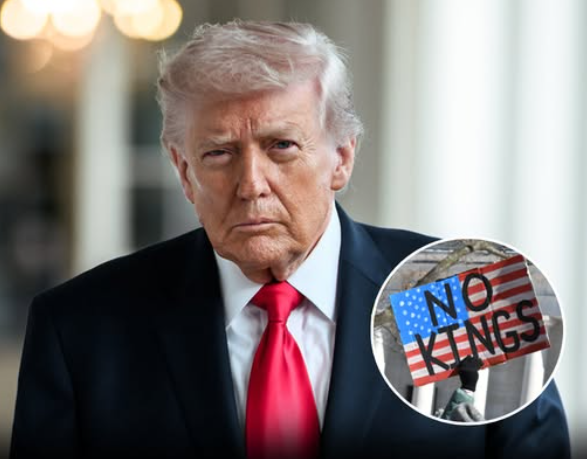
The roar started as a whisper, barely audible at first, like a fragile murmur threading its way through living rooms, cafes, and social media feeds. By nightfall, however, that whisper had grown into a tidal wave of collective rage, grief, and defiance, crashing with unstoppable force directly toward Donald Trump. More than eight million people, representing every corner of society—from grieving spouses clutching the memory of lost loved ones to Hollywood legends carrying the weight of fame and moral responsibility—flooded streets across the nation. They chanted “No Kings,” their voices rising above the city hum, while Robert De Niro thundered his warnings, Bruce Springsteen strummed anthems of resistance, and families hoisted photographs of the dead, keeping their memory alive in the most public of spaces. The demands in the air were terrifyingly clear: accountability, justice, and the affirmation that no individual, no matter how powerful, is above the law or the conscience of the people.
They came armed not with weapons, but with guitars, hand-painted cardboard signs, and stories so raw they seemed to split open the air itself. Robert De Niro’s voice quivered with righteous anger as he labeled Trump an existential threat to the values and institutions of the nation. Jane Fonda’s reading of a widow’s heartfelt words transformed what could have been a standard political rally into a profound, collective act of mourning. Bruce Springsteen answered with a protest anthem that stitched together the names of those lost, threading each tragedy with a solemn promise that “this is still America”—a nation where no president is supposed to wield power like a monarch, where liberty and responsibility must walk hand in hand.
From Minneapolis to Malibu, the presence of celebrities did not overshadow the crowds; it amplified them. Jimmy Kimmel marched shoulder to shoulder with his children, demonstrating that the future generation mattered as much as the present. Doug Emhoff joined strangers in the streets, his solidarity a quiet but firm testament that no one stands alone. Joan Baez sang beside a rising wave of new artists, her voice bridging generations and tying the movement to a long history of protest and song. Every poster held high, every chant, every trembling voice carried a message both urgent and brutally simple: power without accountability is tyranny. “No Kings” became more than a slogan—it became a pledge, a vow by millions to refuse in unison the surrender of their country to unchecked authority, a collective insistence that democracy is a living, breathing promise that must never be taken for granted.
The energy was overwhelming, yet it was also deeply personal. Each person in the streets carried their own story, a private sorrow or indignation transformed into public resolve. Together, these millions forged a moment that felt larger than any single city, larger than any celebrity speech, larger even than the sum of its grief and anger. It was a tidal wave that carried both memory and hope, a roar that began as a whisper but refused to be silenced, a declaration that accountability, justice, and the principles of a free nation are worth fighting for, in every street, every stage, and every heart.