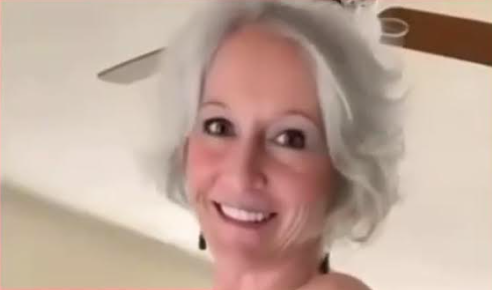
Kerstin Tristan never imagined that one day, the world would know her name because of her tattoos. For more than half of her life, the 56-year-old grandmother from Leipzig, Germany, viewed tattoos with quiet disapproval. To her, they belonged to other people — the wild ones, the reckless, the ones who lived on the edges of convention. She considered herself nothing like them. Her life was steady, predictable, and safe: a small circle of family, her work, and a pattern of days that repeated with gentle regularity.
She was a mother, a grandmother, a woman who followed the quiet rules of the world she was born into. But as the years passed, something within her began to whisper. It was a small, persistent voice — not loud, but impossible to ignore. It spoke of curiosity, of color, of the need to feel something new. In 2015, she finally listened.
It started with a single tattoo. One tiny decision that would open the door to an entirely new version of herself. “I just wanted to try something new,” Kerstin recalls, her eyes lighting up at the memory. “I wanted to know what it would feel like to wear something beautiful — not on my clothes, but on my skin.”
That simple act of curiosity became the beginning of a transformation so profound that she now describes it as a personal rebirth. Within weeks, she was back for another tattoo. Then another. And another. By the end of the year, her once-bare skin had begun to bloom with color and form. Roses blossomed across her thighs, butterflies danced along her collarbone, and delicate lines wrapped around her arms like vines claiming their rightful garden.
Fast forward a decade, and her body is now a living mural — a canvas of stories, symbols, and emotions intertwined. Leopard patterns crawl along her shoulders, portraits blend into wildflowers, and every inch of her skin feels alive with color. She has spent over €30,000 — about $32,000 — crafting this masterpiece. “And every cent,” she says with a knowing smile, “was worth it.”
“When I look at myself in the mirror,” she continues softly, “I see a meadow full of flowers that one simply has to love.” Her words aren’t a metaphor for beauty — they’re a declaration of peace. Kerstin’s tattoos didn’t just change her reflection; they redefined her identity. They became the map of a woman who finally learned to live for herself.
Before her first tattoo, Kerstin lived under the quiet weight of social expectations. She grew up in a time when tattoos carried judgment — seen as marks of rebellion or moral failure, especially for women. “In my generation,” she says, “a woman with tattoos was not taken seriously. People would look and think she’d lost her way.”
But beneath that fear of judgment was something else — boredom, even sadness. Life had become too predictable. “I felt like something inside me was asleep,” she admits. “Like I was fading.” When she finally sat in that tattoo chair, the buzz of the needle felt like electricity awakening her from years of stillness.
Each session became a ritual of discovery. With every new design, she felt herself shedding an invisible layer of hesitation. “Every tattoo gave me more confidence,” she says. “It was as if the ink was filling me with power.”
By 2020, her body had become what she calls her “living garden.” Flowers, animals, symbols, and patterns dance together across her skin, each one a chapter of her personal evolution. Some commemorate milestones, others are pure bursts of joy. “Not everything has to be meaningful,” she laughs. “Sometimes beauty alone is a good enough reason.”
Yet, what truly makes Kerstin’s story powerful isn’t just her transformation — it’s what it represents. In a society where aging women are often told to shrink, to quiet down, to “age gracefully,” she has chosen visibility over invisibility. Her tattoos are not camouflage — they are her rebellion against disappearing. “People stare,” she admits. “Some with judgment, others with admiration. I love both. I didn’t change for them. I changed for me.”
Her story has resonated across the internet. With more than 190,000 followers on Instagram and millions of views on TikTok, Kerstin has become an unlikely icon. Her videos often pair old photos — a modest, unmarked version of herself — with new ones showing her radiant, tattooed body. The contrast is striking: not because one is better than the other, but because one is free.
Comments flood her posts daily. Women thank her for inspiring them to embrace their own transformations — whether through art, fashion, or confidence. “You make me believe it’s not too late to start again,” one message reads. Others tell her she’s helped them see aging differently.
Still, there are critics. Some call her choices strange, some even call them foolish. But she has long since stopped caring. “At my age,” she says, her voice firm, “I don’t need anyone’s approval. I wake up every morning and I feel alive. That’s all that matters.”
To Kerstin, tattoos are not rebellion — they are liberation. They are the visible expression of something invisible: self-ownership. “For most of my life, I lived for others — my family, my job, my responsibilities,” she says. “The tattoos are the one thing I did just for me.”
That statement alone has struck a chord with thousands of women around the world. She represents something rarely seen — a woman who refuses to let society define the limits of her joy. Her transformation isn’t about looking younger. It’s about feeling awake.
Within the tattoo community, Kerstin has found a second family — artists, enthusiasts, and collectors who view the human body as a living art form. “When I walk into a tattoo studio now,” she says, “I feel completely at home. These people don’t care about wrinkles or gray hair. They care about creativity, about courage.”
And courage, more than anything, defines her. Every tattoo was an act of defiance — not against society, but against her own fears.
In a world obsessed with filters, smooth skin, and the illusion of perfection, her tattoos don’t erase her age — they honor it. The ink dances across skin that has lived, stretched, healed, and carried decades of memories. “My tattoos don’t make me younger,” she says proudly. “They make me more me.”
Perhaps that’s why people are drawn to her story. Not because of the spectacle of her transformation, but because of the honesty behind it. She isn’t trying to pretend to be someone else. She’s simply being fully herself — unapologetically, joyfully, and beautifully.
These days, Kerstin continues to add to her collection, though at a gentler pace. She calls it “an endless project of happiness.” There’s always one more idea, one more patch of skin that whispers for color. “It’s never finished,” she says, smiling. “I don’t think it ever will be.”
Her story challenges more than stereotypes about age and beauty. It redefines what it means to live authentically. Whether she’s walking through her neighborhood or sharing a new photo online, Kerstin carries with her a truth that radiates beyond words — that life’s most beautiful transformations often begin the moment we stop asking for permission to change.
“People say, ‘But you’re a grandmother!’” she laughs. “Yes, I am. And I’m also a woman who loves her life. Those two things go perfectly together.”
In the end, her tattoos are not rebellion, decoration, or vanity. They are living proof that transformation doesn’t belong only to the young. It belongs to anyone brave enough to choose themselves — to rewrite their story, no matter how late in life.
Kerstin Tristan did not just decorate her body. She reclaimed it. And in doing so, she became something rare and beautiful — a woman who turned her skin into art and her life into a statement:
It’s never too late to begin again.