For decades, people have watched Love Me Tender, thinking they were simply witnessing the film debut of a rising star.
A young Elvis Presley stepping onto the big screen for the first time, bringing his voice, his presence, and his unmistakable charisma into a new world beyond music.
And on the surface, that’s exactly what it was.
But if you look closer—beyond the obvious—you begin to notice something else entirely.
Hidden details. Unexpected choices. Small moments that reveal a very different story behind the film that introduced Elvis to Hollywood.
When the movie premiered in 1956 at New York’s Paramount Theater, the reaction alone said everything about his influence at the time. Fans didn’t just show up—they camped overnight, waiting for a chance to see him. Inside the theater, their excitement often drowned out his lines with constant screaming.
That wasn’t normal for a film debut.
That was something else.
It was proof that Elvis wasn’t just entering Hollywood—he was bringing an entirely new energy with him.
But most people didn’t realize the film itself wasn’t even meant to revolve around him.
Originally, it had a completely different title: The Reno Brothers. A straightforward Western, loosely based on a real group of outlaws from the 1860s. The story focused on historical figures involved in early train robberies, a darker narrative rooted in crime and consequence.
Elvis wasn’t meant to define it.
He was meant to be part of it.
That changed quickly.
As his popularity exploded, producers saw an opportunity they couldn’t ignore. The title was reworked around the song Love Me Tender, transforming a traditional Western into a project built to capitalize on his growing fame.
The film didn’t just introduce Elvis.
It adapted itself to him.
Even then, his role wasn’t initially designed as a lead. He was cast as Clint Reno, the youngest brother—a supporting character in a story that had already been structured without him. Other actors had even turned down the part, feeling it wasn’t significant enough.
But Elvis approached it differently.
He didn’t treat it like a minor role.
He treated it as an opportunity.
On set, he arrived fully prepared—not just with his own lines memorized, but with everyone else’s as well. He approached acting seriously, despite having no formal training. Those who worked with him noticed immediately. He wasn’t there to coast on reputation; he was there to learn, to improve, to prove something.
And that effort didn’t go unnoticed.
Producers described him as focused, respectful, and fully committed. He completed filming and recorded the movie’s music in just over a month, demonstrating a level of discipline that matched his natural talent.
But beneath the surface, tension existed.
Elvis had hoped to become a serious actor—not a singer who acted. He admired performers like James Dean and Marlon Brando, imagining a career built on dramatic roles.
That wasn’t the direction his management had in mind.
Colonel Tom Parker saw something else—a chance to merge music and film into a single, powerful formula. Songs would promote movies. Movies would promote songs. The two would feed into each other.
From a business perspective, it made sense.
From an artistic perspective, it required compromise.
That’s why, despite the film being set during the Civil War, Elvis breaks into song just minutes after appearing on screen. Later, his performance resembles more of a 1950s concert than a historical moment.
It doesn’t fit the period.
But it fits the strategy.
And the strategy worked.
The title song became one of the defining elements of his career—but even it has a hidden detail many miss. The melody wasn’t originally his; it was adapted from a Civil War-era ballad called “Aura Lee.” What Elvis brought was interpretation—and that interpretation turned it into something timeless.
The song climbed the charts, staying at number one for weeks. It became a defining part of his identity, something he would continue performing for decades.
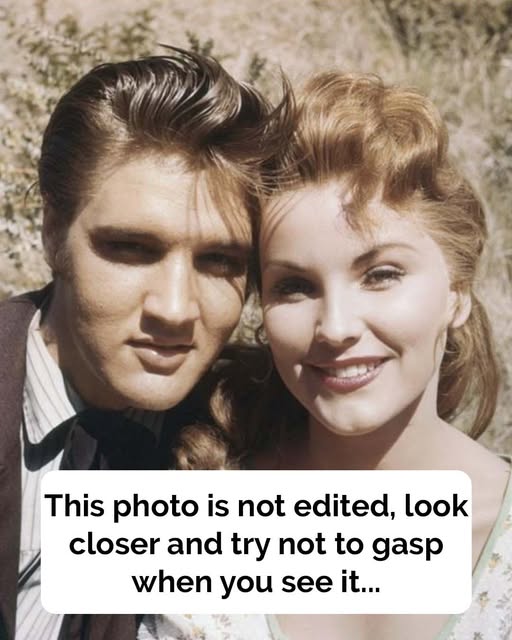
Behind the music and production choices, another story unfolded on set: his connection with Debra Paget.
Already an established actress, Paget was confident, composed, and admired. Elvis, still new to film, was immediately drawn to her. Their interactions carried natural chemistry that extended beyond the script.
He respected her.
Admired her.
And, by some accounts, became deeply attached.
Their relationship never became a public romance—but it mattered.
It shaped how he approached the film, interacted on set, and experienced his first step into acting.
Even small production details reveal how much changed during filming. Additional scenes were written to expand his role. What began as a secondary presence became central. The story adjusted itself around him, reflecting a simple truth: audiences weren’t just watching a movie—they were watching Elvis.
Even the ending became a point of controversy. Originally, his character dies—a dramatic conclusion that didn’t sit well with audiences, or with his own mother. Fans reacted strongly, unwilling to accept the loss of someone they idolized.
So the producers altered it, adding a final scene: a silhouette of Elvis singing during the credits, providing closure that softened the impact.
Even that change introduced subtle inconsistencies. By the time the scene was filmed, Elvis had dyed his hair black, though it appears lighter in the movie. A small detail, but noticeable once seen.
And then there are the mistakes. The kind that slip through unnoticed unless you look closely: a modern car in the background of a Civil War scene, a zipper used before zippers existed, a guitar continuing to play when no one touches it.
Imperfections—but reminders that even iconic films are shaped by real choices, limitations, and moments.
That’s what makes Love Me Tender more than just a debut.
It’s a snapshot of a turning point. A moment when a young performer stepped into a new world, carrying expectations, pressure, and possibility all at once.
Audiences saw a rising star, but few saw what was happening beneath the surface: compromises, adjustments, and a quiet determination to exceed expectations.
In the end, Elvis didn’t just appear in the film.
He transformed it.
And that transformation is what makes it worth watching even now.