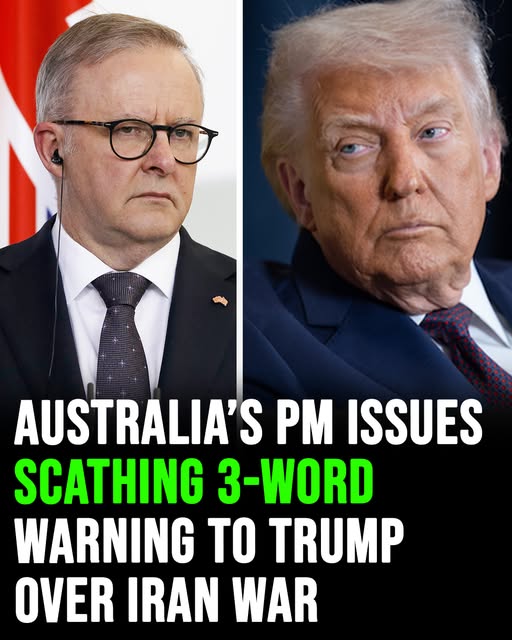
The world watched in disbelief as events unfolded with a surreal mixture of bravado and contradiction. Donald Trump declared a sweeping victory in Iran, framing it as a moment of triumph and strategic mastery, yet behind the scenes, Pentagon planners were quietly preparing operations that seemed to tell an entirely different story. Ground raids, special forces deployments, and potential strikes on coastal positions were all reportedly on the table, signaling a conflict far from concluded.
Allies, long accustomed to Washington’s public rhetoric, were increasingly refusing to follow the script. The cracks were becoming impossible to ignore: Australia publicly broke ranks, questioning not only the coherence of Trump’s strategy but also his honesty and ultimate endgame. And then came a chilling warning from one of the region’s key observers, cautioning that attempts at regime change could unleash consequences far beyond any carefully scripted narrative of victory.
While Washington insisted that the core objectives of the Iran campaign had been achieved, reports suggested that the Pentagon was mapping out limited but precise ground operations. These included raids on coastal positions and Kharg Island, the vital hub for Iran’s oil exports, a lifeline that sustains the country’s economy and military reach.
On one hand, Trump proclaimed the conflict “won,” projecting confidence and finality to the public and to international audiences. On the other hand, military plans indicated a readiness for escalation, with operations that could destabilize regions further rather than bring closure. The stark contradiction between political rhetoric and military preparation left allies deeply uneasy, raising doubts about Washington’s clarity of purpose and the credibility of its assurances. For some, the question was no longer whether the war was over, but whether it had even been properly understood by those claiming victory.
In Canberra, Australian Prime Minister Anthony Albanese did not mince words. He openly challenged Trump’s narrative, accusing Washington of failing to articulate its true objectives with sufficient transparency. While Albanese agreed that Iran’s nuclear ambitions had been sharply curtailed and that its regional power projection had been partially checked, he expressed deep concern about the third stated goal—regime change. Drawing on historical precedents where external interventions had destabilized entire regions, he warned that attempting to force political transformation from the outside could be catastrophic. His stance was measured but firm: de‑escalation must take priority, even while condemning Tehran’s brutal repression of women, minorities, and dissident voices.
Albanese’s message to both Washington and the international community was unmistakable: without clear objectives, restraint, and careful planning, what is being hailed as a “victory” could very quickly spiral into a far wider, uncontrollable war, with consequences that would reverberate across the Middle East and the globe.
The tension between words and action, between triumphal declarations and operational realities, highlighted a dangerous disconnect. Publicly, the narrative of success was meant to reassure citizens and project strength; privately, it revealed a complex, high-stakes game where missteps could trigger escalation, economic shockwaves, and strategic backlash. Allies’ reluctance to unconditionally support the United States signaled that trust was eroding, and that unilateral claims of victory would not suffice. In this high-stakes geopolitical theater, victory could no longer be measured simply in headlines—it depended on diplomacy, strategy, and the delicate balance of power, all while navigating the unpredictable currents of regional politics, historical grievances, and the global economy.