For weeks, I had been counting down to that flight. It wasn’t an extravagant getaway or a trip brimming with sightseeing plans; it was something quieter, something deeply personal — a chance to rise above the humdrum of daily life, to escape the endless noise, the unrelenting deadlines, the constant pull of responsibilities. I had been moving through life on autopilot for months, and when I booked that ticket, I allowed myself one small indulgence: a window seat.
To anyone else, a window seat might seem inconsequential, a minor detail in the orchestration of air travel. But to me, it was sanctuary. From thirty thousand feet, I could watch the world shrink into delicate patterns — rivers threading through emerald fields, clouds rolling like soft mountains, the sunlight spilling across the horizon in golden, liquid lines. From that vantage point, my worries seemed to shrink along with the city streets far below.
When I boarded, I slid into my seat, tucked my bag carefully beneath the chair, and let myself exhale fully for the first time in months. I imagined resting my head against the cool glass, letting the gentle hum of the engines soothe me. For a few hours, I could disappear into the rhythm of the sky, leaving behind the small tensions that had clung to me for weeks.
But the calm I craved did not last.
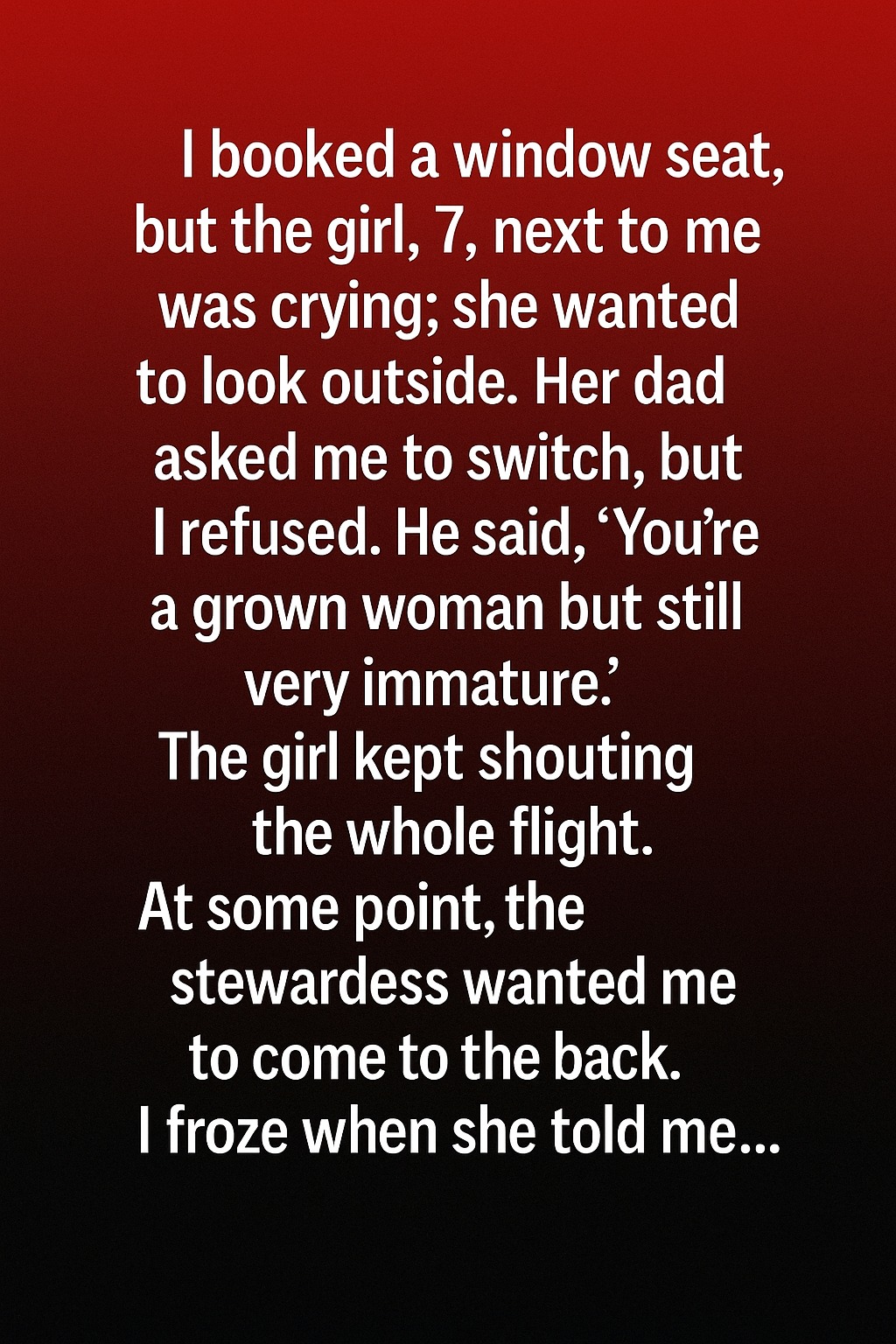
A man arrived with a young girl, likely his daughter. She could not have been older than seven or eight. Her brown eyes were wide with curiosity, and her pigtails, tied with soft pink ribbons, bounced as she clutched a small stuffed bunny. When she saw my window seat, her gaze lingered with wonder and longing, a look so pure and innocent it made her appear even smaller, more vulnerable.
Her face fell when she realized the seat was not hers. The disappointment was instant, raw, and unfiltered — heartbreaking in the way only a child’s emotions can be.
The father leaned toward me, smiling, though the gesture carried a subtle tension. “Excuse me,” he said politely, “would you mind switching seats so my daughter can look out the window?”
His tone was courteous, but beneath it lay an unspoken expectation: of course I would say yes.
I forced a polite smile, my stomach twisting. I had chosen this seat weeks ago, planning it carefully as a small act of self-care, a deliberate pause in a hectic life. I inhaled, grounding myself, and said as gently as I could, “I’m sorry, but I’d really like to keep this seat. I specifically booked it.”
The warmth in his eyes disappeared instantly, replaced by something sharp. “You’re a grown woman,” he muttered, low but cutting through the ambient noise of boarding passengers. “You’re really going to deny a child a window view? That’s… pretty immature.”
His words stung. My chest tightened, and a familiar weight of guilt pressed down, heavy and relentless. The little girl climbed into the middle seat, quiet and teary-eyed, seeking comfort in her father’s presence.
That old reflex — the one that had taught me to apologize even when I wasn’t wrong, to prioritize others over myself, to quell conflict at the cost of my own peace — stirred deep inside. I had spent years living like that, surrendering comfort, enduring judgment, and shrinking my own needs.
Yet, this time, something resisted. I had not wronged anyone. I had not stolen anything. I had merely claimed what was mine, a space I had earned and planned for intentionally.
The guilt lingered, though, as the plane lifted. The little girl sniffled softly, and her father’s irritation radiated in the narrow space beside me. I fixed my gaze on the window, watching the city diminish into a delicate mosaic of streets and fields, clinging to the view I had fought quietly to preserve.
Mid-flight, just as the tension in my shoulders began to ease, a flight attendant paused beside me. Leaning slightly, she said, “Miss, could you come to the back for a moment?”
For a heartbeat, panic surged. Had the father complained? Was I about to be chastised for standing my ground? I followed her down the aisle, bracing for humiliation.
But at the back of the plane, she smiled gently. “You did nothing wrong,” she said quietly. “You booked your seat. You’re entitled to it. People often forget that — especially when emotions run high.”
Her words were like a balm, unexpectedly comforting. Simple acknowledgment that my choices were valid, that protecting my own comfort didn’t make me selfish.
“Thank you,” I whispered, my voice softer than I realized.
Returning to my seat, the atmosphere had shifted. The father was telling the little girl whimsical stories about clouds shaped like dragons, elephants, and castles. Her laughter replaced the earlier disappointment. I turned back to the horizon, where fields, forests, and rivers blended into a soft patchwork below. And in that quiet moment, I felt something settle within me.
I understood then how often I had surrendered little things — not from generosity, but from fear. Fear of being judged, fear of being called selfish, fear of disappointing others. I had said yes to things I didn’t want, absorbed criticisms I didn’t deserve, remained silent when my voice should have spoken.
But up here, soaring above the clouds, I grasped a truth that had eluded me for years: boundaries are not cruelty. They are clarity. They are the fine line between generosity and self-erasure.
I glanced at the little girl again. She peeked past me occasionally, and then, unexpectedly, she smiled. Not a tentative or forced smile, but genuine, unguarded. Perhaps she realized it wasn’t a matter of great importance. Perhaps she forgave me, or maybe she simply chose joy over disappointment. Either way, the small smile felt like liberation — for both of us.
As the plane descended, sunlight poured through the thinning clouds, golden and warm. The father offered a quiet apology for his earlier words, and I nodded, understanding and forgiving. When I stood to leave, I pressed my hand gently against the window one last time. Warm from the sun, it reflected the runway stretching ahead, endless and inviting.
That flight taught me something I wish I had learned long ago: kindness and boundaries are not mutually exclusive. Saying no does not make one unkind; it makes one self-aware. Protecting your space can be an act of love — for yourself, and indirectly, for those around you.
Once you stop giving from guilt, you begin to live from truth. And above the clouds, surrounded by the sky and light, I finally allowed myself to do exactly that.