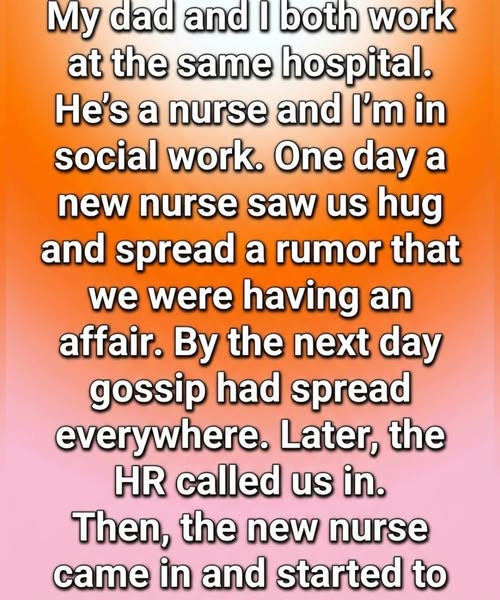
Working in the same hospital as my father was never something I spoke about much.
It wasn’t something we highlighted or used to stand out. It was quieter than that—something steady, grounding. In a place filled with pressure, urgency, and constant emotional weight, knowing he was somewhere in the same building made everything feel just a little more manageable.
He had been there for nearly three decades.
People knew him—not just his name, but his presence. He was the kind of nurse others relied on without thinking twice. Calm under pressure, thoughtful in his decisions, always able to bring reassurance where it was needed most. Families trusted him. Younger staff looked to him for guidance. Doctors respected him in a way that couldn’t be earned quickly.
He didn’t chase recognition.
He didn’t need to.
I worked in a different department—social services. My days were filled with conversations no one is ever truly prepared for: helping families navigate diagnoses, paperwork, and decisions that carried weight far beyond a single moment. It wasn’t easy work, but it mattered.
Our schedules rarely aligned. We didn’t plan to see each other.
But sometimes, in the middle of a busy day, our paths would cross in the hallway.
And when they did, we hugged.
Not long. Not dramatic.
Just a brief, familiar gesture—a silent exchange that said everything we didn’t have time to say out loud:
“I see you. You’re okay. Keep going.”
In a place where so much revolves around stress, uncertainty, and difficult outcomes, that small moment mattered more than it probably looked from the outside.
For years, no one noticed.
Until one day, someone did.
It was a typical shift—fast-paced, unpredictable, the kind of day where hours disappear without warning. I spotted my father near the elevators as I headed to meet with a family. We smiled, exchanged a few quick words, and shared our usual hug before moving on.
A new nurse passed by at that exact moment. She smiled politely—and kept walking.
I didn’t think about it again.
By the next morning, something felt different. Subtle at first: conversations that ended too quickly when we approached, brief, distracted acknowledgments from people who usually greeted us warmly. A shift in tone that didn’t match the environment we were used to.
At first, I assumed it was just one of those weeks. Hospitals have rhythms, and sometimes that rhythm carries tension. But as the morning went on, the pattern became harder to ignore.
It wasn’t just stress. It was something else.
My father noticed it too. I could see it in the way he paused before speaking, a slight hesitation not part of his usual confidence. For someone who had spent decades building trust in that environment, the shift was noticeable—and uncomfortable.
We didn’t know why. Not yet.
The answer came sooner than expected. Around midday, our supervisor asked us to come to her office.
The tone was formal. More serious than usual.
She explained that concerns had been raised about inappropriate behavior between two staff members.
At first, it didn’t register. Then it did.
She was talking about us.
The room felt smaller, heavier. A simple, routine hug had somehow been transformed into something else entirely—something that carried implications neither of us had imagined.
The explanation unfolded quickly. The new nurse had seen the interaction. Without context, without understanding who we were to each other, she had mentioned it to another colleague. That conversation grew, reshaped by assumptions, and passed along until it became something far removed from the truth.
A moment that meant nothing more than connection had turned into speculation. And speculation had turned into a narrative. That’s how quickly it happens.
My father sat quietly, absorbing it. For someone who built his career on professionalism and trust, the idea that his actions could be questioned—even mistakenly—cut deeper than he showed.
For me, it was different. There was frustration. Not because someone had misunderstood, but because no one had asked. No one had paused to consider another explanation.
We agreed immediately to meet with human resources. We had nothing to hide. But that didn’t make the waiting easier.
The conversation that followed was tense. My father and I explained our roles, our relationship, and the nature of what had been seen. Then the nurse was brought in.
She looked overwhelmed, nervous. It became clear she hadn’t intended for things to escalate. She had made an assumption, mentioned it casually, and never expected it to spread the way it did.
Listening to her, I realized something uncomfortable. The truth doesn’t always change—but the way it’s interpreted can. And once that interpretation starts moving from person to person, it takes on a life of its own.
My father spoke calmly. He explained that he was my father. He showed photos—years of shared life captured in simple moments: birthdays, holidays, family gatherings. Proof that shouldn’t have been necessary—but was.
The atmosphere shifted quickly. What had been suspicion turned into embarrassment. Apologies followed—genuine, but awkward. Human resources addressed the situation directly, reminding everyone involved about the importance of context, communication, and the real harm that assumptions can cause.
Because in a place built on trust, even small misunderstandings can have lasting effects.
Over the next few days, things returned to normal. Conversations came back. Ease returned. Some colleagues even joked about how far off the assumptions had been.
But something had changed. Not in a negative way—in a clearer way.
My father and I didn’t stop what we had always done. We still hugged in the hallway. But now, it felt more intentional. Not just a routine, but a quiet statement. That connection doesn’t need to be hidden. Assumptions don’t get to define reality. And sometimes, the simplest gestures carry more meaning than people realize.
What stayed with me most wasn’t the misunderstanding itself. It was how quickly it happened. How easily a single moment, without context, could be turned into something else entirely. And how important it is to pause before filling in the blanks with your own version of the story.
Because once a story starts spreading, it doesn’t wait for the truth to catch up. It becomes something people believe simply because it’s been repeated.
That experience didn’t just resolve a misunderstanding. It reinforced something I’ll carry with me long after: clarity matters. Asking questions matters. And sometimes, the difference between truth and assumption is nothing more than a conversation that never happened.