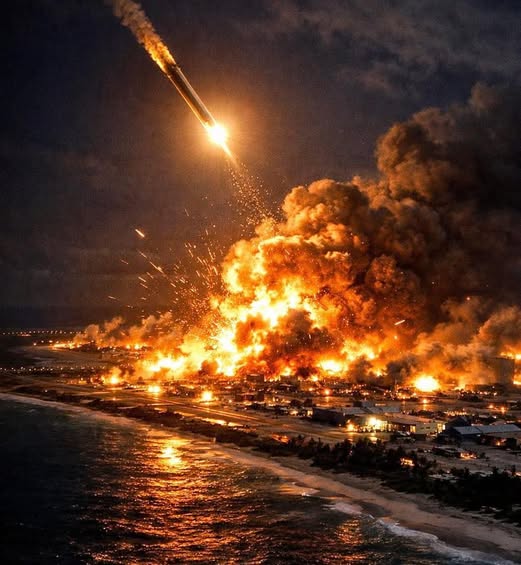
In the fast-moving digital world of 2026, a single notification can ripple around the globe in mere seconds, blurring the line between real crises and viral fabrications. Recently, a dramatic claim began circulating widely across social media: that Iran had allegedly launched a missile strike on a U.S. military installation on the remote island of Diego Garcia. The posts were urgent and highly charged, describing a long-range ballistic missile crossing thousands of kilometers to hit one of the most secure military sites in the Indian Ocean. Yet, as is often the case with sensational online reports, a closer look reveals a complete lack of verified evidence, highlighting the tension between the speed of information and the necessity of accuracy.
Understanding why such an alarming claim spreads so quickly requires examining both psychological and technological factors. Diego Garcia is no random location—it is a linchpin of international military strategy. Located in the British Indian Ocean Territory and jointly operated by the U.K. and the U.S., the island serves as a critical hub for long-range bomber deployments, naval operations, and intelligence surveillance throughout the Indo-Pacific. Any credible attack on this facility would dominate global news immediately, from the BBC to the Wall Street Journal, and yet no official statements, satellite data, or independent reporting corroborated these claims. The absence of confirmation strongly suggests that the narrative is speculative rather than factual.
The posts also reference a missile traveling roughly 4,000 kilometers, which would classify it as an Intermediate-Range Ballistic Missile (IRBM). These weapons occupy a complex category between regional systems and intercontinental missiles. While Iran has made notable advancements in its missile capabilities, a successful strike on a distant U.S. base would be an extraordinary geopolitical escalation. Such a launch could not happen in secret: global early-warning satellites would detect thermal signatures, trajectories would be tracked, and defense protocols worldwide would activate. The lack of supporting data raises serious doubts about the legitimacy of these claims.
The rapid dissemination of such misinformation exposes systemic challenges in today’s media consumption. In 2026, credibility can often be a veneer for sensationalism. Misleading posts frequently rely on emotional language, all-caps headlines, and references to trusted publications—like citing the Wall Street Journal—without providing verifiable links. These techniques exploit the reader’s trust, creating the illusion that the information has already passed through traditional journalistic filters. Combined with graphic descriptions of “shattered buildings” or imminent conflict, they bypass critical thinking and encourage rapid, reflexive sharing.
The consequences extend far beyond online chatter. False reports of military strikes can stoke unnecessary panic, disrupt markets, and even interfere with diplomatic efforts aimed at maintaining stability. When speculation masquerades as fact, public confidence in reliable sources erodes, making it harder to recognize genuine threats. Consequently, the responsibility for verification has shifted to the consumer. Readers must now apply disciplined scrutiny: Are multiple independent news outlets reporting the same event? Are there official statements from governments involved? Are there concrete, verifiable details, or is the post primarily emotional and vague?
Media literacy has become a critical civic tool in this environment. A responsible citizen recognizes that the digital fog of war is often thicker than reality. In the hours following the alleged Diego Garcia strike, no satellite imagery or diplomatic fallout emerged, which in itself indicates the event likely never occurred. What was reported online was a narrative, not a kinetic reality. Geopolitical tension is real, but responding effectively demands verified intelligence and careful analysis, not panicked reactions to unsubstantiated posts.
As our world becomes ever more interconnected, individual responsibility in shaping the information landscape is paramount. Engaging directly with primary sources, refusing to amplify unverified claims, and practicing critical scrutiny all contribute to a more accurate, stable public discourse. In the high-stakes arena of global security, clarity is not optional—it is essential. The story of the missile strike that never happened serves as a reminder that, in the era of instant connectivity, the most powerful defense is a critical mind. Verification is the ultimate measure of truth, and in matters that could influence international relations, it is far better to wait for facts than to rush the fiction.