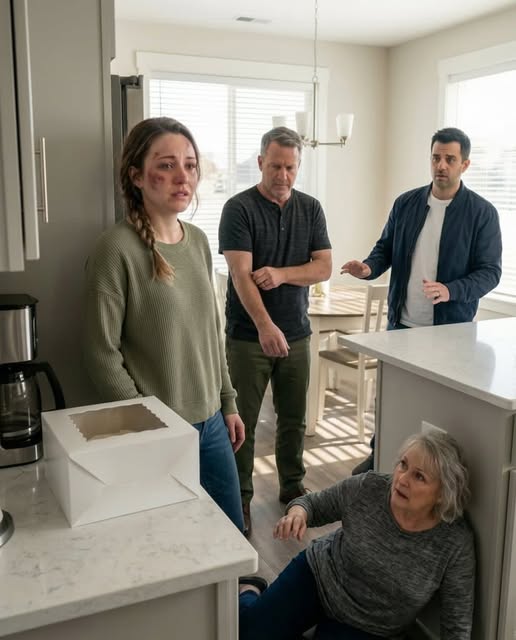
My father came to celebrate my birthday. Instead, he found my face covered in bruises—purple and blue marks telling a story that words alone could not. The man who had raised me, steady and strong, froze in the doorway, his eyes scanning the scene as if calculating every second before deciding what needed to happen. My husband stood there, smirking, casually admitting, “Oh, that was me.” No shouting. No chaos. Just the kind of chilling, quiet cruelty that cuts deeper than any scream.
But my father did not panic. He did not yell or charge blindly. Instead, he quietly removed his watch, rolled up his sleeves, and, without hesitation, turned my kitchen into a makeshift courtroom of justice. With each swing, each strike, he made a clear, undeniable statement: the line had been crossed, and no one—especially not the person I had trusted—would ever harm me in that space again. The violence was precise, controlled, but in that precision lay its power. It wasn’t rage that saved me; it was certainty, the unwavering knowledge that I was his child, that I deserved protection, and that he would act when I could not.
In that kitchen, my father drew a line I had been too afraid to see myself. When he told me to call the police, he wasn’t simply ensuring my safety. He was handing me back something I had lost: my voice. Saying “911” aloud felt terrifying at first, like stepping off a cliff and discovering solid ground beneath my feet. For the first time in months, I felt that my words had weight, that my fear could be acknowledged, and that help could arrive—not just for me, but for the life I still had the right to live.
Healing didn’t arrive in grand, cinematic moments. It came in paperwork and court dates, in restless nights and the slow, deliberate learning to sleep without listening for footsteps in the hall. It came in small victories: the taste of strawberry cake at my parents’ table, a home officially in my name, the first deep, uninterrupted night of sleep in months. It came in objects that carried memory and meaning, like the silver watch my father had once worn—the same one he took off to stand between me and the man who had hurt me. Every time I glance at it, I am reminded of his quiet courage and the unwavering certainty that saved my life.
Abuse tried to erase me slowly, to make me invisible, to turn me into someone’s secret shame. It failed. I survived. I remember every bruise, every whispered threat, every moment of fear—but I also remember the power of someone who chose to show up when it mattered most. I know who I am now: I am not a secret. I am not defined by his violence. I am someone who survived, who reclaimed her voice, and who will never be anyone’s hidden pain again.
In that kitchen, surrounded by the echoes of fear and the strength of my father’s love, I realized something essential: survival is not just about making it through the night. It’s about reclaiming yourself, your story, your power. And once you do, nothing—not rage, not threats, not silence—can take it from you.