I believed I was doing something easy. Quiet, gentle, perhaps even forgettable. I had no concept that a single, insignificant choice would immediately draw me into a narrative I was unaware I was a part of.
I’ve been a second-grade teacher long enough to know that most days have the same rhythm: noisy corridors, small skirmishes over pencils, and a never-ending chorus of “Miss Angie!” coming from all directions. It’s hectic, but you come to love the turmoil.
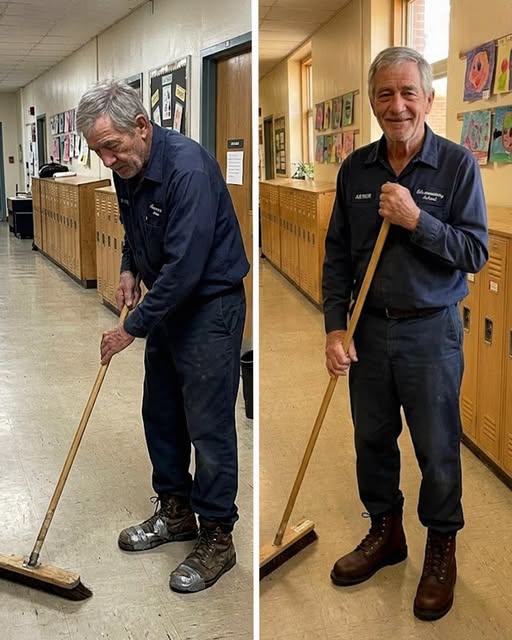
Harris, the school janitor, was a constant in the midst of it all.
He didn’t make a big impression. He made no attempt. However, he was everywhere—tying children’s shoelaces, scooping up lost lunches, adjusting shaky tables without being asked, and discreetly mending items before anyone noticed they were damaged. He was adored by the students in the natural manner that children adore someone who is constantly kind.
He was constant and dependable, moving through the building like background music.
Then there were his boots.
Brown labor boots that were old and worn out, with layers of silver tape securely wrapped around the soles to keep them together. Several strips, not just one. The framework was barely holding, and the leather was cracked. Rainy mornings caused the tape to get soaked through and discolor before the first recess even began.
I initially thought he was just waiting for his paycheck.
However, weeks went by.
Nothing was altered.
Those boots didn’t change at all.
I was no longer able to ignore it.
It was simple to assist. The difficult aspect was figuring out how to assist him without making him feel uncomfortable.
I called Mia to my desk one Friday while my class was working in silence. At eight years old, she was brave and prepared for anything that seemed significant.
I said, “Mia, I need a favor.”
Her eyes immediately brightened. “A genuine one?”
A genuine one. Go find out Mr. Harris’s shoe size. Don’t let him know that I asked.
With a smile, she took off.
I saw her approach him directly at the water fountain from the doorway.
“What size shoes do you wear, Mr. Harris?”
He stopped in the middle of his sweep, grinned, and glanced down at her.
“Why is that necessary?”
She gave a casual shrug. “I believe my dad wears the same size.”
He laughed. “Size 11. Somehow, I’m still hanging on.
I was struck by the way he phrased it.
I traveled across town that weekend to purchase a pair of sensible, warm, and durable boots. Nothing ostentatious. Just something sturdy. Something that would be beneficial.
I wrote a short note at home that said, “For everything you do.” I’m grateful.
Not a name.
No focus.
Just goodwill.
Before the hallways filled up on Monday morning, I slipped into the janitor’s closet and put the box in his cubby. My pulse was pounding like if I had done something far more significant than I had.
That seemed to be the end of it.
I was mistaken.
Someone knocked on my door that evening at approximately 9:00 p.m.
Harris was standing there, drenched from the rain, with the shoebox carefully wrapped in a plastic bag when I opened it.
He claimed, “I kept them dry.” “But I’m unable to accept them.”
I immediately took a step back. “Enter.”
After hesitating, he entered slowly.
I made him coffee and gave him a towel. Sitting close to the hearth, he held the mug but did not take a sip, the box perched on his lap like a delicate object.
“How did you recognize me?” I inquired.
“I noticed you,” he muttered. “You had good intentions.”
“So why bring them back?”
His voice had softened as he peered down at the package.
“I can’t replace some things.”
I recognized then that this had nothing to do with money.
I said, “Help me understand.”
He gave a headshake. “It’s better to leave some things alone.”
Then he got to his feet.
“I ought to leave. My spouse is anticipating my arrival.
There was something off about the way he stated it.
Nevertheless, I gave him an umbrella, and he departed.
That ought to have been it.
It wasn’t.
Harris wasn’t at school the following day.
I was concerned about that alone. I had never seen him miss a day without warning in six years.
I discovered he was home sick by lunchtime.
I drove directly to his address with groceries after school, using the pretext of dropping off a card.
His home was modest, dilapidated, and silent.
The door was not even completely shut.
Everything changed when I went inside and called his name.
I was first struck by the fragrance.
Marigolds and aged wood.
I then noticed the picture.
A female. candles. New flowers.
It was immediately recognized.
“Catherine,” I muttered.
I hadn’t mentioned that name in years.
A woman from my early years.
A woman who used to look after me when I was ill.
A woman who, at a time I can hardly recall clearly, had been everything to me.
I bolted upstairs.
Harris was pale and feverish in bed.
“Why is her photo downstairs?” I inquired.
Before he said anything, he turned to face me and his eyes brightened.
“She was my spouse.”
I lost everything inside of me.
The boots.
The recording.
the rejection.
He said, “They were the last thing she bought me.” “I felt like I was still walking in something she chose, so I kept fixing them.”
That’s when I realized.
There was no wear on those boots.
They were revered.
Then he stated something different.
“She never lost sight of you.”
I froze.
“She recalled the young child who had brought her marigolds.”
Suddenly, the memories came flooding back.
Those were the flowers I had given her.
I had used candy wrappers to create a tiny doll for her.
When my life collapsed, I said her farewell, and I never saw her again.
Up until now.
Harris had known all along.
He knew who I was.
Even though I didn’t know who he was, he had silently carried that connection with him every day.
“Why didn’t you inform me?” I inquired.
He stated, “I didn’t want sympathy.” “I was just relieved that you were alright.”
That devastated me.
Not very loudly.
Not in a big way.
Simply put.
I remained. I brewed him some tea. I reheated the soup. I left my phone number.
I returned a week later with my spouse, groceries, medication, and additional boots.
I did more than just give assistance this time.
I gave an explanation.
I softly remarked, “You don’t have to wear them to honor her.” “We are able to protect them. Keep them secure. Remembering her doesn’t require self-harm.
He examined the new footwear.
Then at the older ones.
Then look back at me.
He remarked, “I never thought of it that way.”
Everything changed at that point.
The old footwear were put in a box.
We preserved her memory.
And instead of hanging on, he moved forward for the first time.
I put some fresh marigolds next to her picture before I left.
I told him, “You don’t have to do this alone anymore.” “You can consider me to be your daughter.”
He sobbed.
And there we remained, three individuals bound together by something none of us had anticipated.
We went to her grave the next Sunday.
The new boots were on him.
The elderly remained secure at home.
And he gave me a gentle smile as we stood there.
He remarked, “She would have loved this.”
I gave his arm a squeeze.
“I believe she does.”