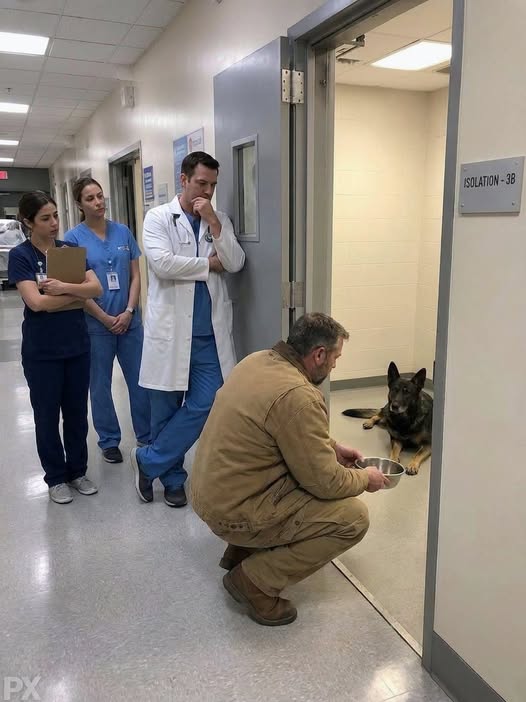
He hadn’t eaten in six days. The growl had become a warning, a wall, and a promise of damage no one could afford to ignore. Every attempt to approach him seemed to confirm what everyone already feared: this was no longer simply a hungry or frightened animal. Cota had become unpredictable, defensive, and consumed by something nobody could reach through commands alone. Then one sound—half memory, half prayer—crossed a reinforced door and stopped the war dog cold. There was no sudden rage, no violent lunge, no snapping jaws against the barrier. Just silence. Then a question hanging in the air, trembling on the edge of remembrance. For the first time in days, Cota seemed to be listening instead of fighting.
They brought me in when every other option came with teeth marks, failed attempts, and incident reports. Cota had been reduced to a problem to be managed, a risk to be mitigated, a cost center with a pulse. People were focused on what he could do rather than what had happened to him. He was dangerous, and that fact could not simply be ignored, but there was something beneath the aggression that the usual methods were failing to reach. Grief doesn’t answer to protocols, and it doesn’t surrender to force; it only loosens, slowly, in the presence of something that refuses to leave. So I stopped trying to make him obey. I stopped treating every moment as a test of control. Instead, I sat on the concrete outside his reinforced door and gave him something no one else had offered: time.
I let him hear what no one else had offered in a language older than commands and training. A steady pattern. A familiar rhythm. Something simple that carried the meaning, “I am here, and I am not asking anything from you.” There was no demand that he come closer. No attempt to touch him. No expectation that he would suddenly trust a stranger. I simply stayed. The first few moments passed with nothing but the low sound of his breathing and the occasional warning rumble from behind the door. But I kept the same rhythm, allowing the silence between us to become less threatening.
Cota had learned to associate people with pressure, expectations, and consequences. Every approach meant someone wanted something from him. Every command carried the possibility of another confrontation. But this was different. Nobody was forcing the door open. Nobody was demanding that he stand, eat, or obey. I was simply there. Day after day, the same presence returned. The same patience. The same sound. The same quiet message that did not require him to understand every word. It was an invitation without pressure.
What followed wasn’t a cinematic breakthrough where everything changed in a single miraculous moment. It was much smaller than that, and because of that, it was far more meaningful. First came a softened growl. Then a pause that lasted a little longer than the one before it. A shared breath through the narrow space between fear and trust. A remembered cue that seemed to reach somewhere deeper than the anger surrounding him. Each tiny change could have been dismissed as insignificant, but together they became evidence that Cota was still in there.
The hardest part was understanding that progress could not be measured in dramatic victories. Some days were better than others. There were moments when Cota retreated behind the same emotional wall and moments when the old defensiveness returned. Healing did not move in a straight line. Trust had to be rebuilt carefully, because forcing it would only confirm everything he already believed about people. So patience became part of the work. Every small permission mattered: allowing someone to remain nearby, accepting food, responding to a familiar sound, or simply choosing not to growl when someone entered the space.
Slowly, the dog who had seemed unreachable began to reveal pieces of himself again. The war dog identity, the training, the discipline, and the instinct to respond to danger were still there, but they were no longer the only things defining him. Beneath them was an animal who had experienced attachment and loss, and who had apparently been struggling with the absence of someone important. Cota did not need another person to overpower him. He needed someone willing to understand that grief could look like aggression when there were no other tools available to express it.
Then came the harder work: handing Cota’s future to Dani, the one person whose life had been built, unknowingly, around the space Marcus left behind. Dani carried a connection to the past that Cota could recognize in ways that no stranger could reproduce. The transition was not simple. Cota had changed, but he was still carrying fear, confusion, and memories that could not simply be erased. Dani had her own grief to navigate, too. Bringing them together meant asking both of them to approach a loss from opposite sides and somehow find a way forward.
Watching them relearn each other was like watching a bridge rebuild itself from both ends. Slowly. Unspectacularly. With no guarantee that the two sides would ever meet. There were pauses, uncertainty, moments when neither seemed to know what the other needed. But there were also small signs of recognition. A familiar movement. A familiar sound. A moment when Cota looked toward Dani and did not see a stranger. The past could not be recreated exactly as it had been, but something new could be built from what remained.
For Dani, the process meant learning that Cota was not simply the same dog who had existed before Marcus was gone. Loss had changed him. The world around him had changed. The routines he understood had disappeared, and he had been left trying to make sense of an absence he could not explain. Cota, in turn, had to learn that Dani was not there to take Marcus’s place, but to offer him another kind of home. Neither of them could undo what had happened. They could only decide what they would do with the life that remained.
Months passed, and the small signs gradually became something larger. Cota began eating more consistently. The constant tension eased. His body no longer seemed permanently prepared for a fight. The space between him and the people around him became less dangerous and more familiar. He began allowing himself to rest rather than remaining constantly alert. These changes were not dramatic enough for a movie montage, but they were enormous for the people who had watched him struggle.
And then came the moment that made all those difficult days feel worthwhile. Cota leaned his full weight against my leg. There was no command behind it. No training exercise. No reward waiting afterward. He simply chose to make contact. For a dog who had once treated every approach as a potential threat, that small movement carried the weight of an entire transformation. It meant trust. It meant safety. It meant that, somewhere along the way, the wall had finally begun to come down.
By then, Cota was no longer a weapon without a mission. He was a dog with a home. His past had not disappeared, and the loss that had changed him could never be erased. But he no longer had to live entirely inside that loss. He had learned that the world could contain something besides danger. There could be patience. There could be familiar voices. There could be someone sitting outside the door without demanding anything. There could be another person waiting at the other end of the bridge.
The sound between us had changed, too. In the beginning, it had been a rescue signal—a carefully chosen pattern meant to reach through fear and remind him that someone was there. Later, it became something much quieter. It no longer needed to pull him back from the edge. It simply existed between us as a familiar reminder of everything that had happened. The sound meant, “I am here.” But now, Cota seemed to understand something more: he didn’t have to be alone.
That is what made his recovery so powerful. Nothing about it was instant. There was no single command that fixed everything, no miraculous moment that erased grief, and no easy solution that transformed a frightened, aggressive dog overnight. There was only persistence, patience, memory, and the willingness to stay when leaving would have been easier. Sometimes healing does not announce itself. Sometimes it arrives as a softened growl, a shared breath, a remembered cue, or a dog finally deciding that it is safe enough to lean against someone.
By the time Cota rested his full weight against my leg months later, the meaning of that gesture was unmistakable. The dog who had once been defined by danger had found another identity. The dog who had refused food had learned to accept care. The dog who had built a wall around his grief had slowly allowed someone to stand beside him. And the dog who had once seemed to have lost his purpose had found something more important than another mission.
He had found home.
The sound between us was no longer a rescue signal. It was no longer a plea, a command, or an attempt to pull him out of darkness. It was simply a promise kept—a quiet reminder that someone had stayed, that someone had listened, and that even after profound loss, trust could still be rebuilt one small permission at a time.