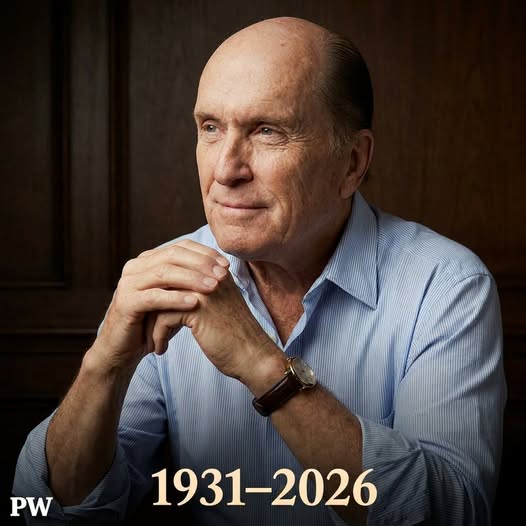
The news hit like a punch to the chest. Robert Duvall is gone, and with him disappears a piece of American cinema that can never truly be replaced. Friends, fans, fellow actors, and generations of moviegoers are now trying to process the loss of a performer who spent more than half a century disappearing so completely into his characters that the man himself sometimes seemed to vanish behind them. His death marks the end of an extraordinary era, leaving behind memories, performances, and stories from a career that helped define modern American film.
He died much as he often lived away from the spotlight: quietly and without spectacle, surrounded by the people who mattered most to him. At 95, in his Virginia home, Robert Duvall’s final chapter unfolded far from the bright heat of studio lights and movie premieres. Yet the work he created there continues to live. His performances remain preserved on screens around the world, allowing audiences who never met him to encounter the intensity, restraint, humor, and humanity he brought to every role.
For many viewers, Duvall will forever be connected to Tom Hagen in *The Godfather*, the calm and calculating family lawyer whose controlled presence carried enormous weight. But reducing his career to one iconic role would overlook the extraordinary range of the man behind it. In *Tender Mercies*, he delivered a deeply moving performance as a broken country singer searching for redemption and a reason to continue. His characters were often flawed, wounded, stubborn, or complicated, but they rarely felt artificial. They seemed like people who could walk out of the screen and exist somewhere beyond the story.
That realism became one of Duvall’s greatest strengths. He did not need exaggerated gestures or dramatic speeches to command attention. Sometimes a pause, a glance, or a change in his voice could communicate more than pages of dialogue. He understood that powerful acting could be quiet. A character could reveal fear without saying he was afraid, and vulnerability could become more frightening when it was barely visible beneath a controlled exterior.
Colleagues often described him as an actor’s actor—a craftsman who cared deeply about the work itself and had little interest in becoming a celebrity for celebrity’s sake. Even as fame followed him, Duvall remained focused on the characters, the story, and the process of making a performance believable. He treated acting as a discipline rather than simply a path to recognition. That commitment helped him remain relevant across generations of filmmakers and performers.
His career brought seven Academy Award nominations and one Oscar win, along with countless other honors and unforgettable performances. But his legacy cannot be measured by trophies alone. Awards can identify moments of recognition, but they cannot fully explain why certain performances remain alive decades later. Duvall’s greatest achievement was making audiences believe in the people he portrayed, even when those people were difficult to understand or impossible to admire.
Again and again, he explored themes that belong to ordinary human life: power, failure, loneliness, faith, regret, love, pride, and redemption. His characters were rarely perfect, because Duvall seemed more interested in what happened when people were tested. He showed that heroism could exist alongside weakness and that broken people could still search for something better. His work gave dignity to characters who might otherwise have remained on the margins of a story.
As tributes begin to spread, former colleagues and fans are remembering not only the famous performances but also the small moments that revealed the person behind them. Stories of his professionalism, his intensity, his independence, and his devotion to the craft will continue to emerge. Each memory adds another layer to a career that already feels almost impossible to summarize.
Robert Duvall leaves behind more than a filmography. He leaves behind a lesson in what acting can accomplish when an artist chooses truth over vanity. He showed that the strongest performances do not always announce themselves. Sometimes they simply settle into the viewer’s memory and refuse to leave.
Long after the mourning fades, his work will continue breathing. Someone will press play on *The Godfather*. Someone else will discover *Tender Mercies* for the first time. Another generation will encounter one of his many characters without having known the man who created them. And for those moments, Robert Duvall will not truly be gone. He will still be there—in the pauses, the voices, the faces, and the unforgettable human beings he left behind on screen.