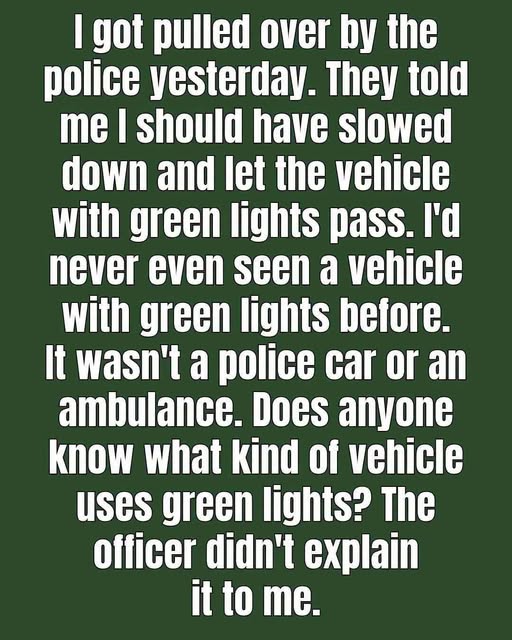
A quiet green glow on a moving car can mean the difference between hope and disaster, yet most drivers have no idea what it represents. Many people may notice the unusual light for only a second before continuing down the road. But behind that small signal can be a person responding to an urgent situation, transporting someone who desperately needs medical care, or volunteering their time to help others in their community. What looks like an ordinary colored light may actually be a quiet request for understanding from someone racing against the clock.
That subtle green light is sometimes used to identify people involved in community response or certain forms of medical transportation, depending on local rules and circumstances. It might be a volunteer firefighter heading toward an emergency, or a driver transporting a dialysis patient to a critical appointment. These individuals may not have the same sirens, lights, or legal traffic privileges as an emergency vehicle, meaning they cannot simply force other drivers to move out of the way.
Instead, they often have only that small signal and the hope that other motorists will recognize that something important may be happening. Their situation can be especially difficult because the urgency may be invisible to everyone around them. A driver passing them on the highway has no way of knowing whether the person behind the wheel is trying to reach an emergency call or whether a passenger in the vehicle is depending on them to arrive somewhere on time.
That is why a moment of patience can matter. You may not always be legally required to yield to a vehicle displaying a green light, and the exact meaning and legal status of such lights can vary by location. Drivers should always follow the traffic laws that apply where they are driving. But when it is safe to do so, creating a little space, easing off the accelerator, or allowing another vehicle to merge can be a simple act of courtesy.
Imagine being the person behind that wheel. You may be trying to reach someone who needs help, transport a vulnerable patient, or respond to a call that cannot simply wait until traffic becomes convenient. You may not have the authority to stop traffic or demand that everyone move aside. You are simply hoping that the drivers around you will notice the signal and understand that there may be more happening than they can see.
For the driver encountering the green light, the decision may seem insignificant. Letting another vehicle merge might cost only a few seconds. Giving additional space might require nothing more than lifting your foot from the accelerator. But for the person inside that vehicle, those seconds can sometimes feel far more important.
This is also a reminder that not every urgent situation arrives with flashing lights and a loud siren. Some emergencies are quiet. Some people serving their communities travel without the dramatic equipment associated with traditional emergency vehicles. Their work may happen largely unnoticed, with no crowd watching and no recognition afterward.
Volunteer responders in particular often make sacrifices that most people never see. They may leave their homes at inconvenient hours, interrupt family time, or drive toward situations that other people are trying to escape. They do it because someone in their community needs assistance, not because they expect strangers to applaud them.
Medical transportation can carry its own urgency. A person traveling to dialysis or another essential medical appointment may not appear to be in an emergency simply because there is no ambulance involved. Yet missing a scheduled treatment can have serious consequences for someone who depends on regular care. The driver transporting that person may therefore be working within a schedule that is much more important than it appears from the outside.
None of this means drivers should take unnecessary risks or break traffic laws to accommodate another vehicle. Safety still comes first. A sudden maneuver, illegal pass, or aggressive attempt to clear a path could create a new danger for everyone on the road. The better response is simply to remain aware, avoid blocking the vehicle when possible, and provide reasonable space when it can be done safely.
You are not always required by law to yield, but you are always free to choose decency. Sometimes that choice is as simple as slowing down slightly, allowing a vehicle to merge, or resisting the temptation to block someone who appears to be trying to get through traffic.
The next time you notice an unfamiliar green light on a moving vehicle, it may be worth taking a second look rather than immediately assuming it means nothing. Its exact meaning depends on where you are and who is using it, but it can represent service, urgency, responsibility, or a vulnerable passenger depending on the circumstances.
A strange color on the road can therefore become a quiet reminder that we rarely know what another driver is carrying with them. The person behind the wheel may be on an ordinary trip—or they may be trying to reach someone who needs help.
And sometimes, the smallest act of patience can become part of something much bigger. Giving another driver a little room may take only a few seconds, but those seconds could matter deeply to someone you’ll never meet. On a busy road filled with impatience and hurry, recognizing that possibility is a simple way to remember that every vehicle carries a story, and sometimes your courtesy can help that story reach its next destination safely.