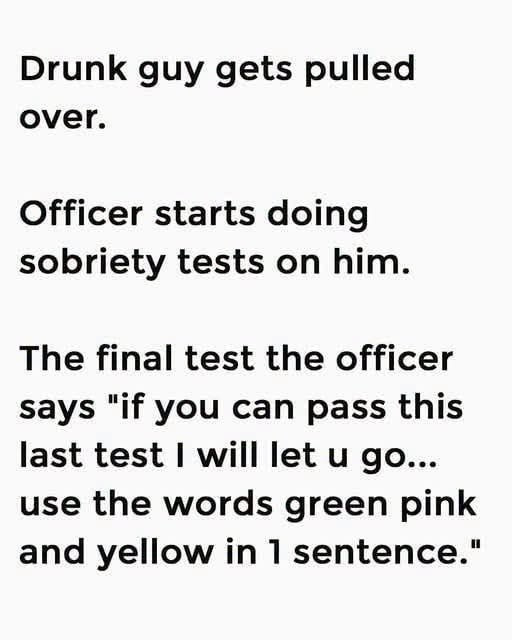
The flashing red and blue lights cut through the midnight fog as a state trooper activated his emergency lights behind a sedan weaving unpredictably across a quiet stretch of highway. The vehicle drifted from one lane to another several times before finally pulling onto the shoulder. For the officer, it looked like a situation he had encountered many times before—a driver whose actions suggested impairment and whose decisions had already placed everyone on the road in danger.
As the patrol car came to a stop, the officer took a deep breath before stepping into the cold night air. Experience had taught him never to underestimate the unpredictability of a traffic stop, especially one involving a potentially intoxicated driver. Every encounter required caution, patience, and constant awareness because even a routine stop could change in an instant.
The driver rolled down his window with an exaggerated smile stretching across his face. Before the officer could even introduce himself, the unmistakable smell of alcohol drifted from inside the vehicle. Empty fast-food wrappers littered the passenger seat, and an open beverage container rested awkwardly in the cup holder. The man’s eyes were bloodshot, and his movements appeared noticeably sluggish.
“Good evening,” the officer said calmly. “Do you know why I stopped you tonight?”
The driver chuckled.
“I was probably admiring the scenery a little too much.”
The officer requested his driver’s license, registration, and proof of insurance.
The man fumbled clumsily through his wallet, dropping several cards onto the floor before finally handing over the correct documents. His speech was slow and slightly slurred, and he laughed at his own mistakes as though the entire encounter were simply an inconvenience rather than a serious matter.
While the officer returned to his patrol vehicle to verify the driver’s information, he reviewed the dash camera footage showing the sedan repeatedly crossing lane markings and varying its speed without any apparent reason. Combined with the driver’s appearance and the odor of alcohol, the evidence strongly suggested impairment.
When the officer returned, he politely asked the driver to step out of the vehicle.
The man opened the door and climbed onto the shoulder, but he immediately lost his balance and caught himself against the side of the car.
“You okay?” the officer asked.
“I’m perfect,” the driver insisted with another laugh.
Standing beneath the flashing patrol lights, the officer observed several additional signs of impairment. The driver swayed noticeably, struggled to stand still, and continued speaking louder than necessary. Every answer seemed to wander away from the original question.
Trying to lighten the mood, the driver suddenly grinned.
“You know,” he said, “traffic lights and I have an agreement.”
The officer raised an eyebrow.
“Oh?”
“Yeah,” the driver continued proudly.
“The green light tells me to go.”
“The red light tells me to stop.”
“It’s the yellow one that keeps giving me relationship advice.”
The officer looked at him for a second.
“What do you mean?”
The driver burst into laughter.
“It keeps saying, ‘Slow down… think about your choices!'”
For a brief moment, the absurdity of the joke caught the officer off guard.
A small laugh escaped before he could stop it.
The driver immediately pointed toward him with a triumphant smile.
“See?”
“I knew I’d make you laugh.”
“I think that means we’re good.”
For a few seconds, the atmosphere felt strangely relaxed.
The driver appeared convinced he had somehow transformed a serious traffic stop into a friendly late-night conversation.
But the officer’s smile disappeared almost as quickly as it had appeared.
Years of experience returned to the forefront of his mind.
He remembered fatal crash scenes.
Families standing beside twisted vehicles.
Phone calls that no parent ever wanted to receive.
The laughter faded because the reality had never changed.
The man standing before him had still driven while impaired.
He had still endangered everyone sharing the highway.
The officer calmly explained that he needed to conduct standardized field sobriety tests to further assess whether the driver was safe to operate a vehicle.
The driver agreed but struggled to follow several of the instructions. Based on the totality of the circumstances—including the driving behavior, physical observations, and the results of the roadside investigation—the officer determined there was probable cause to make an arrest for suspected impaired driving.
“I’m placing you under arrest,” the officer said professionally.
The driver’s smile vanished.
“What?”
“You laughed.”
“I thought…”
The officer spoke calmly.
“Laughing at a joke doesn’t change what happened tonight.”
He carefully secured the man’s hands behind his back with handcuffs, explaining each step as required.
The metallic click echoed across the otherwise silent highway.
Only minutes earlier, the driver had believed his sense of humor might rescue him from the consequences of his decisions.
Instead, reality caught up with him.
The patrol car door closed.
The flashing lights continued reflecting across the empty road.
As they drove toward the station, the driver sat quietly staring through the window.
Eventually he spoke.
“So… I guess the joke didn’t work.”
The officer glanced briefly through the rearview mirror.
“It was funny.”
He paused before adding one final sentence.
“But driving under the influence isn’t.”
The rest of the ride passed in silence.
Later, after the necessary legal procedures had begun, the driver had plenty of time to think about the events of the evening. The joke that had earned a brief laugh no longer seemed particularly clever. What remained instead was the realization that humor cannot erase poor decisions or undo the risks created by impaired driving.
Looking back, he would remember that night for many reasons, but not because of the punchline he delivered on the side of the road. He would remember it because it became the moment he finally understood that a single reckless choice can place countless innocent lives at risk. A moment of laughter may briefly ease tension, but accountability remains. No matter how charming, witty, or entertaining someone believes they are, the responsibility that comes with getting behind the wheel cannot be joked away.
In the end, the officer’s brief smile was never a sign of forgiveness—it was simply a human reaction. His duty, however, was to protect the public, and that responsibility outweighed every laugh, every excuse, and every attempted distraction. Sometimes the most important lesson comes not from the joke itself, but from realizing that actions always carry consequences, especially when other people’s lives are on the line.