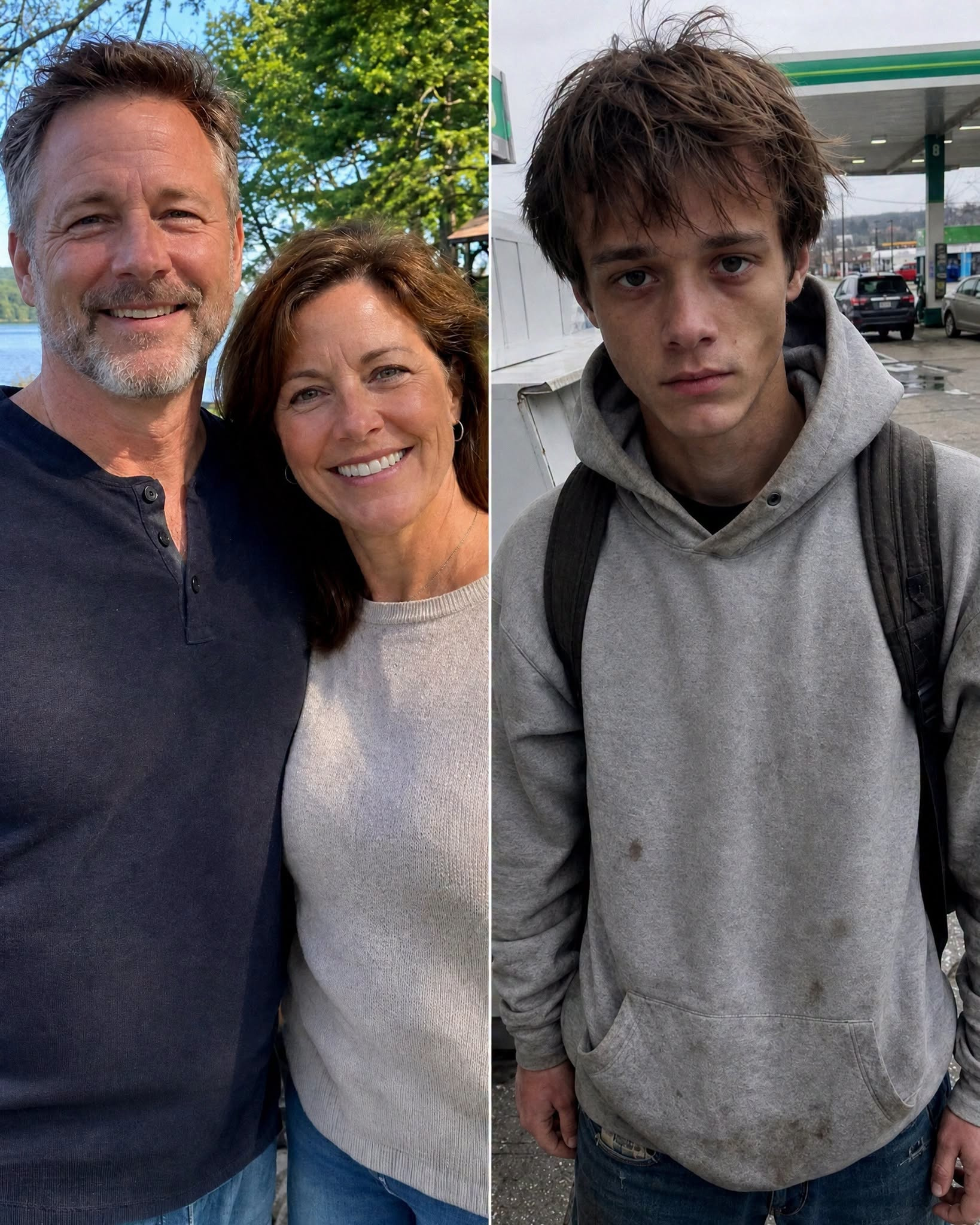
The long Tuesday evening stretched quietly before me as I pulled into a small gas station only a few miles from home. It had been an ordinary day, the kind that blends seamlessly into the rhythm of a settled life. Our two children were away at college, adjusting to adulthood, while my husband, David, had spent another long shift at the hospital where he was respected as an accomplished physician. After twenty-two years of marriage, I believed we had built something solid. We owned a comfortable home, shared decades of memories, and still escaped to the lakeside cabin I had inherited from my parents whenever life became too hectic. A developer had recently offered an astonishing amount of money for that property, but I couldn’t imagine letting it go. It wasn’t simply real estate—it was the place where my family history lived.
Still, subtle changes had begun creeping into our marriage.
David had recently installed a new brass lock on his home office, insisting he needed extra privacy because of confidential patient files. That explanation sounded reasonable at the time. Then I found the business card of an attorney specializing in estate planning and guardianships tucked inside one of his jackets. When I asked about it, he casually dismissed it as professional networking through the hospital. I wanted to believe him, so I did. After more than two decades together, trust felt easier than suspicion.
That quiet confidence unraveled during what should have been the most forgettable stop of my week.
While my car filled with gas, I noticed a teenage boy sitting beside the ice machine near the entrance. He looked painfully thin beneath an oversized hoodie several sizes too large, and there was an exhaustion in his face that no teenager should have carried. He hesitated for several moments before slowly approaching me.
“Ma’am,” he asked quietly, “could I borrow your phone for one quick call? I need to reach my aunt.”
His voice reminded me of my own son during stressful moments.
Without much hesitation, I unlocked my phone and handed it to him.
He stepped a short distance away, made a brief call, thanked whoever answered, and returned a minute later.
“Thank you,” he said sincerely while handing the phone back.
I smiled.
“No problem.”
I climbed into my car, started the engine, and prepared to leave.
Then I noticed he hadn’t walked away.
Instead, he remained standing beside my driver’s window, his expression suddenly filled with anxiety as he glanced toward the convenience store entrance.
He leaned closer.
“You need to know something.”
His voice dropped almost to a whisper.
“Your husband is paying me to watch you.”
For a second, I actually laughed.
It was such an unbelievable statement that my mind rejected it immediately.
“My husband?” I asked.
“David?”
“He’s a doctor.”
The boy nodded slowly.
“I know.”
“My name’s Marcus.”
“And he’s been paying me every week.”
The humor disappeared from my face.
Marcus explained that nearly two months earlier he had met David through a local church outreach program that helped homeless teenagers and young adults.
According to Marcus, David introduced himself as a worried husband.
He claimed I had begun experiencing serious memory problems.
He said I wandered around town confused.
He said I sometimes forgot where I lived.
He insisted he simply needed someone nearby to let him know if I appeared lost or in danger.
Marcus believed he was helping protect a sick woman.
David paid him three hundred dollars every week.
All Marcus had to do was send text messages describing where I went during the day.
Which grocery stores I visited.
Which restaurants.
Who I spoke with.
When I returned home.
Recently, however, David’s requests had changed.
“He wanted me to lie,” Marcus admitted quietly.
“He asked me to say you looked drunk.”
“Or confused.”
“Even when you weren’t.”
“I couldn’t keep doing it.”
A cold numbness spread through my entire body.
Nothing about the story made sense.
Yet Marcus wasn’t asking me for money.
He wasn’t demanding anything.
If anything, he looked ashamed.
I gave him my phone number.
I told him I wanted to understand everything.
Before leaving, I slipped him enough cash for dinner and promised to help him get a prepaid phone so we could stay in contact.
The drive home passed in complete silence.
Every conversation David and I had shared over the previous months replayed endlessly in my mind.
Every unusual question.
Every unexplained absence.
Every locked door.
That evening, David seemed perfectly relaxed.
During dinner he casually asked whether I had thought any more about selling the lake cabin.
“The offer’s still excellent,” he said.
“It would make retirement much easier.”
I smiled politely.
“I’ll think about it.”
Inside, however, I couldn’t stop hearing Marcus’s voice.
The following morning, David left early for work.
As soon as his car disappeared down the street, I walked directly to the kitchen.
Months earlier, while organizing junk drawers, I had noticed a small spare key I couldn’t identify.
Now I wondered.
Sure enough…
It fit the lock on his office.
Inside, everything appeared perfectly organized.
Medical journals lined the shelves.
Patient textbooks covered the desk.
For several minutes I found nothing unusual.
Then I noticed a locked file cabinet.
The key hanging beneath the desk opened it.
Inside rested a thick manila folder labeled only with my initials.
My hands began trembling.
The folder contained pages documenting my daily routines.
Dates.
Times.
Locations.
Descriptions.
There were photographs of me shopping for groceries.
Pictures of me walking through the local park.
Notes describing conversations I’d had with neighbors.
Most disturbing of all were written observations claiming I appeared forgetful, emotionally unstable, and increasingly incapable of managing financial decisions.
None of it was true.
Mixed among those papers was correspondence with an attorney discussing the possibility of petitioning a court to appoint a legal guardian based on alleged cognitive decline.
The documents referenced financial planning, medical evaluations that had not yet occurred, and possible management of significant assets if guardianship were approved.
One section discussed the practical implications for property decisions, including the possibility of selling real estate if authorized through appropriate legal processes.
I photographed every single page.
Exactly as I found them.
Then I carefully returned everything to its original position.
Within hours I had scheduled a consultation with an experienced family law attorney named Karen.
She spent nearly an hour reviewing the photographs.
When she finally looked up, her expression had become remarkably serious.
“If these documents are authentic,” she said carefully, “we need to act immediately.”
Over the next several days, Marcus continued sharing copies of messages David had sent him.
The requests became increasingly troubling.
David appeared eager to create situations that could be interpreted as evidence supporting his allegations.
Finally, Marcus forwarded one final message.
Saturday.
Restaurant near the lake.
Public setting.
David intended to document what he hoped would appear to be another example of my supposed instability.
Karen smiled for the first time all week.
“Then,” she said, “let’s make sure he’s the one who gets surprised.”
Saturday evening arrived.
David insisted we enjoy a quiet dinner together overlooking the lake.
He seemed unusually cheerful.
Halfway through the meal he reached across the table.
“You’ve seemed tired lately,” he said gently.
“How have you been feeling?”
Instead of answering, I opened my purse.
I placed a neatly organized folder on the table.
Inside were copies of every surveillance log.
Every payment record.
Every message Marcus had preserved.
The attorney correspondence.
The photographs.
Finally…
I placed divorce papers on top.
David’s face immediately lost all color.
“I can explain,” he whispered.
I remained calm.
“I’m sure you want to.”
He reached toward the documents.
“They can’t use these.”
Karen’s words echoed in my mind.
I looked directly into his eyes.
“Marcus has already provided a sworn statement.”
“The financial records speak for themselves.”
“And everything else will be addressed through the proper legal process.”
For the first time in twenty-two years…
David had absolutely nothing to say.
The confident physician who had spent months quietly constructing a case against me now sat frozen in complete silence.
Around us, conversations continued, waiters carried plates between tables, and the sun slowly disappeared beyond the lake.
The world kept moving.
But my marriage had quietly reached its end.
I stood.
Collected my purse.
Left the folder exactly where it was.
And walked toward the exit without looking back.
The legal process that followed was long and emotionally exhausting, but it also became the beginning of a new chapter. With the guidance of my attorney and the evidence we had gathered, I was able to protect my rights, preserve my independence, and ensure that decisions about my future remained my own. The lake cabin stayed exactly where it belonged, untouched and unsold, continuing to overlook the water just as it had for generations.
Marcus eventually found stable housing through a local support program, finished school, and found steady work. We stayed in touch from time to time, and I never forgot that an act of honesty from a frightened teenager had changed the course of my life. He could have remained silent and accepted another payment, but instead he chose integrity over convenience.
Looking back, I often think about how deception rarely begins with dramatic betrayals. More often, it starts with small secrets, subtle manipulations, and questions that are too easily dismissed because trust makes us want to believe the best in the people we love. I ignored warning signs because I believed a long marriage guaranteed honesty. Instead, I learned that real trust is built on transparency, not assumptions.
Today, when I sit on the porch of the lake cabin watching the sun set across the water, I no longer think of it simply as an inheritance. I see it as a reminder that our greatest strength often appears only after our deepest betrayals. Sometimes losing the life you thought you had is the very thing that allows you to reclaim the life that was always meant to be yours.