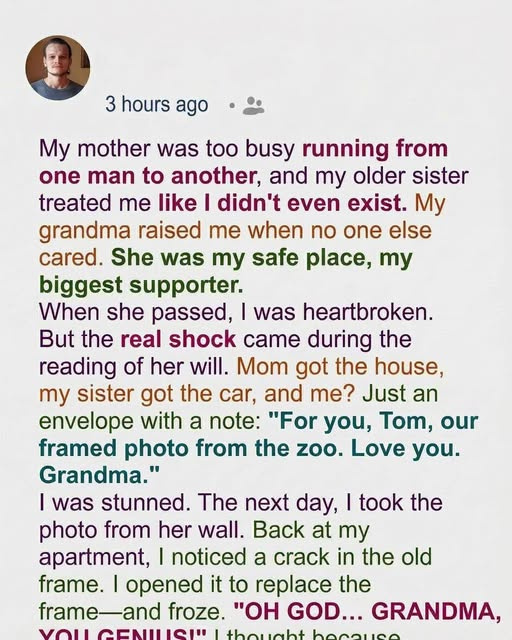
The reading of my grandmother’s will felt less like a family gathering and more like a final judgment against me. Around the room, relatives exchanged satisfied smiles as they discussed property, savings, and everything they believed they had inherited. Their laughter echoed while they measured success in houses, land, and financial value. When the meeting ended, I walked away carrying nothing more than an old family photograph and a crushing silence. In that moment, it seemed to confirm every fear I had carried for years—that I had always been the overlooked one, the family member who came last, the person easiest to leave behind.
For days, I replayed that painful afternoon in my mind, convinced there had been nothing hidden beneath the disappointment. Then I received a call asking me to visit the bank regarding a private deposit box that had been left in my name. Curious but without much hope, I arrived expecting little more than forgotten paperwork. Instead, the bank employee quietly unlocked the secure vault, stepped back, and allowed me a moment alone with what my grandmother had carefully arranged years earlier.
Inside the box rested a handwritten letter, its paper softened by time but its message unmistakably clear. As I slowly read each line, the story I had been telling myself began to unravel. My grandmother had not forgotten me at all. She had intentionally separated the most meaningful part of her inheritance, believing it would matter most when I was finally ready to understand why she had protected it so carefully. What had once felt like rejection suddenly revealed itself as an act of extraordinary foresight and love.
Alongside the letter were documents transferring ownership of her old house into my name. It was not the largest or most valuable property she owned, but it was the place where countless family memories had been created over the years. More importantly, it represented the future she had quietly envisioned for me—a place where kindness, generosity, and community could continue long after she was gone.
Eventually, I transformed the home into a welcoming community space called Grace’s Corner. Opening its doors did not erase the hurt I had experienced during the reading of the will, but it gave that pain a new purpose. Instead of becoming a reminder of rejection, the house became a place where neighbors gathered, shared meals, supported one another through difficult seasons, and discovered comfort during times of loss. In giving to others, I slowly found healing for myself.
As word spread about what Grace’s Corner had become, something unexpected began to happen. Family members who had once laughed during the reading of the will gradually started appearing at the front door. Some arrived carrying homemade meals, others offered quiet apologies, and a few simply asked whether there was any way they could help. The atmosphere that had once been defined by division slowly gave way to conversations filled with honesty, regret, and the possibility of reconciliation.
My sister’s first visit ended with tears as she stood on the front steps, overwhelmed by everything that had remained unspoken between us. But when she returned a second time, the conversation was different. Before she left, I placed a key in her hand—not because the past had disappeared, but because forgiveness had become more valuable than holding onto old resentment. It felt like the beginning of something new.
Today, whenever I hear laughter echo through the old house or watch strangers become friends around a shared table, I think of my grandmother’s final gift. She had never measured wealth by possessions alone. Instead, she believed a home should always be a place of refuge, compassion, and second chances. By trusting me with that responsibility, she left behind something far greater than an inheritance. She left a legacy of shelter, kindness, and hope—one that continues to outlive every storm that comes our way.