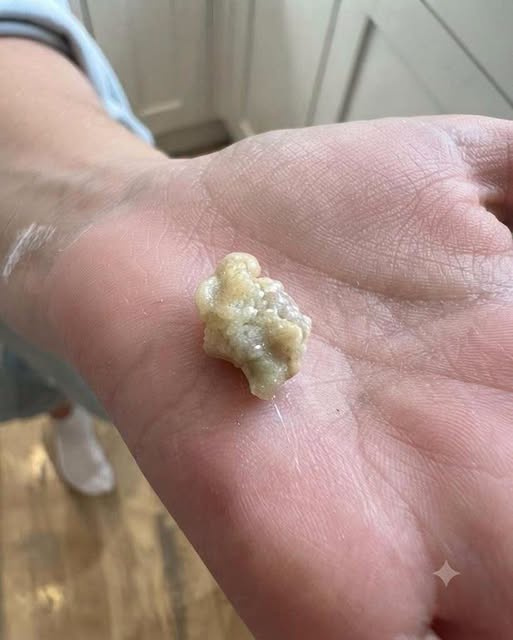
The first time most people see one, the reaction is almost impossible to control. A tiny white or yellowish lump slowly emerges from the back of someone’s throat, captured in crystal-clear video that leaves nothing to the imagination. Instinct says to look away, yet curiosity keeps your eyes fixed on the screen. It feels both fascinating and revolting at the same time. Within seconds, what began as a simple medical video transforms into something oddly mesmerizing, leaving millions of viewers asking the same uncomfortable question: *Could something like that be hiding inside my own throat right now?*
Over the past few years, videos showing the removal of tonsil stones have spread across social media platforms, attracting millions of views despite their undeniably unpleasant appearance. Many people discover these clips by accident, expecting to scroll past them immediately. Instead, they often find themselves watching until the very end. The mixture of disgust, curiosity, and relief has turned tonsil stone videos into one of the internet’s most unexpected viral trends, proving once again that people are strangely drawn to the hidden realities of the human body.
What surprises many viewers most is that tonsil stones are actually quite common. They are not considered a rare disease, nor are they usually a sign of a serious medical emergency. Instead, they develop gradually through ordinary biological processes. Tiny particles of food, dead cells, mucus, bacteria, and other debris can become trapped inside small crevices, known as tonsil crypts, located in the tonsils at the back of the throat. Over time, these materials accumulate, dry out, and harden, eventually forming the small, chalky deposits known as tonsil stones, or *tonsilloliths*.
For many people, these stones remain so small that they never realize they have them. Others may notice no symptoms at all until one becomes visible or is accidentally dislodged while coughing, eating, or brushing their teeth. However, larger tonsil stones can produce a variety of uncomfortable symptoms. Persistent bad breath is one of the most common complaints because bacteria trapped within the stones produce sulfur-containing compounds responsible for unpleasant odors. Some people also experience a sore throat, a persistent sensation that something is stuck in the throat, difficulty swallowing, an irritating cough, or mild ear pain caused by shared nerve pathways.
For individuals who have struggled with unexplained bad breath for years despite excellent oral hygiene, discovering tonsil stones can be both shocking and relieving. Suddenly, a mystery that seemed impossible to solve has a simple explanation. What appeared to be a dental problem or digestive issue may actually originate from small deposits hidden deep within the folds of the tonsils. In many cases, removing the stones significantly improves symptoms and restores confidence.
Medical professionals explain that certain people are more likely to develop tonsil stones than others. Individuals with naturally deeper tonsil crypts provide more places for debris to collect. Repeated throat infections or chronic inflammation can enlarge these crevices over time, making stone formation more likely. Poor oral hygiene, frequent sinus drainage, allergies, or excessive mucus production may also contribute by increasing the amount of material available to become trapped inside the tonsils.
Fortunately, most tonsil stones are harmless and do not require emergency medical treatment. Many eventually work their way out naturally through coughing or swallowing. Others can sometimes be loosened with gentle gargling using warm salt water or careful cleaning recommended by healthcare professionals. In cases involving recurring infections, significant discomfort, or unusually large stones, an ear, nose, and throat specialist may recommend additional treatment options. People should avoid using excessive force or sharp objects to remove tonsil stones themselves, as doing so can injure delicate tissue and increase the risk of infection.
The enormous popularity of tonsil stone videos also reveals something fascinating about human psychology. At first glance, it seems strange that millions of people would willingly watch something many describe as disgusting. Yet psychologists have long recognized that people are naturally curious about hidden aspects of the human body. Similar fascination exists for videos involving blackhead removal, earwax cleaning, or other medical procedures that combine discomfort with an oddly satisfying sense of resolution. The moment the stone finally comes free often delivers a feeling of relief that viewers describe as unexpectedly rewarding.
Perhaps even more interesting is what these viral videos say about modern culture. Social media is filled with carefully edited photographs, flawless smiles, and heavily filtered versions of everyday life. We are constantly encouraged to present polished, perfected versions of ourselves. Tonsil stone videos shatter that illusion completely. They remind us that every human body, regardless of appearance, has ordinary biological functions that are sometimes messy, imperfect, and surprisingly strange. Instead of hiding those realities, the internet has turned them into shared experiences that millions of people can relate to.
For many viewers, watching these videos triggers an emotional progression that is almost universal. The first response is revulsion. The second is curiosity. The third is reassurance. Learning that tonsil stones are relatively common helps replace embarrassment with understanding. People realize they are not dealing with something bizarre or shameful but with a common condition that many others experience as well. That realization often reduces anxiety while encouraging better awareness of oral health.
Ultimately, the viral success of tonsil stone videos has little to do with the stones themselves and much more to do with our fascination with the human body. They expose something hidden, answer questions many people never thought to ask, and remind us that normal biology is often far less glamorous than the carefully curated images we see online every day. They may never become pleasant to watch, but they have earned a permanent place in internet culture by transforming one of the body’s least attractive quirks into an unexpected lesson about health, curiosity, and the surprisingly universal experience of being human.