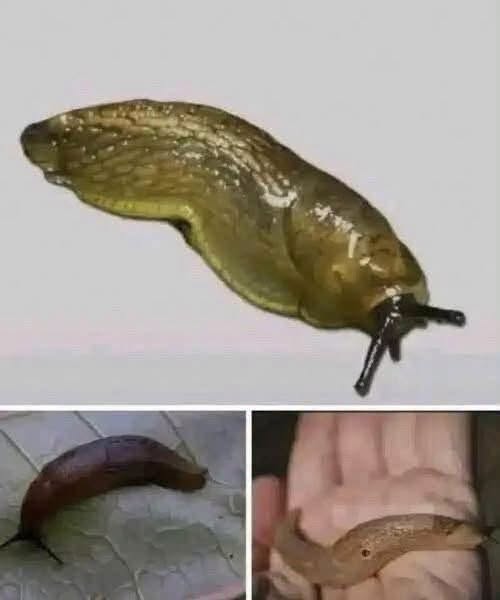
Most people react the same way when they spot a slug slowly gliding across a sidewalk after a rainstorm. The first instinct is often to wrinkle their nose, step around it, or wonder how such a slimy creature could possibly serve any useful purpose. Because slugs are commonly associated with chewed garden leaves and damp corners of the yard, they rarely receive much admiration. Yet beneath their unassuming appearance lies an extraordinary story of biological adaptation, ecological importance, and scientific potential. Far from being simple garden pests, slugs play essential roles in healthy ecosystems and have inspired innovations that may influence the future of medicine, materials science, and biotechnology.
Slugs belong to a group of animals known as gastropods, making them close relatives of snails. Unlike their shelled cousins, most slugs have either greatly reduced internal shells or no visible shell at all, allowing them to squeeze through remarkably narrow spaces while searching for food. Their soft bodies and constant production of mucus help them move across rough surfaces, protect them from injury, and reduce water loss. Although their slow movement often makes them appear vulnerable, these adaptations have allowed slugs to survive successfully in a wide variety of habitats around the world for millions of years.
One of the most valuable services slugs provide occurs quietly beneath our feet every day. In forests, gardens, fields, and wetlands, they function as natural recyclers. Rather than feeding exclusively on healthy plants, many species consume decaying leaves, dead vegetation, fungi, and other organic material already beginning to decompose. As they digest this material, they help break it down into smaller particles that microorganisms can process even further. This continuous recycling returns nutrients to the soil, supporting the growth of future plants and contributing to healthy, productive ecosystems.
Without countless decomposers working together—including slugs, earthworms, fungi, bacteria, and insects—dead organic material would accumulate much more rapidly across natural landscapes. Nutrient cycling would slow dramatically, affecting soil fertility and ultimately influencing the health of forests, grasslands, and gardens. While slugs represent only one part of this complex ecological network, their contributions are both steady and significant.
Slugs also occupy an important position in food webs. Many animals rely on them as a dependable food source throughout the year. Birds such as thrushes, amphibians including frogs and toads, reptiles, ground beetles, hedgehogs, shrews, and numerous other predators regularly feed on slugs. In turn, these predators help regulate slug populations while benefiting from the nutrition they provide. The removal of any one component from a food web can create ripple effects throughout an ecosystem, illustrating how even small creatures contribute to environmental balance.
Of course, not every interaction between humans and slugs is entirely positive. Certain species can damage crops, ornamental flowers, and vegetable gardens by feeding on tender leaves and seedlings. Farmers and gardeners have long sought methods to manage slug populations where they become excessive. However, ecologists increasingly emphasize that broad assumptions about all slugs being harmful overlook the diversity of slug species and the many ecological functions they perform. Responsible management focuses on balancing agricultural needs with preserving healthy ecosystems rather than eliminating slugs altogether.
Beyond ecology, slugs have attracted growing scientific attention because of one remarkable feature: their mucus. Although many people view slug slime simply as an unpleasant nuisance, researchers recognize it as an exceptionally sophisticated biological material. Slug mucus performs several functions simultaneously. It allows movement across rough surfaces, helps defend against predators, reduces dehydration, and in some species even forms powerful adhesive bonds under wet conditions that would challenge many synthetic materials.
This unusual combination of strength, flexibility, and moisture tolerance has inspired scientists working in biomaterials and biomedical engineering. Researchers have studied the adhesive properties of slug mucus in hopes of developing improved medical adhesives capable of functioning inside the human body. Traditional sutures and staples remain essential tools in modern surgery, but they are not always ideal for every situation, particularly when tissues are wet, delicate, or difficult to access. Materials inspired by slug mucus may eventually complement existing surgical techniques by providing strong, flexible adhesion in challenging environments.
Experimental medical adhesives modeled after slug mucus have shown encouraging results in laboratory research. These materials are designed to stick securely to moist tissues while remaining flexible enough to accommodate natural body movement. Scientists hope such technologies may one day assist in sealing wounds, repairing damaged organs, controlling bleeding, or improving recovery following certain surgical procedures. Although much of this research remains under development, it demonstrates how careful observation of nature can inspire entirely new approaches to solving medical challenges.
Slug-derived research has also attracted attention within the cosmetics and skincare industries. It is important to distinguish between slug mucus and the better-known snail mucin used in many skincare products, as they come from different animals and are not identical substances. Nevertheless, scientists studying gastropod mucus have identified various biological compounds that contribute to hydration, protection, and tissue maintenance. Some skincare formulations inspired by this research aim to support skin hydration and barrier function, although individual product effectiveness varies and consumers should rely on evidence-based information when evaluating cosmetic claims.
The broader field responsible for these discoveries is known as biomimicry—the practice of studying natural systems to inspire technological innovation. Engineers, chemists, and biologists frequently examine organisms that have solved difficult problems through millions of years of evolution. The remarkable adhesive ability of slug mucus joins a growing list of biological inspirations that include gecko feet for climbing surfaces, lotus leaves for water-repellent coatings, spider silk for advanced fibers, and shark skin for antimicrobial materials. Nature often provides elegant solutions that scientists adapt for human applications.
Researchers continue exploring many unanswered questions about slugs. How do their mucus molecules achieve such unusual combinations of elasticity and adhesion? Can similar materials be manufactured safely on a large scale? Might additional compounds found within gastropod mucus have applications beyond wound care? These ongoing investigations highlight how even familiar backyard creatures can contribute valuable insights into chemistry, medicine, and materials science.
Perhaps the greatest lesson slugs offer is one of perspective. Creatures that appear insignificant or unattractive at first glance often perform essential ecological functions while inspiring important scientific discoveries. Judging an organism solely by its appearance can obscure the remarkable adaptations it has evolved and the benefits it may ultimately provide. The next time a slug slowly crosses a garden path after a rainstorm, it is worth remembering that this small, seemingly ordinary animal is participating in nutrient recycling, supporting local wildlife, and helping researchers explore technologies that could influence future medical treatments. Sometimes the most extraordinary innovations begin not in high-tech laboratories, but by paying closer attention to the overlooked wonders quietly moving through the natural world.