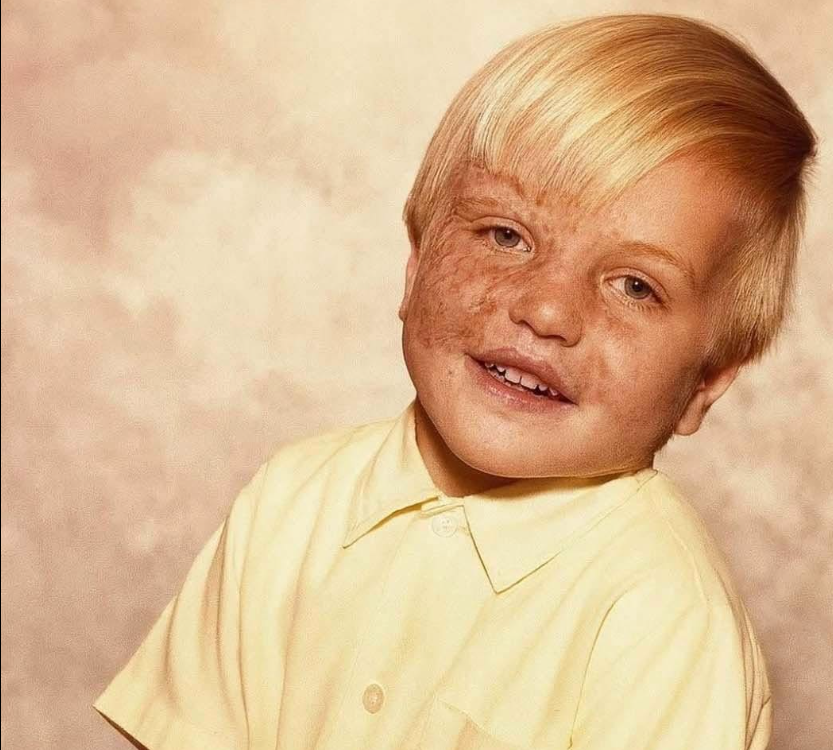
The fire lasted only moments, but its consequences stretched across an entire lifetime. Before he was old enough to remember his first birthday, unimaginable violence left him with severe burns that forever changed his appearance. Doctors fought to save his life while his family wondered whether he would survive the night. He did—but survival proved to be only the beginning of a much longer battle. As he grew older, mirrors became painful reminders of a tragedy he never chose. Strangers stared. Children whispered. Cruel comments followed him through classrooms, sidewalks, and nearly every public place he entered. Anger settled deep inside him, feeding years of bitterness and self-destruction. For decades, he believed his future had already been decided by someone else’s cruelty. Then, on his thirty-fifth birthday, standing at one of the darkest crossroads of his life, he made a single decision that would transform everything—not only for himself, but for countless others who desperately needed someone to prove that healing was still possible.
His childhood unfolded beneath the weight of trauma.
The physical scars were impossible to hide.
The emotional wounds reached even deeper.
Growing up, he quickly learned that people often noticed his appearance before they noticed him.
Questions came constantly.
So did uncomfortable silence.
Some children avoided him.
Others mocked him openly.
Every glance reinforced the painful belief that he would never truly belong.
As adolescence arrived, loneliness hardened into anger.
The pain he carried became difficult to escape.
Alcohol slowly entered his life, offering temporary relief from emotions he didn’t know how to process.
One drink became many.
One difficult night blended into another.
The cycle repeated itself for years.
At the same time, thoughts of revenge quietly grew stronger.
The person responsible for changing his life had served only a relatively short prison sentence.
To him, justice felt incomplete.
He imagined confronting the man who had stolen his childhood.
He replayed those fantasies endlessly, believing they might finally bring peace.
Instead, they only deepened his suffering.
The more he focused on the past, the less future he could imagine for himself.
Relationships became fragile.
Opportunities slipped away.
Addiction consumed more of his life than hope ever seemed capable of replacing.
By the time he reached his mid-thirties, exhaustion had replaced anger.
He realized something terrifying.
The person who had hurt him years earlier no longer controlled his daily life.
His addiction did.
His resentment did.
His belief that he was beyond saving did.
On his thirty-fifth birthday, he made a choice that frightened him more than revenge ever had.
He chose recovery.
The decision itself did not erase decades of pain.
Sobriety demanded honesty.
Patience.
Relapses in confidence.
Daily discipline.
Healing unfolded slowly, one difficult day at a time.
Yet with each sober morning, he began discovering parts of himself that had long been buried beneath fear and anger.
Gradually, purpose replaced survival.
He pursued meaningful work.
He built healthier relationships.
Most importantly, he began speaking publicly about his experiences.
Children living with burns, abuse, or visible differences saw something in him they rarely found elsewhere.
Someone who understood without needing lengthy explanations.
His scars became more than reminders of tragedy.
They became proof that life could continue after unimaginable suffering.
Eventually, he established a foundation dedicated to supporting children who had experienced abuse, trauma, or severe injuries.
Instead of allowing his past to define only his pain, he transformed it into a source of encouragement for others.
He visited hospitals.
Spoke in schools.
Met families facing impossible circumstances.
Again and again, he reminded young people of one simple truth:
What happened to you does not determine who you become.
Perhaps his greatest personal victory came when he began exploring forgiveness.
Not because the harm done to him was acceptable.
Not because justice no longer mattered.
But because carrying hatred had become its own prison.
Forgiveness did not erase accountability.
It simply allowed him to stop giving his past control over every remaining chapter of his life.
That freedom proved more powerful than revenge ever could have been.
Looking at him today, many people notice the scars first.
Then they notice something else.
Confidence.
Compassion.
Peace.
The very qualities he once believed had been permanently stolen now define him far more than the injuries themselves.
His story continues to inspire because it refuses to offer easy answers.
Recovery was not instant.
Forgiveness was not simple.
Healing never followed a straight path.
Instead, it unfolded through thousands of small decisions made consistently over many years.
Every sober day.
Every child encouraged.
Every painful memory faced honestly.
Every opportunity to choose hope over bitterness.
Together, those choices built a life stronger than the tragedy that once threatened to destroy it.
His journey reminds us that resilience is not the absence of pain.
It is the decision to keep moving despite it.
Scars may tell the story of what someone survived, but they never tell the whole story of who that person becomes.
In the end, the flames that once threatened to consume his future did not have the final word.
Compassion did.
Purpose did.
Hope did.
And through the lives he now helps transform, his greatest legacy is no longer the tragedy that marked his face—but the extraordinary kindness that now shines far brighter than any scar ever could.