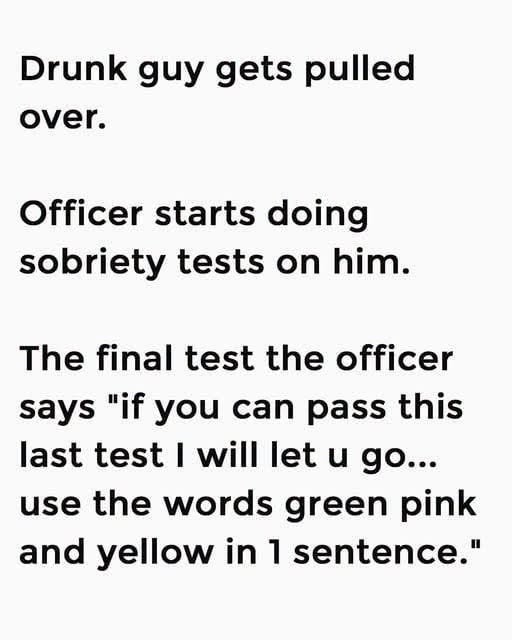
He believed the right joke could get him out of trouble. In his mind, one clever remark would distract from the smell of alcohol, excuse his reckless driving, and convince the officer to let him leave with nothing more than a warning. But on that quiet stretch of road, illuminated only by flashing red and blue lights, everything depended on whether he could prove he was fit to drive. One question. One field sobriety test. One decision that would change the rest of his night.
Standing on the shoulder of the road, he struggled to keep his balance. His speech was slow and slurred, and the scent of alcohol lingered with every breath. Despite the seriousness of the situation, he continued trying to lighten the mood, hoping humor would somehow outweigh the evidence unfolding in front of the officer.
The officer, however, remained focused on one thing—public safety.
Every missed step during the sobriety test, every stumble, and every confused response made it increasingly clear that this was no harmless mistake. The empty roadway may have appeared peaceful at that moment, but it could just as easily have been filled with families returning home, teenagers driving after a game, or parents with young children in the back seat. The danger wasn’t measured by what had happened—it was measured by what easily could have happened.
That reality carried far more weight than any excuse the driver could offer.
Still convinced he could talk his way out of the situation, he delivered what he considered the perfect one-liner. He expected the officer to smile, laugh, perhaps issue a warning, and send him on his way.
Instead, his words were met with silence.
The absence of laughter spoke louder than the flashing patrol car lights surrounding them.
Moments later, the officer calmly informed him that he was under arrest.
As the handcuffs closed around his wrists, the reality of the situation finally became impossible to ignore. Those cuffs were more than a consequence for breaking the law—they represented a barrier that prevented a potentially devastating crash before it could happen.
The evening that began with misplaced confidence ended with criminal charges, lasting consequences, and a lesson that could not be erased with humor.
No clever remark was powerful enough to undo impaired judgment. No joke could erase the danger created by getting behind the wheel after drinking.
That night didn’t become a funny story to tell friends.
It became a permanent reminder that the line between a safe trip home and an irreversible tragedy is often crossed long before anyone realizes it—and that choosing not to drive under the influence can save not only your own future, but the lives of countless others sharing the road.