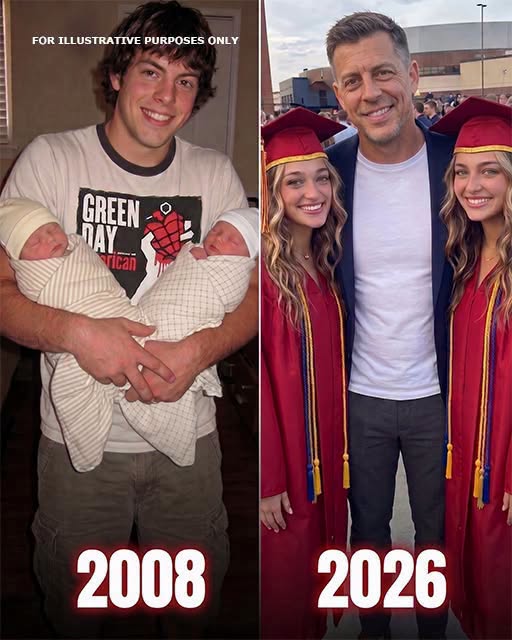
For nearly eighteen years, an old cardboard box sat untouched on the highest shelf of my bedroom closet.
Its corners were crushed, the tape had yellowed with age, and dust had settled into every crease. To anyone else, it looked like nothing more than forgotten clutter—something that should have been thrown away years earlier.
But I could never bring myself to get rid of it.
Every time I reached toward it, I stopped.
I knew that one day my daughters would ask questions I couldn’t answer with words alone.
Only that box could tell the whole story.
When Emma and Sophie finally opened it on their sixteenth birthday, everything they believed about their past changed.
Two years later, during their high school graduation ceremony, that same worn-out box quietly dismantled the carefully crafted story their biological mother had spent years trying to rewrite.
Rachel left us three days after the twins were born.
There was no screaming argument.
No dramatic betrayal.
No financial disaster.
She simply stood beside the hospital bassinets, looked at our sleeping daughters, and admitted something I never imagined hearing.
“I don’t want to be a mother.”
At first, I thought she was exhausted.
Sleep deprivation can make anyone say things they don’t mean.
But when I looked into her eyes, I realized she wasn’t confused.
She had already made her decision.
“I thought having children would change me,” she said quietly.
“I thought I’d feel different once they were here.”
She glanced at the babies again before looking back at me.
“It didn’t.”
I barely managed to whisper,
“Rachel… they’re our daughters.”
“I know.”
Her voice never trembled.
“But I want to build my company.”
“I want to travel.”
“I want freedom.”
“I don’t want to spend the next twenty years raising children.”
I stared at her, waiting for her to say she was joking.
She never did.
Then came the sentence that echoed through my mind for years afterward.
“I’ll regret staying more than I’ll regret leaving.”
Three days later, I woke up to silence.
Her side of the bed was empty.
Her clothes were gone.
Her suitcase had disappeared.
The only thing she left behind was her wedding ring, sitting alone on the kitchen counter.
There wasn’t even a note.
No explanation.
No goodbye.
People often tell me I was courageous for raising twin daughters alone.
The truth isn’t nearly that inspiring.
I wasn’t brave.
I was simply too busy surviving to fall apart.
Those early years blurred together into endless bottles, sleepless nights, doctor appointments, laundry, daycare schedules, and constant exhaustion.
My mother moved into our spare bedroom almost immediately.
My sister stopped by after work nearly every evening.
Neighbors left casseroles on the porch.
Coworkers donated vacation days whenever one of the girls became sick.
Friends assembled cribs, fixed broken appliances, and quietly stepped in whenever I was too overwhelmed to ask for help.
Without every one of those people, I honestly don’t know how we would have made it.
Little by little, life found a rhythm.
Baby bottles became lunchboxes.
Lunchboxes became homework assignments.
Homework became piano recitals, soccer practices, science fairs, learner’s permits, and eventually college applications.
It never became easy.
It simply became our normal.
When Emma was seven years old, she looked up from her cereal one morning and asked a question I’d dreaded for years.
“Dad… does Mom ever think about us?”
I stirred my coffee far longer than necessary.
Finally, I answered honestly.
“I don’t know.”
Her shoulders dropped.
“But I know who I think about every morning.”
She looked up.
“Who?”
“You two.”
Before the moment could become too heavy, Sophie interrupted.
“Even when Emma steals my markers?”
Emma immediately protested.
“You wore my favorite hoodie for an entire month!”
Within seconds they were arguing across the breakfast table.
I smiled quietly.
Their bickering had just saved me from crying.
From that day forward, whenever life became difficult, I’d smile and tell them,
“I choose you every morning.”
As teenagers they rolled their eyes dramatically.
“Dad… you’re so cheesy.”
But I always caught the tiny smiles that followed.
They understood more than they admitted.
One promise I made to myself from the beginning was simple.
I would never poison them against their mother.
Children deserve honesty.
They don’t deserve bitterness.
Whenever they asked why Rachel left, I always answered the same way.
“Your mother made one choice.”
“I made another.”
That was enough.
Every year I mailed Rachel updates.
I no longer had a home address, only the business address listed publicly for her growing technology company.
Inside each envelope were photographs.
School report cards.
Birthday letters.
Stories about missing teeth, first bike rides, favorite books, funny moments, and the remarkable young women Emma and Sophie were becoming.
Every single envelope came back.
RETURN TO SENDER.
At first I assumed she’d moved offices.
Eventually I realized the truth.
She simply wasn’t interested.
Still, I never threw the letters away.
Each unopened envelope went carefully into the cardboard box.
Not because I expected her to read them one day.
Because I wanted my daughters to know that I never stopped trying.
When they turned sixteen, I finally carried the dusty box downstairs.
The three of us sat around the dining room table in silence.
Emma opened the oldest envelope.
It had been returned when she was only four years old.
Sophie picked up another from middle school.
Neither girl spoke for several minutes.
Finally Emma whispered,
“You kept writing?”
“Every year.”
“And she never answered?”
“No.”
Sophie looked at the growing stack of unopened envelopes.
“You knew they’d come back.”
“I did.”
“So why keep sending them?”
I looked at both of them.
“Because one day I wanted you to know something.”
“You were never abandoned by me.”
Neither of them cried.
Neither needed to.
Something much quieter happened instead.
A question they’d carried their entire childhood finally settled inside them.
Two years later, Rachel was everywhere.
Magazine covers.
Business conferences.
Television interviews.
Her technology company had made her famous.
Journalists praised her as an innovative entrepreneur.
Then someone uncovered a forgotten chapter of her past.
The articles began asking uncomfortable questions.
What happened to the twin daughters she left behind?
Almost overnight, everything changed.
Emails arrived.
Letters.
Invitations.
Phone calls.
Lawyers contacted us requesting meetings.
For the first time in eighteen years, Rachel wanted a relationship.
Emma and Sophie politely declined every request.
I never told them what to do.
I only asked one question.
“What feels right to you?”
Emma answered first.
“We don’t know her.”
Sophie nodded.
“And we don’t owe anyone a reunion just because other people are watching.”
Graduation arrived beneath a warm June sky.
The auditorium overflowed with proud parents and grandparents.
My mother sat beside me holding tissues before the ceremony even began.
Near the end, the principal introduced the evening’s surprise guest.
A generous donor whose recent scholarship program had benefited the graduating class.
Rachel walked onto the stage.
She looked polished.
Confident.
Successful.
She spoke eloquently about perseverance, second chances, and learning from life’s mistakes.
Then she smiled toward the graduating seniors.
“I’d especially like to recognize my daughters, Emma and Sophie.”
My stomach tightened.
Even the principal looked surprised.
Clearly, this hadn’t been planned.
Emma and Sophie exchanged uncertain glances before walking onto the stage.
Rachel handed each of them an expensive gift box wrapped with elegant ribbon.
Then she turned toward the audience.
“For years,” she began, “I’ve tried to rebuild my relationship with my daughters after difficult circumstances separated us.”
Her eyes briefly met mine.
“There were barriers that made reconnecting almost impossible.”
She never actually accused me.
She didn’t need to.
The implication settled over the room anyway.
Then she made one fatal mistake.
“I wrote to them.”
“I reached out repeatedly.”
“I tried everything I could.”
Emma slowly looked toward Sophie.
Sophie stepped forward and gently took the microphone.
“Our father never stopped you from contacting us.”
Rachel’s confident smile faded.
Emma spoke next.
“He mailed you birthday letters.”
“School photos.”
“Report cards.”
“Stories about our lives.”
Rachel immediately answered,
“I never received those.”
For one brief moment, several people in the audience seemed willing to believe her.
Then Sophie quietly replied,
“He mailed them to the business address you publicly used for years.”
Emma nodded.
“He saved every returned envelope.”
A murmur spread across the auditorium.
Rachel hesitated.
“My assistants handled the mail.”
Emma remained calm.
“Maybe later.”
“But those letters started coming back years before you hired assistants.”
“And the first letter we ever received from you came only after reporters started asking why you left.”
Silence settled across the room.
Sophie looked directly into Rachel’s eyes.
“So when you say you tried everything…”
“…when exactly did you start trying?”
Rachel opened her mouth.
Nothing came out.
Emma turned toward the audience.
“Our father never spoke badly about our biological mother.”
“He taught himself how to braid hair by watching videos online,” Sophie added.
“He never missed a recital.”
“He worked overtime so we could take music lessons.”
“He stayed home every time we were sick.”
“He never stopped showing up.”
Then both girls looked directly at me.
“He chose us every morning.”
I lowered my head.
After eighteen years, they remembered.
Emma turned back toward Rachel.
“You gave birth to us.”
Sophie gently finished the sentence.
“But he raised us.”
For several long seconds, no one moved.
Then someone stood.
Another person followed.
Within moments the entire auditorium rose to its feet.
The applause wasn’t for dramatic speeches.
It was for eighteen ordinary years of choosing love every single day.
Emma quietly placed her unopened gift box back onto the podium.
Sophie placed hers beside it.
“We appreciate the gesture,” Emma said kindly.
“But relationships aren’t built with expensive gifts.”
“They’re built with time.”
Then both girls stepped away from the stage.
Straight toward me.
Each slipped an arm through mine.
Neither looked back.
Five days later I helped move them into their college dorm rooms.
Driving home alone felt strangely quiet.
Halfway home I noticed an envelope resting on the passenger seat.
Neither had mentioned leaving it there.
Inside was a handwritten letter.
**Dad,**
**You always told us that you chose us every morning.**
**When we were little, we thought it was simply something parents said.**
**Now we understand that choosing someone isn’t a feeling.**
**It’s something you do every single day, especially when life becomes difficult.**
**This year we finally met the woman who gave us life.**
**But we’ve spent eighteen years living with the man who gave us everything else.**
**You worried you hadn’t done enough.**
**We never wondered.**
**Love always,**
**Emma & Sophie**
When I arrived home, I walked upstairs to my bedroom.
The old cardboard box still sat on the top shelf exactly where it always had.
I opened it one final time.
Inside rested eighteen years of unopened letters, returned envelopes, forgotten hopes, and silent disappointments.
I gently placed Emma and Sophie’s letter on top.
Then I closed the lid.
For nearly two decades, that box had carried every unanswered question.
Now, at last, it held the only answer I had ever truly needed.
Because the letters I sent had never reached the woman who walked away.
But everything I did reached the two little girls who stayed.
And in the end, that was always the only destination that truly mattered.