Moving into a new neighborhood, I expected the usual challenges—unpacking endless boxes, arranging furniture that never seemed to fit quite right, learning unfamiliar streets, and figuring out which cabinet held the coffee mugs every morning. I anticipated awkward introductions with neighbors, a few wrong turns while driving home, and the slow process of making an unfamiliar place feel comfortable. What I never expected was that something as ordinary as porch lights would completely change the way I looked at the neighborhood around me. During my very first evening walk, I noticed something unusual. One home glowed beneath a brilliant red porch light. Across the street, another radiated a calm green hue. A few houses farther stood a home illuminated by a single soft blue light. At first, I assumed people were simply decorating or experimenting with colorful bulbs. But the more evenings I spent walking those same streets, the more I realized those lights often carried stories far deeper than simple decoration.
Curiosity eventually got the better of me. I began paying closer attention to the homes displaying colored lights. Some changed with the seasons, while others remained exactly the same month after month. Certain houses always glowed blue. Others faithfully displayed green throughout the year. I started wondering whether these homeowners knew one another or whether there was some neighborhood tradition I hadn’t yet discovered. It wasn’t until I casually asked one of my neighbors that I learned something fascinating. Many of those colored porch lights weren’t chosen because they looked attractive. They were quiet symbols—small but meaningful messages of support, remembrance, gratitude, or awareness that required no explanation for those who understood them.
Across countless communities, colored porch lights have become silent forms of communication. Without displaying signs or hanging banners, homeowners use something as simple as a light bulb to express compassion, honor loved ones, raise awareness for important causes, or quietly stand beside people facing difficult circumstances. Every color tells a different story, and although the meanings may vary slightly from one community to another, the intention behind them is often rooted in empathy rather than decoration. What appears to be an ordinary porch light can actually represent years of personal experience, loss, hope, or unwavering support for others.
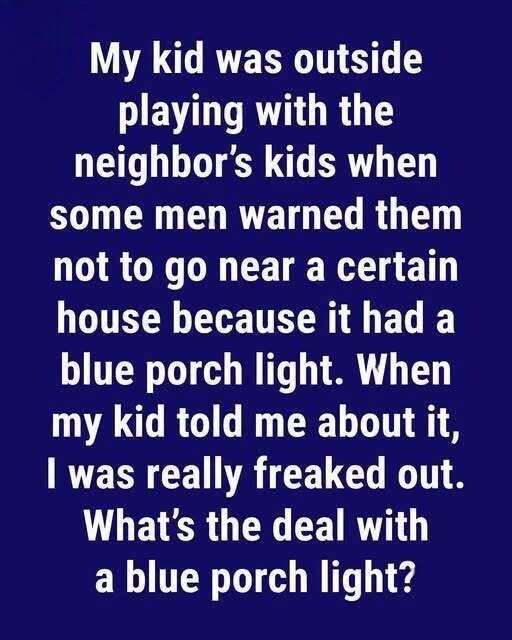
Among the most recognized is the blue porch light. Many people associate blue lights with support for law enforcement officers and their families, displaying them as a visible sign of appreciation for those who serve their communities every day. In other places, however, blue lights represent autism awareness and acceptance, encouraging understanding, inclusion, and compassion for individuals living on the autism spectrum. Because there is no single nationwide definition, the exact meaning often depends on the homeowner or the awareness campaign taking place at the time. Yet regardless of the specific cause, the gentle blue glow usually reflects someone’s desire to publicly stand beside a group of people they deeply care about.
Green porch lights have become increasingly common over the past several years. They are often displayed to honor military veterans and active-duty service members, expressing gratitude for sacrifices made both at home and abroad. During certain national campaigns, neighborhoods encourage residents to install green bulbs as a simple reminder that those who have served should never be forgotten. In recent years, green has also become associated with mental health awareness. Many families choose green lights to encourage open conversations about anxiety, depression, and emotional well-being, hoping to reduce stigma and remind struggling individuals that help, hope, and understanding are always within reach.
Purple porch lights carry some of the most emotional significance. During Domestic Violence Awareness Month, many homes shine purple to honor survivors, remember victims, and encourage conversations about prevention and support services. For someone escaping an abusive relationship or rebuilding their life after trauma, seeing a purple porch light can serve as a quiet reminder that compassion exists even among strangers. It may simply be a colored bulb to some, but to others, it represents safety, solidarity, and the hope that no one should ever suffer in silence.
Red porch lights also appear in neighborhoods across the country, though their meaning often changes depending on local traditions. Some homeowners install red lights to recognize firefighters and emergency responders who risk their lives protecting others. In certain communities, red lights become symbols during heart health awareness campaigns, reminding families to take cardiovascular wellness seriously and encouraging regular health screenings. Others display red lights during patriotic holidays or memorial events as expressions of national pride and remembrance. Like many colored bulbs, the true meaning often rests with the homeowner who chose to install it.
Gold porch lights are perhaps among the most touching. Every September, during Childhood Cancer Awareness Month, countless families replace their standard porch bulbs with soft golden lights to honor children bravely battling cancer. Entire neighborhoods sometimes participate, creating streets filled with glowing reminders of courage, resilience, and hope. For parents facing the unimaginable challenge of caring for a child with cancer, seeing homes illuminated in gold can offer comfort that complete strangers are thinking about them and recognizing their journey. Some homes continue displaying gold long after September has ended, quietly honoring children who survived and lovingly remembering those who did not.
White porch lights, although less frequently discussed, often symbolize peace, unity, and remembrance. Some families leave white lights burning throughout the year as symbols of hope during difficult times or in memory of loved ones they have lost. Others simply appreciate the timeless elegance of a warm white glow while privately attaching personal significance known only to those within the home. Even without public awareness campaigns, these lights often become deeply meaningful to the families who choose them.
Orange porch lights have also gained popularity in recent years. Around Halloween, they naturally appear as seasonal decorations, but in some communities, orange lights have also become symbols supporting hunger awareness initiatives or neighborhood safety campaigns. Like every other color, context matters. What appears festive to one passerby may hold a much deeper personal meaning for the homeowner.
Of course, not every colored porch light carries symbolic importance. Many people genuinely enjoy experimenting with colored lighting simply because they like the appearance. Others change bulbs to celebrate holidays, sporting events, or seasonal decorations. Without asking the homeowner directly, it’s impossible to know the exact reason behind any particular color. That uncertainty is part of what makes the experience so interesting. Every glowing porch invites curiosity while reminding us that people often carry stories invisible to those passing by.
After learning the meanings behind many of these colors, my evening walks changed completely. Instead of simply admiring attractive homes, I found myself wondering about the lives unfolding behind each front door. Was the blue light shining for a police officer working the night shift? Was the purple light honoring someone who finally found safety? Did the gold light represent a child courageously fighting cancer, or was it quietly remembering one who had already been lost? Every color suddenly felt less like decoration and more like a conversation taking place without words.
One evening I finally met the elderly woman who lived beneath the green porch light I had admired for weeks. We spoke while she watered flowers near her front steps. I complimented the light, assuming it honored a veteran in her family. She smiled warmly before pointing toward an old framed photograph hanging inside the doorway.
“My husband served for thirty-two years,” she said softly. “He passed away five years ago.”
She paused for a moment.
“I leave the green light on because every soldier deserves to know someone still remembers.”
Her words stayed with me long after our conversation ended.
Another evening, I noticed a father changing the blue bulb on his porch. Curious, I asked whether it was for autism awareness or law enforcement.
He smiled.
“My son has autism,” he explained.
“He loves looking out the window every night. He says the blue light helps him know he’s home.”
What had once seemed like an ordinary light bulb suddenly became something deeply personal—a symbol of acceptance created not for strangers but for one little boy who wanted to feel understood.
Since moving into this neighborhood, I no longer pass illuminated porches without wondering about the stories hidden behind each glow. Some represent gratitude. Others speak of resilience, sacrifice, hope, healing, or remembrance. Each light quietly reflects a chapter of someone’s life without demanding attention or applause. In a world often filled with loud opinions and constant noise, these silent symbols remind us that compassion doesn’t always need words to be powerful.
Sometimes the most meaningful messages aren’t written on signs, posted online, or spoken aloud. Sometimes they’re as simple as replacing one ordinary light bulb with a different color. That small decision may honor a loved one, support a struggling neighbor, celebrate a survivor, or quietly remind someone that they are not facing life’s challenges alone.
Now, whenever darkness settles across the neighborhood and colorful porch lights begin glowing one by one, I don’t just see houses.
I see courage.
I see gratitude.
I see remembrance.
I see hope.
And I realize that even the smallest light has the power to tell a story far brighter than the darkness surrounding it.