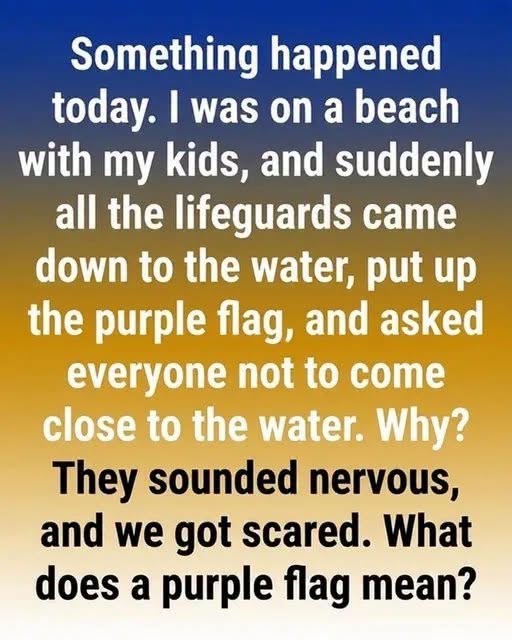
The beach looked perfect.
Children chased waves with plastic buckets in their hands. Teenagers tossed footballs through the warm afternoon air. Families stretched out beneath colorful umbrellas while gulls drifted lazily overhead. The ocean shimmered beneath the sunlight, inviting everyone a little closer with every gentle wave that rolled onto the sand.
Then someone noticed the flag.
It wasn’t the familiar green that promised calm conditions.
It wasn’t the yellow warning visitors to exercise caution.
It certainly wasn’t the bright red flag that sent swimmers back onto the shore.
Instead, a square of deep purple fabric snapped sharply in the wind.
At first, many people ignored it.
Some assumed it represented weather conditions.
Others thought it marked a surfing area or a special event.
Only those who had visited the beach before understood why the lifeguards had quietly replaced the morning’s flag.
The purple flag carried a simple but important message.
Potentially dangerous marine life had been spotted nearby.
The ocean itself hadn’t become more violent.
The waves hadn’t suddenly grown larger.
What had changed was something hidden beneath the surface.
Perhaps a group of jellyfish had drifted closer to shore with the changing tide.
Maybe stingrays had settled into the shallow sand where beachgoers often entered the water.
In some places, the warning could even indicate the presence of Portuguese man o’ war, sea urchins, or other marine creatures capable of causing painful injuries.
The beach usually remained open.
Swimming wasn’t automatically forbidden.
The purple flag wasn’t meant to frighten visitors.
It was meant to remind them that the sea is never completely predictable.
Many people imagine the greatest dangers at the beach come from towering waves or dramatic storms.
In reality, some of the most common injuries happen on calm, beautiful days when the water appears perfectly safe.
A child steps on a stingray hidden beneath the sand.
A swimmer brushes against drifting jellyfish tentacles carried by an unseen current.
Someone reaches into a tide pool without realizing a venomous creature has already claimed it as home.
None of these situations begin with obvious warning signs.
That is precisely why the purple flag exists.
Lifeguards don’t raise it casually.
They monitor beach conditions throughout the day, watching currents, weather patterns, marine life sightings, and reports from other beaches nearby. Many work closely with local wildlife experts and emergency responders, combining experience with real-time observations to decide when additional caution is necessary.
To an experienced lifeguard, small details tell important stories.
A sudden shift in wind direction may push jellyfish toward shore.
Changing tides can bring unfamiliar marine life into shallow water.
Large groups of seabirds feeding in one location may signal changes beneath the surface that most visitors never notice.
The flag becomes a quiet conversation between those who know the ocean well and those who have come simply to enjoy it.
Unfortunately, not everyone pays attention.
Some visitors walk past warning signs without reading them.
Others assume nothing bad could happen because the weather is sunny and the water looks calm.
Confidence can be useful in the ocean.
Overconfidence can be dangerous.
One of the smartest things any beachgoer can do is spend thirty seconds speaking with a lifeguard before entering unfamiliar water.
A simple question like, “Is there anything we should watch out for today?” can provide information that no smartphone weather app ever could.
Lifeguards might point out where jellyfish have recently drifted.
They may recommend a safer stretch of shoreline for young children.
They often know which sandbars attract stingrays and which currents are carrying marine life closer to swimmers.
That short conversation can transform uncertainty into practical confidence.
A few simple habits can make an enormous difference.
When entering shallow water where stingrays may be resting, many experienced beachgoers shuffle their feet instead of taking large steps. The movement creates vibrations that encourage stingrays to swim away before anyone accidentally steps on them.
Wearing a rash guard or protective swim shirt can reduce exposed skin and provide some protection against minor stings or scrapes.
Keeping basic first-aid supplies nearby—including clean water, bandages, and knowing where the nearest lifeguard station is located—can make responding to small injuries much easier.
Parents have an especially important role.
Children are naturally drawn toward the water without always recognizing potential hazards. Explaining the meaning of beach warning flags before they begin swimming helps them understand that safety isn’t about fear—it’s about awareness.
The ocean offers incredible experiences.
It also demands respect.
Every year, millions of people safely enjoy beaches around the world because they understand that nature follows its own rules. Marine animals are not searching for people. Most encounters happen accidentally, when humans unknowingly enter the animals’ space.
The purple flag serves as a gentle reminder of that reality.
It doesn’t mean the beach is dangerous.
It means visitors should pay a little more attention.
Slow down before diving into unfamiliar water.
Look around.
Listen to local advice.
Stay aware of changing conditions.
Respect the wildlife that calls the ocean home.
As the afternoon continued, the purple flag continued to wave steadily above the lifeguard tower.
Families still built sandcastles.
Surfers still caught waves farther offshore.
Children still laughed as foam reached their ankles.
The beach remained full of life.
The only difference was that people moved with a little more awareness and a little more respect.
That small piece of purple fabric had quietly accomplished exactly what it was designed to do.
Not to spoil a perfect beach day.
But to help ensure everyone returned home safely after enjoying one.
The ocean has always been one of the world’s most beautiful places, filled with wonder, adventure, and life beyond imagination. Yet it has never belonged entirely to us. Every wave, every tide, and every creature beneath the surface is a reminder that we are visitors in a living, constantly changing environment.
The purple flag is not a symbol of fear.
It is a symbol of knowledge.
And sometimes, the safest adventures begin not by ignoring a warning, but by understanding the wisdom behind it.