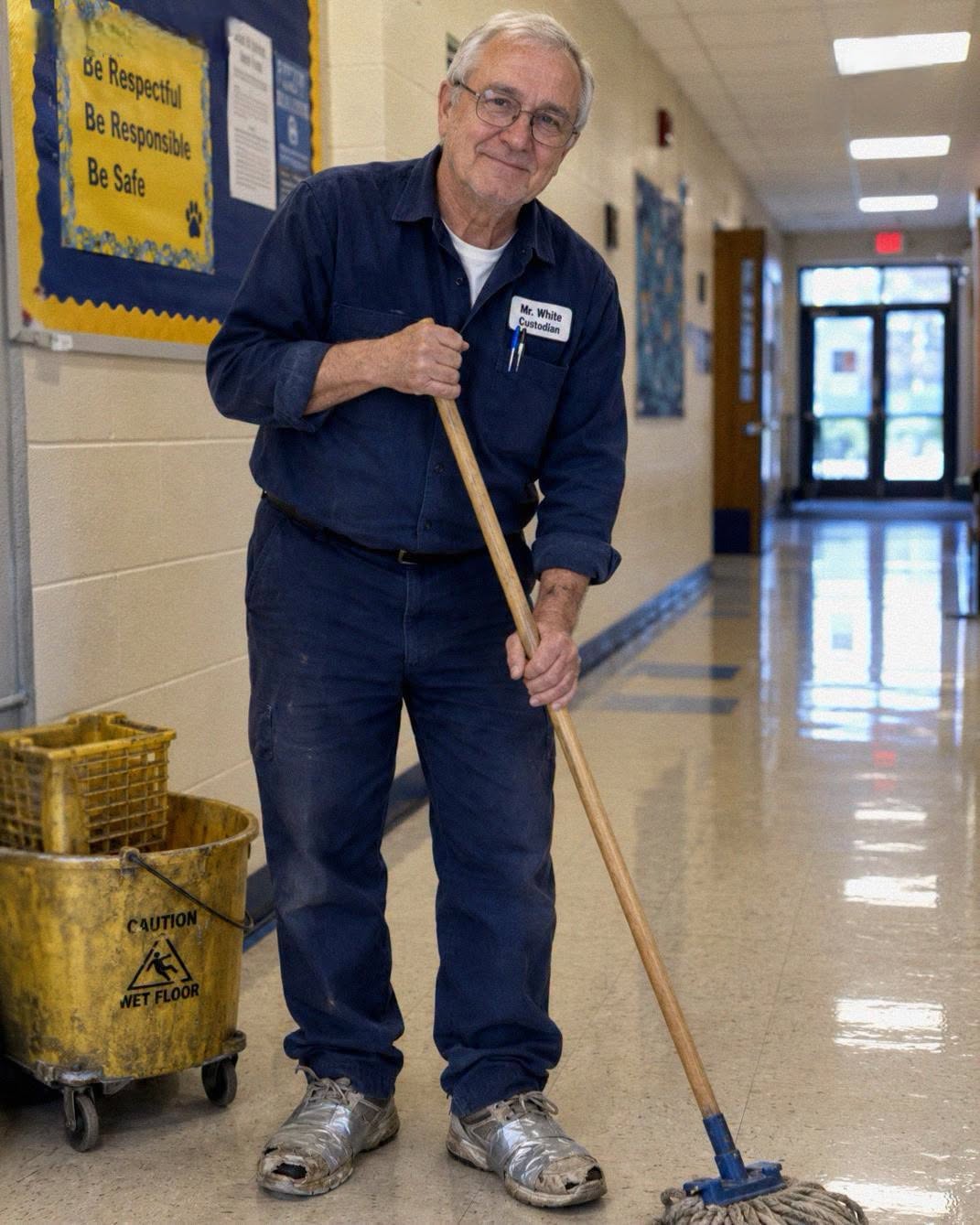
When my classmates surrounded the school janitor, Mr. White, laughing at the worn-out shoes barely held together with strips of duct tape, I couldn’t just stand there pretending not to notice. Without thinking twice, I walked over to the gym bench, untied my own basketball sneakers, and handed them to him before making the long walk home wearing nothing but my socks. To me, it was nothing more than a simple act of kindness for a man who deserved far better than humiliation. I never imagined that less than twenty-four hours later, the principal would call me into his office, where two police officers were waiting beside a weathered wooden box that would completely change the way I saw Mr. White—and myself.
Mr. White had only worked at our school for a couple of months, but somehow he had quietly become one of the most important people in the building. While teachers hurried between classrooms and administrators rushed through meetings, he was always there repairing broken lockers, tightening loose desks, unclogging drains, and greeting every student with the same warm smile. He looked to be somewhere in his early sixties, with silver hair, rough hands, and the patient expression of someone who had spent a lifetime solving other people’s problems. Most students barely noticed him, yet I often caught small moments that others ignored. He would kneel to tie a little kid’s untied shoelace before the child could trip, quietly pick up books someone had dropped without expecting a thank-you, or stay late fixing things so everyone else could return to a normal classroom the next morning.
Everything changed one Tuesday afternoon. Three boys from my grade cornered Mr. White near the trophy display after school. They weren’t satisfied with making jokes—they deliberately pointed toward his feet, laughing at the cracked black work shoes that had been patched together with layers of gray tape. One of them loudly joked that “janitors must not make enough money for real shoes.” The hallway echoed with laughter. Mr. White tightened his grip on the mop handle but never argued back. His face remained calm, though I could see the embarrassment in his eyes. Something inside me snapped. I stepped between them and told them exactly how pathetic they looked making fun of someone who worked harder than any of us ever had. They shoved past me, laughing as they walked away, but by then my attention was already on Mr. White.
Before he could wheel his cleaning cart away, I caught up with him. I asked him one simple question.
“What size shoes do you wear?”
He looked surprised before quietly answering, “Ten and a half.”
The exact same size as mine.
Without another word, I sat down on the nearby gym bench and untied my sneakers. Mr. White immediately refused, insisting he couldn’t possibly take them. I ignored every protest and gently pushed the shoes toward him. Slowly, almost reluctantly, he slipped them on. As he tightened the laces, his hands moved with remarkable precision, almost as though tying shoes had once been something far more meaningful than getting dressed. Finally he admitted the truth. His daughter had been battling a serious illness, and every paycheck he earned disappeared into hospital bills and medication. Buying himself a new pair of work shoes had become an impossible luxury. Before leaving, he hugged me tightly. He smelled faintly of peppermint and floor polish. It wasn’t simply gratitude—it felt like someone clinging to the last reminder that kindness still existed.
Walking home in my socks didn’t bother me nearly as much as I expected. My feet were cold, but somehow my heart felt lighter. I thought the story ended there.
The next morning everything changed.
Halfway through first period the classroom speaker crackled to life.
“Would Noah please report to the principal’s office immediately?”
The room instantly grew silent. Confused, I gathered my backpack and headed downstairs. When I stepped into the office, I froze. The principal stood beside two uniformed police officers. Sitting on the desk between them rested an old wooden box darkened by age.
One of the officers spoke gently.
“Mr. White suffered a heart attack last night.”
The words knocked the air out of me.
Seeing the panic on my face, he quickly added that Mr. White had survived emergency surgery. Before being taken into the operating room, however, he repeatedly begged the nurses to find “the boy who gave me his shoes.” He had left specific instructions asking that I be brought to a place before anyone visited him.
A short drive later we arrived outside an aging brick storefront on the opposite side of town. Faded letters above the entrance read:
WHITE’S SHOE REPAIR.
Inside, the shop smelled of leather, wood polish, and decades of careful craftsmanship. Dust covered the counters, but everything remained neatly organized as though the owner had planned to return at any moment. Rows of unfinished shoes still waited patiently on shelves.
The officers handed me the weathered wooden box.
Inside lay a brass key, a worn leather name tag stamped with “Samuel White,” an old photograph of a younger Mr. White smiling proudly outside the same shop with two small children beside him, and several handwritten notes.
The landlord quietly filled in the rest of the story.
Before becoming our school’s janitor, Mr. White had owned one of the town’s most respected shoe repair businesses for nearly forty years. People came from neighboring counties because nobody restored shoes better than he did. When his daughter became seriously ill, medical expenses slowly consumed everything he owned. One by one he sold his equipment, then his inventory, and eventually even the shop itself just to continue paying for her treatment. All he managed to keep were a few of his favorite tools and the memories of the life he had built.
Using the brass key, we unlocked a small storage room behind the workshop.
Along one wall stood dozens of neatly repaired children’s shoes, carefully arranged by size. Some looked almost brand new despite obvious signs of heavy wear.
A handwritten note rested on the shelf.
“For children who still have miles left to walk.”
The landlord smiled sadly.
“Even after losing his business, Samuel repaired shoes for families who couldn’t afford new ones. He never charged them a dollar.”
Suddenly I understood why he had laced my sneakers with such incredible care.
He hadn’t simply worn shoes.
He had spent an entire lifetime giving them second chances.
Later that afternoon I visited him at the hospital. He looked tired and much older than I remembered, but the moment he saw me his face brightened.
“You found the shop,” he whispered.
I nodded.
He smiled.
“I wanted someone good to know it existed.”
He never thanked me again for the sneakers. Instead, he thanked me for reminding him that people still noticed the man behind the mop instead of only the uniform he wore.
Three weeks later Mr. White returned to school. His movements were slower after surgery, but he walked proudly through the hallways wearing the sneakers I had given him. They had been cleaned, polished, and restored so perfectly they looked brand new. The students who had mocked him avoided looking him in the eye. No one laughed anymore.
One afternoon I watched him kneel beside a frightened first grader whose shoelaces had come undone. With the same practiced hands that had repaired thousands of shoes throughout his life, he carefully tied the child’s sneakers before sending him off with a smile.
Standing there, I finally realized something I would never forget.
I had believed I was giving an old man a pair of shoes.
In reality, I had simply reminded a master craftsman that his life’s work—and his quiet kindness—still mattered. Sometimes the smallest gesture doesn’t just help someone for a day. Sometimes it reminds them that they have never truly been invisible, and that the kindness they have spent a lifetime giving to others will always find its way back home.