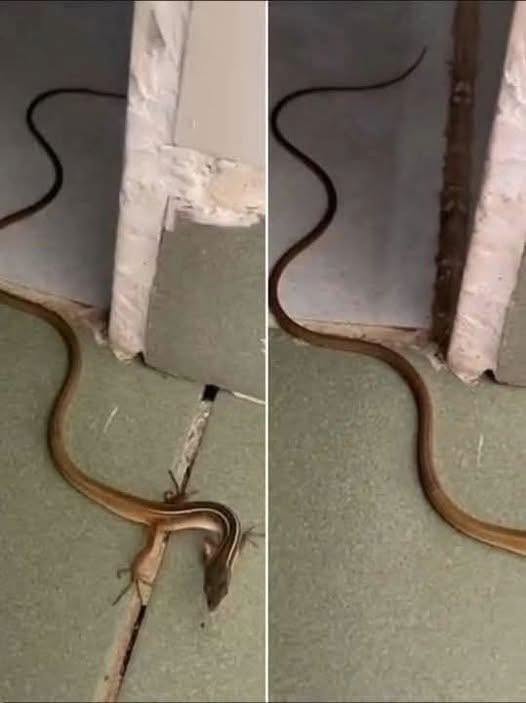
For most people, the thought of finding a snake inside their home is enough to send a wave of panic through their entire body. One moment you’re walking through the hallway, making coffee, or relaxing in your living room, and the next you catch sight of something long, silent, and moving across the floor. Your heart begins pounding, your breathing quickens, and your mind immediately jumps to the worst possible conclusion. Should you run? Should you try to kill it? Should you grab a broom or attempt to trap it? In those first few terrifying seconds, every decision feels critical, yet acting on instinct can often make the situation far more dangerous than it needs to be.
Although the experience is undeniably frightening, experts emphasize that finding a snake indoors does not automatically mean you are facing a life-threatening emergency. In many cases, the snake has no interest in attacking people at all. Like most wild animals, its primary goal is survival. It is usually frightened, confused, and simply searching for a safe place to hide or an exit back outside. Understanding why snakes occasionally enter homes can help reduce panic and lead to much safer decisions for everyone involved.
Snakes typically do not invade houses because they want to interact with humans. Instead, they are attracted by the same basic needs that drive every wild creature: warmth, shelter, water, and food. During colder months, homes provide comfortable temperatures that reptiles cannot generate on their own. In warmer seasons, garages, basements, crawl spaces, and storage rooms offer cool, shaded hiding places where snakes can remain undisturbed throughout the day.
Food is another major reason snakes find their way indoors. If a property has mice, rats, insects, frogs, or other small animals, snakes may simply be following their next meal. A rodent infestation often attracts predators without homeowners even realizing it. In this sense, the snake itself may actually be pointing toward another hidden problem inside or around the house that deserves attention.
Many people assume a snake must have entered through an open door or window, but they are remarkably skilled at squeezing through surprisingly tiny spaces. Small cracks in foundations, gaps beneath doors, damaged window screens, openings around plumbing pipes, attic vents, crawl spaces, and even loose siding can provide enough room for certain species to enter unnoticed. Once inside, they often hide in dark, quiet locations where they can remain undetected for days.
If you suddenly discover a snake inside your home, your first priority should always be remaining as calm as possible. While fear is completely natural, rushing toward the animal, swinging objects at it, or attempting to grab it dramatically increases the chances of someone getting injured. Even nonvenomous snakes may bite when they feel trapped or threatened, and identifying whether a snake is venomous can be extremely difficult for someone without specialized training.
Experts recommend immediately creating as much distance as possible between yourself and the snake. Keep children, pets, and anyone else in the home away from the area. If the snake is confined to one room, slowly back away and close the door if it can be done safely. This helps prevent the animal from moving throughout the house while also making it easier for professionals to locate and remove it.
One of the biggest mistakes homeowners make is trying to corner the snake. When an escape route disappears, the animal may feel it has no option except to defend itself. Remember that snakes generally prefer retreat over confrontation. Giving the animal space often reduces stress for both the snake and the people nearby.
Another common mistake is attempting to capture the snake using household items like buckets, blankets, sticks, or brooms. While videos online may make snake removal appear simple, professionals receive specialized training and use equipment specifically designed for handling reptiles safely. Without proper experience, a well-intentioned rescue attempt can quickly become dangerous.
Instead, contact local animal control, wildlife rescue organizations, licensed pest removal services, or other qualified wildlife professionals. These experts know how to safely identify different snake species, determine whether they are venomous, and remove them with minimal risk to both humans and the animal. In many regions, wildlife agencies encourage residents to report indoor snake encounters rather than attempting removal themselves.
Once the snake has been safely removed, the next step is preventing future visits. Carefully inspect the exterior of your home for potential entry points. Seal cracks in foundations, repair damaged vents, install door sweeps, replace torn window screens, and close openings around utility pipes. Even small repairs can significantly reduce the chances of wildlife entering your home.
Keeping your property clean also plays a major role in prevention. Remove piles of wood, stacked debris, overgrown vegetation, and clutter located close to your home’s foundation. These areas provide excellent hiding places not only for snakes but also for the rodents they hunt. A tidy yard creates fewer opportunities for unwanted visitors to settle nearby.
Managing rodent populations is equally important. Since snakes often follow mice and rats, eliminating food sources makes your property much less attractive. Store food securely, keep garbage containers tightly sealed, repair leaks that provide water, and address any signs of rodent activity as soon as possible.
It’s also worth remembering that snakes play an essential role in the natural environment. They help control populations of rodents and other pests that can spread disease, damage crops, and invade homes. While no one wants a snake inside the living room, these animals provide valuable ecological benefits when they remain in their natural habitats.
Education is one of the most effective ways to reduce fear. Learning which snake species live in your area, understanding which ones are harmless, and knowing what to do during an encounter can replace panic with confidence. Many wildlife agencies offer identification guides and safety recommendations specifically designed for local communities.
If you ever find yourself face-to-face with a snake inside your home, remember that your safety depends far more on your response than on the snake itself. Stay calm, keep your distance, protect children and pets, avoid trying to capture or kill the animal, and contact trained professionals who can remove it safely.
A snake encounter may be one of the most startling experiences a homeowner can face, but it does not have to become a tragedy. With patience, careful decisions, and a few preventive measures afterward, you can protect both your family and the wildlife that plays an important role in maintaining nature’s delicate balance.