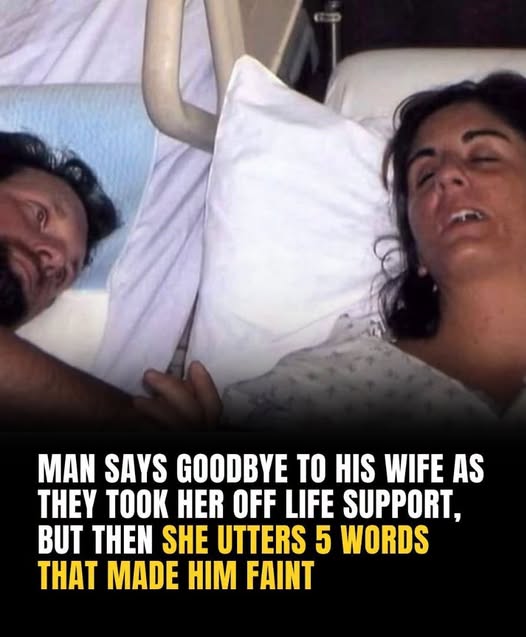
Ryan Finley stood beside his wife’s hospital bed feeling as though his world had already ended. Jill, only thirty-one years old, lay completely motionless, her breathing controlled by machines while doctors quietly admitted they had exhausted every available treatment. After days of heartbreaking conversations, they told Ryan there was no realistic hope of recovery. Fighting back tears, he prepared to make the most painful decision of his life—to remove her life support. As he leaned close to whisper one final goodbye, something happened that no one in the room could explain.
That Sunday morning had begun like countless others.
Ryan reached across the bed to wake Jill, expecting her usual sleepy smile.
Instead, she didn’t respond.
He called her name.
Nothing.
He shook her shoulder harder.
Still nothing.
Panic flooded through him as he realized she wasn’t breathing normally.
His trembling hands dialed emergency services while the dispatcher guided him through CPR.
Every second felt endless.
He begged her to come back while waiting for the ambulance, refusing to believe the woman he loved could disappear without warning.
Paramedics rushed Jill to the hospital, where doctors worked desperately to restart her heart and stabilize her condition.
Eventually they succeeded.
But the victory came with devastating news.
Jill had suffered a sudden cardiac arrest.
Although her heart was beating again, the lack of oxygen had placed her into a deep coma.
Ryan spent the following hours pacing the brightly lit hospital corridors, unable to think about anything except the possibility of losing her forever.
When the attending physician finally approached him, his expression revealed the seriousness of the situation before he even spoke.
He offered no unrealistic optimism.
No comforting promises.
Instead, he quietly said,
“You should pray for your wife.”
Those simple words carried more weight than any medical explanation ever could.
Ryan immediately understood how critical her condition had become.
Days turned into weeks.
Jill remained unconscious.
Her hospital room filled with family members, close friends, whispered prayers, and long stretches of heartbreaking silence.
Every visitor searched her face for the smallest sign of improvement.
None came.
One afternoon, Jill’s cousin arrived carrying a worn Bible.
He quietly read several passages beside her bed before placing the book into Ryan’s hands.
From that day forward, reading aloud became part of Ryan’s daily routine.
Whether she could hear him or not, he refused to let the room become completely silent.
He spoke to her constantly.
He reminded her of their happiest memories.
He described life waiting outside those hospital walls.
Most of all, he begged her to keep fighting.
By the eleventh day, however, the medical team’s outlook had become even more discouraging.
Repeated neurological examinations showed no meaningful improvement.
Doctors explained that the chances of recovery were becoming increasingly remote.
They encouraged Ryan to begin preparing for the possibility that Jill would never wake up.
The decision crushed him.
For days he wrestled with guilt, hope, fear, and unbearable grief.
Finally, after fourteen agonizing days, he signed the paperwork authorizing the removal of life support.
He believed he was saying goodbye to the love of his life.
The machines were disconnected.
The constant mechanical sounds that had filled the room gradually faded.
Unable to watch the final moments, Ryan stepped into the hallway.
He collapsed into a chair, convinced his life had ended alongside hers.
Then everything changed.
A nurse suddenly rushed through the doorway.
Her face showed complete disbelief.
“You need to come back,” she called.
“Right now.”
Confused, Ryan hurried into the room.
He expected to hear that Jill had taken her final breath.
Instead, she was looking directly at him.
Her eyes were open.
She appeared exhausted, but fully aware.
Then she quietly spoke.
“Get me out of here.”
“I want to go home.”
Ryan stood frozen.
For several seconds he couldn’t move.
He wondered if grief had caused him to imagine the impossible.
To convince himself she was truly awake, he began asking questions only Jill could answer.
She remembered family pets.
She solved simple math problems without hesitation.
She even smiled and said she wanted food from their favorite Mexican restaurant.
Every answer made the impossible seem increasingly real.
Against every prediction, Jill had returned.
Recovery was slow.
She had to rebuild her strength one step at a time.
Simple tasks that once required no thought—buttoning clothes, tying shoes, brushing her hair—became daily victories.
Physical therapy demanded patience.
Occupational therapy required determination.
Yet every small improvement reminded them how close they had come to losing everything.
When people later asked Ryan how he explained what had happened, he never pointed to statistics or medical textbooks.
Instead, he simply said he believed they had been given another chance.
Their lives changed completely after that experience.
Neither of them took ordinary days for granted anymore.
Even years later, Ryan occasionally woke during the night just to make sure Jill was still beside him.
Sometimes he would gently nudge her.
When she sleepily pushed him away or mumbled for him to stop bothering her, he smiled.
Those tiny moments became quiet reminders of something they once feared they would never have again.
For them, every ordinary morning had become extraordinary, and every new day together felt like a gift they never expected to receive.