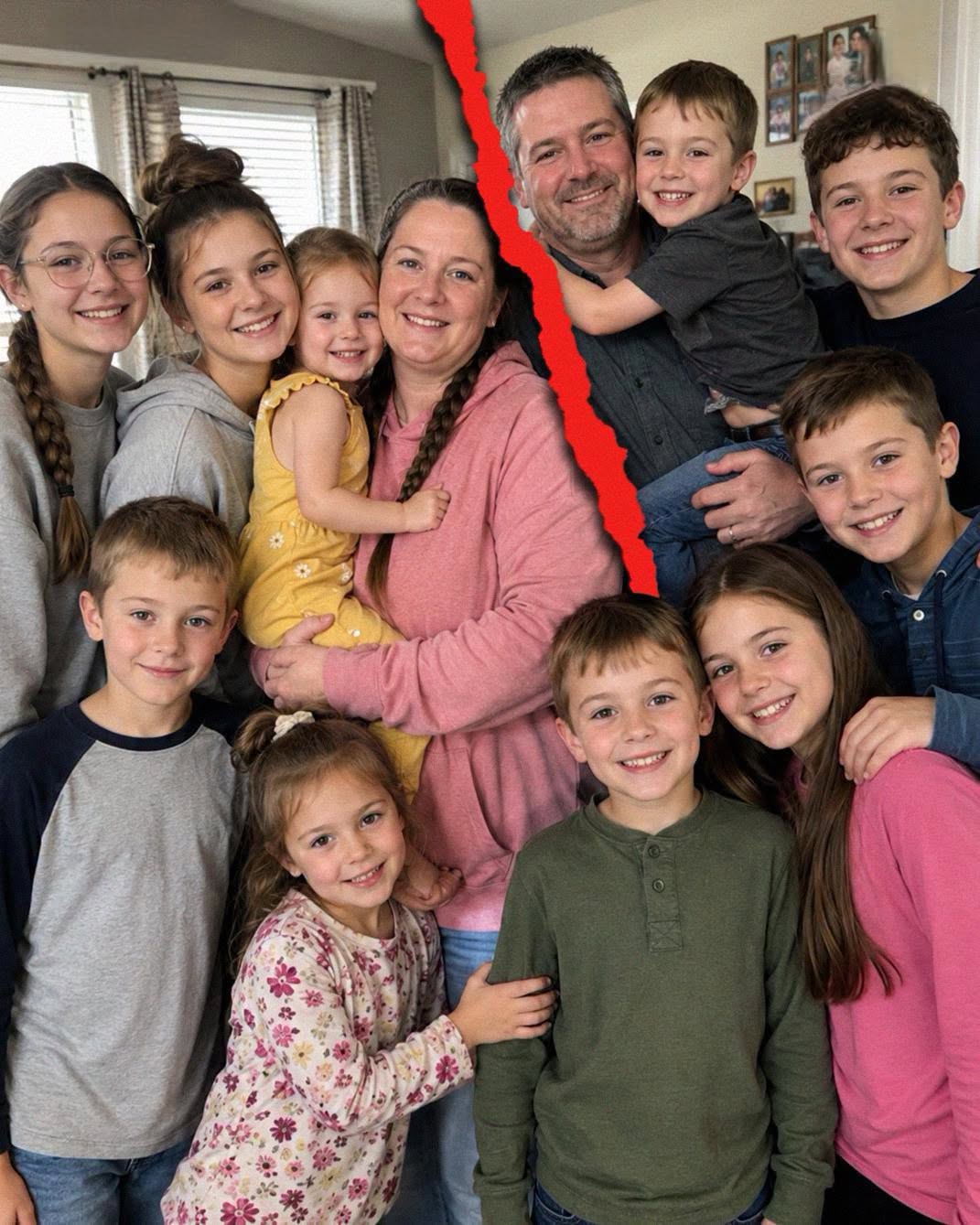
People always say they never saw the end of their marriage coming, that one day everything simply fell apart without warning. I cannot honestly say that about mine. Looking back, I saw the cracks forming long before everything collapsed. I noticed the growing distance, the excuses, the late nights, and the way my husband, Gabriel, slowly stopped looking at me with the warmth he once had. Deep down, I knew something was changing, but after twenty years together, ten children, and a lifetime built on shared sacrifices, I convinced myself that love would always be stronger than temptation. I believed no temporary distraction could outweigh everything we had survived together. I was wrong.
For two decades we built our lives one difficult day at a time. There was never enough money, never enough sleep, and almost never a moment of peace in a house filled with ten energetic children. Every paycheck disappeared into groceries, school supplies, doctor visits, and endless bills. We celebrated birthdays with homemade cakes instead of expensive parties and vacations usually meant spending afternoons in our own backyard. It wasn’t glamorous, but it was ours. Every struggle strengthened my belief that we were building something permanent—something no outside force could ever destroy.
Then Sherlyn entered his life.
She was twenty-five years old, worked as a personal fitness trainer, and supposedly helped Gabriel recover from lingering back pain. At first, I welcomed the idea. I wanted my husband healthy again. But gradually his “therapy sessions” became longer, more frequent, and strangely secretive. He smiled at his phone more than he smiled at his family. Weekend appointments appeared from nowhere, and conversations that once flowed naturally between us became painfully short. I recognized the warning signs, but I kept telling myself that twenty years of marriage surely meant more than a few months of attention from someone new.
Eventually, I could no longer ignore what was happening. One evening, after the children had finally gone to bed, I asked him directly if there was someone else. I expected denial, maybe guilt, perhaps even tears. Instead, he calmly admitted everything. There was no hesitation in his voice, no visible shame, no attempt to protect my feelings. While I stood there holding our youngest daughter, only three years old, Gabriel looked me straight in the eyes and told me that Sherlyn was “actually better” than me. Those few words shattered something inside me that could never be repaired. In that instant, the husband I had loved for two decades disappeared forever.
The divorce that followed wasn’t loud or dramatic. It was cold, calculated, and deeply painful. Gabriel fought over everything. Furniture, appliances, kitchen equipment, electronics—even things he hadn’t used in years suddenly became important to him. It felt less like dividing property and more like watching someone deliberately erase the life we had created together. By the time everything was finalized, the house still stood, but almost every comfort inside it had disappeared. What remained was me, ten children, and the overwhelming responsibility of rebuilding our lives from almost nothing.
Then Gabriel disappeared completely.
For nearly a year he barely contacted the children. Phone calls stopped. Birthdays passed without messages. School events came and went with one empty chair that never seemed to be filled. Meanwhile, my sister occasionally sent me photos she found online. Gabriel smiling on beaches in Bali. Gabriel dining beneath the Tuscan sun. Gabriel posing beside luxury resorts as though the family he had abandoned had never existed. After the third photograph, I asked her to stop sending them. I refused to waste another ounce of energy wondering how someone could smile so easily while his own children cried themselves to sleep.
Life didn’t stop simply because my heart was broken.
Bills still had to be paid. School lunches still had to be packed. Doctor appointments still filled the calendar. Laundry continued piling up, meals still needed cooking, and bedtime stories still had to be read. Somehow, despite the exhaustion, our home slowly found a new rhythm. It wasn’t perfect, but it was filled with genuine love rather than false promises.
The person who surprised me most was my oldest son, Michael.
At only twelve years old, he quietly stepped into responsibilities no child should ever have to carry. He began waking before sunrise to prepare breakfast for his younger brothers and sisters. He helped with homework, tied shoes, packed lunches, comforted crying toddlers, and made sure everyone caught the school bus on time. He never complained. He never asked why his father had left. Without realizing it, Michael was becoming the kind of man Gabriel had chosen not to be.
When Michael turned thirteen, I wanted the day to feel special despite our circumstances. The decorations were homemade, the presents were modest, and the chocolate cake leaned noticeably to one side because my youngest kept bumping into the table while I frosted it. The children laughed until their stomachs hurt over our crooked masterpiece. For the first time in many months, our house felt light again. Joy had finally found its way back inside.
Then someone knocked on the front door.
When I opened it, Gabriel stood there wearing an expensive tailored suit, polished shoes, and a luxury watch that probably cost more than our monthly grocery budget. He looked healthy, confident, and completely untouched by the emotional devastation he had left behind. He didn’t ask permission to enter. He simply walked past me as though he still owned the house, barely acknowledging my presence.
He walked directly toward Michael, who was surrounded by friends opening birthday gifts.
Without saying much, Gabriel reached into an elegant shopping bag and carefully removed a massive LEGO Millennium Falcon set—the exact one Michael had begged for nearly a year earlier, back when we simply couldn’t afford it. It was beautiful, expensive, and painfully obvious. This wasn’t a birthday gift. It was an attempt to purchase forgiveness with plastic bricks.
The room became completely silent.
Michael looked at the enormous box for several long seconds before lifting his eyes toward his father.
“Thanks, Dad,” he said quietly.
Then, with remarkable calmness, he added, “I actually have something for you, too.”
Without another word, he walked upstairs.
Gabriel smiled confidently, clearly expecting a homemade card or perhaps a framed family photograph. A few moments later, Michael returned carrying a large, worn cardboard storage box. He placed it carefully on the hallway table with a heavy thump that echoed through the room.
“Go ahead,” Michael said softly. “Open it.”
Gabriel lifted the lid.
Within seconds, every trace of confidence disappeared from his face.
Inside wasn’t a gift.
It was an entire year of memories he had chosen to miss.
There were unopened birthday invitations addressed to him. School report cards waiting for congratulations that never came. Soccer schedules with every game highlighted in bright yellow. Programs from choir concerts. School artwork. Father’s Day cards. Family photographs. Even simple drawings from the younger children where the outline labeled “Dad” remained completely blank because they no longer knew how to draw someone who wasn’t there.
Michael gently picked up each item one at a time.
“This was Maya’s birthday,” he explained calmly.
“She asked if you were coming three different times.”
He picked up another paper.
“This was Clara’s first concert.”
Then another.
“This was my soccer semifinal.”
Every sentence landed harder than the one before.
There was no anger in his voice.
No yelling.
No tears.
Only quiet honesty.
Finally, he handed Gabriel one last folded Father’s Day card.
On the front, written in shaky childhood handwriting, was a single word:
“Dad.”
Inside it read:
“Happy Father’s Day. Maybe you’ll be here next year.”
Gabriel’s hands began shaking.
His eyes filled with tears as he struggled to speak.
“Michael… I…”
But Michael gently interrupted him.
“I’m not angry anymore,” he said.
“I started collecting these about three weeks after you stopped calling. I wasn’t saving them because I thought you’d come back. I was saving them so that if you ever did, you’d know exactly what you missed.”
There was nothing left for Gabriel to say.
No apology could erase twelve months of absence.
No expensive gift could replace hundreds of forgotten moments.
He quietly closed the box, tucked it beneath his arm, and walked back toward the expensive car waiting outside.
He arrived carrying a toy.
He left carrying the weight of an entire year of fatherhood he could never recover.
Later that evening, after the younger children had gone to bed and the house had finally fallen quiet, Michael and I sat together in the kitchen drinking hot chocolate.
I asked him when he had started putting the box together.
“Last March,” he answered.
“About three weeks after Dad stopped calling.”
I looked at him for a long moment before asking one final question.
“Were you hoping he’d come back?”
Michael thought quietly before answering.
“I hoped he’d want to come back,” he finally said.
“That’s different from hoping he actually would.”
At that moment, I realized my thirteen-year-old son had learned a lesson that had taken me more than twenty years to understand. Love cannot survive without effort. Forgiveness cannot replace responsibility. And sometimes the most powerful goodbye is not spoken through anger or revenge, but through quiet truth. Michael hadn’t given his father a box filled with paper. He had given him twelve months of missed birthdays, forgotten hugs, broken promises, and irreplaceable memories—a reminder that while possessions can always be bought again, time with the people who love you is the one thing that can never be reclaimed.