After the usual flurry of complaints about early mornings, jokes about food, and one person wondering if “no excuses” included traffic—as if traffic had ever prevented them from doing anything important—the group chat became quiet.
I sat there for a while with the phone face down on the table.
For what had transpired the previous evening, the house remained excessively silent. It was no longer empty, but it was still adjusting, as if it hadn’t yet decided how loud it could be.
Charlotte had put her letter back in the drawer. I could practically hear her voice between the lines because I had read it so many times.
Nearly.
Nearly.
More than anything else, that word stuck with me.
I got up before the sun came up on Sunday.
Not because I was nervous. Not precisely. It was more like my body had decided it didn’t trust me to sleep through anything significant once more.
Nevertheless, I began cooking.
It gave my hands something to do while my head fought to catch up, not because I wanted to impress them—there was nothing left to prove in that house.
eggs. Pancakes. Bacon that might cause the smoke alarm to reevaluate its decisions. Strong enough coffee to dispute with you.
I heard the first automobile at 7:42.
Then one more.
Then there’s the silence that only occurs just before a house realizes it is once again inhabited.
Like she always did when she wasn’t sure how the rest of the room would feel, Mia entered first.
She didn’t knock. Really, she never had.
She simply opened the door, hesitated for a while, and then grinned upon seeing me.
She remarked, “You produced enough food for a minor uprising.”
I answered, “I wasn’t sure how many would survive traffic.”
Laughing, she approached me and planted a kiss on my cheek as if it were the most natural thing in the world.
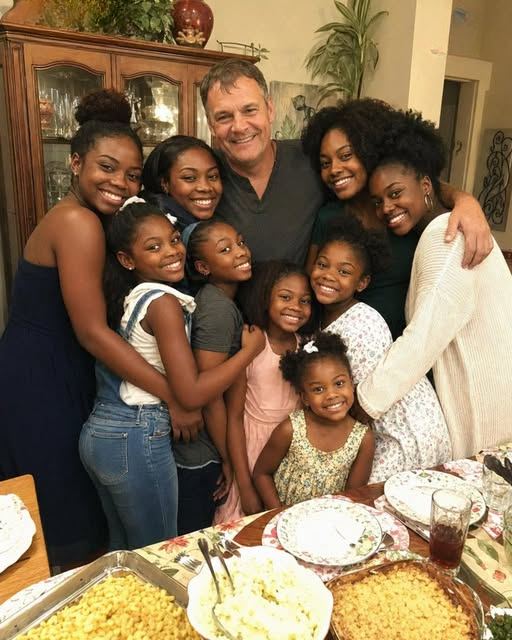
In a wash of overlapping voices, shoes, luggage, and welcomes that didn’t quite land in order, Dina, Lacy, and the smaller ones followed behind her.
Around them, the house took on new forms.
It did so every time.
It was noise at first.
Not an awful sound. Simply put, life is attempting a simultaneous reset.
A fork was dropped. Another person debated the placement of the syrup as if it were a formal policy matter. There was genuine laughter, not courteous one-liners masquerading as a connection.
I pretended that the bacon needed close supervision as I stood at the stove longer than was necessary.
It didn’t.
I simply wasn’t prepared to take a seat just yet.
Naturally, Mia noticed.
She was always perceptive.
From behind me, she muttered, “You’re hovering.”
I said, “I’m cooking.”
“You haven’t touched anything while cooking for twenty minutes.”
I pivoted a little. “I’m very meticulous.”
She rested on the counter. “You’re anxious.”
“I’m not anxious.”
She arched an eyebrow.
“I am somewhat conscious of things,” I clarified.
She laughed at that.
It also forced me to take a seat at last.
Breakfast lasted longer than it ought to have.
No one hurried it.
Just that seemed like a tiny miracle.
Jokes eventually gave way to more somber topics of discussion. updates on the work. Life shifts. Tiny admissions passed off as informal remarks.
Lacy brought up a job interview that she had not disclosed to me.
Dina said that she was considering getting near once more.
Nelly, one of the younger ones, inquired as to if I still had the old toolbox that she used to “borrow permanently.”
“Yes,” I said. “Half of its contents are still missing.”
She said gravely, “I was testing your organizational skills.”
I said, “You didn’t pass the test.”
“Emotionally, I passed.”
Mia almost choked on her coffee.
It was typical. Oddly typical.
And I didn’t yet have complete faith in that aspect.
They remained after the dishes were cleared.
I observed that shift first.
Visits typically had a rhythm. Arrive, eat, hang around, depart, and make a commitment to return soon. A cycle that terminated at the door every time.
However, no one grabbed their keys this time.
Rather, they wandered into the living room.
Some pretended that furniture was optional while sitting on the floor like they were still teenagers. Others claimed the couch, leaned into pillows as if to see if the room could accommodate them, and claimed corners.
Mia remained close to me once more, but not in close proximity.
Reachable enough.
Not near enough for a crowd.
It seemed deliberate.
As if we were all learning each other’s new geometry.
The topic of conversation changed at one point.
Not very loudly.
Just, of course.
Mia turned to face me from the other side of the room.
She said, “Have you ever regretted it?”
Without anyone’s intention, the room became a little quieter.
“What do you regret?” I stated.
“Everything,” she uttered. “Raising us.” taking us in. the challenging aspects.
The weight of the question was greater than I anticipated.
Not because it was unjust.
since it was truthful.
I reclined a little.
“No,” I finally replied. “However, I’ve come to regret how isolated I allowed myself to be while doing it.”
There was a little pause after that.
Not awkward.
Just genuine.
I went on.
“Those are two distinct things. I never felt sorry for you. any of you. I hated believing that I had to complete everything alone.
Mia gave a slow nod as if she were flipping that over.
She remarked, “Mom used to say you were stubborn.”
I gave a snort. “She wasn’t incorrect.”
“You only ever did things halfway when you were trying not to feel something,” she added.
That one struck closer than I had anticipated.
I briefly averted my gaze.
She wasn’t incorrect about it either.
Someone later inquired about Charlotte once more.
It wasn’t anticipated. It was never the case.
It simply occurred as memories do when people feel secure enough to let them to.
“Did she truly resemble us?” Nelly enquired.
I paused.
Not because I was unaware of the solution.
since I did.
Too well.
“Yes,” I said. “And no.”
She scowled at that.
I gave it another go.
I remarked, “She had all of your stubbornness.” “All of your generosity as well. However, she carried things in silence. As if she didn’t want anyone to see how exhausted she was.
Now Mia was observing me.
This time, I didn’t turn away.
I said, “I think that’s why I loved her.” She didn’t request to be understood. All she could hope was that someone would try.
After that, nobody said anything.
It didn’t feel like absence, though.
It was like being in space.
Slowly, afternoon arrived.
Individuals began to split themselves into smaller groups.
To answer a call, one went outside. Another vanished into the kitchen once more, explaining that the remaining pancakes were “strategic reserves.”
When the most of them left the room, Mia remained.
After a while, there was just the two of us.
She surveyed the silent living room.
She remarked, “This feels different.”
“Yes,” I said.
“Better?” she inquired.
I gave that some thinking.
Not in a fast-paced manner.
in a lengthy response.
I remarked, “I think it feels… honest.”
She gave a small smile. “That’s a fitting term for it.”
“Avoid sounding shocked.”
“I’m not,” she replied. “I simply believe that sometimes we’re not very good at it.”
“Being truthful?”
“No,” she clarified. “Thinking it will remain that way.”
That one persisted.
Mia paused at the door longer than usual before she left.
It wasn’t as if she was holding off on going.
It was more as though she was inspecting something unseen before leaving.
She then faced me once more.
She remarked, “You know, this doesn’t fix everything.”
“I am aware,” I answered.
She continued, “But it’s still good.”
“Yes,” I said. “Yes, it is.”
After giving one nod, as if it resolved the matter, she eventually departed.
After she left, the door shut.
After then, the house didn’t feel deserted.
It simply had a different, quieter vibe.
I sat at the kitchen table once more that evening.
Charlotte’s letter was returned.
Not because I was no longer in need of solutions.
However, I wanted the reminder.
that things in life don’t always end well.
Sometimes it simply keeps going in the same direction and you give up.
I touched her penmanship with my thumb.
Then I gave a small smile.
“You were correct,” I muttered. “It didn’t end the way I had anticipated.”
The home remained silent.
It didn’t have to.
Because I did, for the first time in a long time.