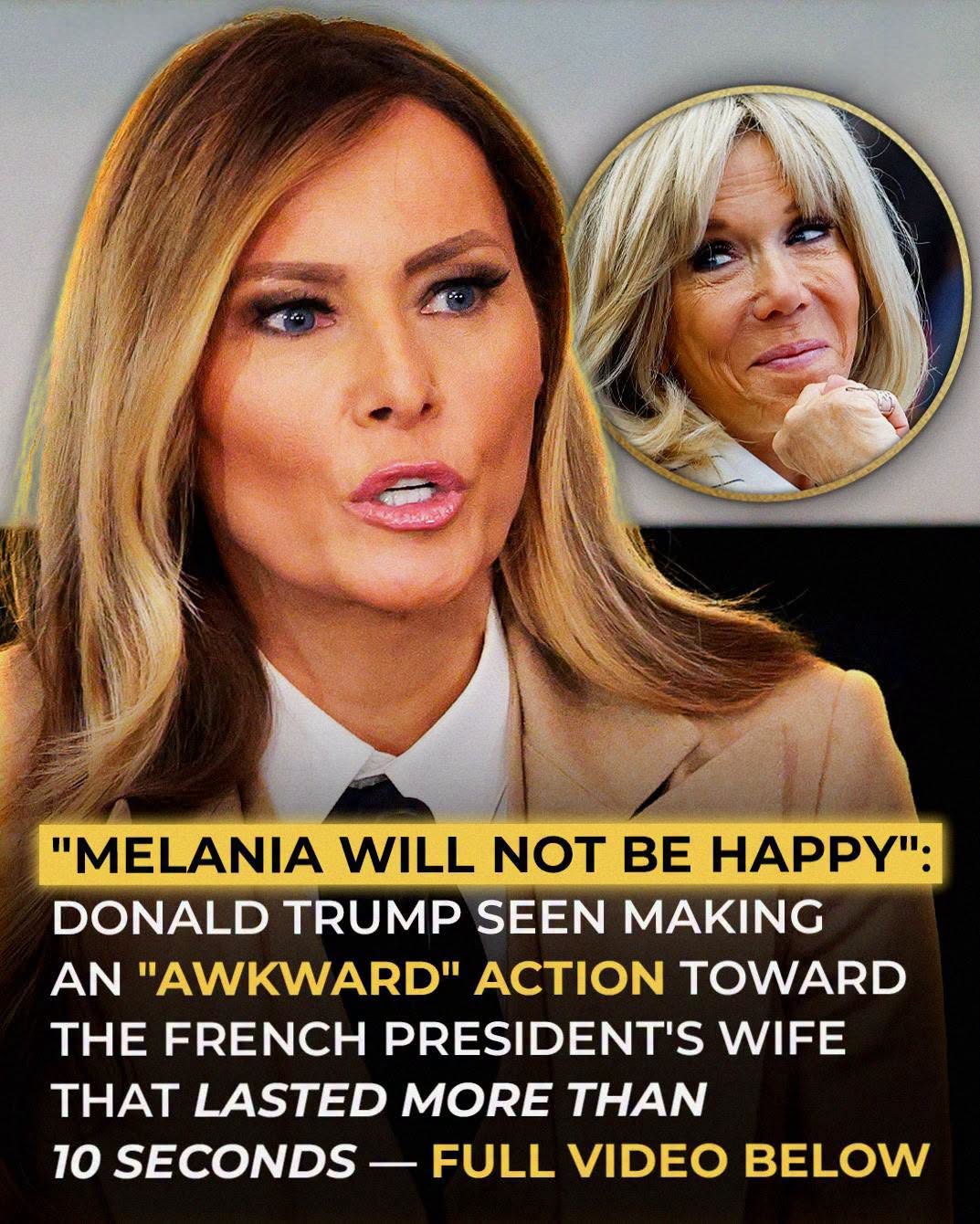
What was supposed to be an ordinary diplomatic greeting at the G7 summit quickly became one of the most talked-about moments of the event. A brief exchange between Donald Trump and French First Lady Brigitte Macron unexpectedly turned into an awkward interaction that lasted far longer than anyone anticipated, fueling endless speculation online. What should have been a routine welcome transformed into a fourteen-second moment that body-language experts, political commentators, and social media users immediately began dissecting. The footage sparked questions about whether the interaction carried any deeper meaning or whether it was simply an uncomfortable misunderstanding amplified by cameras and public attention.
The encounter began as many high-level diplomatic greetings do. French President Emmanuel Macron and First Lady Brigitte Macron stood ready to welcome the American president ahead of an important summit dinner. The initial exchange followed standard European protocol, including the customary cheek kisses that often accompany formal greetings among political figures. However, attention quickly shifted when the greeting transitioned into a handshake between Trump and Brigitte Macron.
Rather than ending after a few seconds as expected, the handshake continued for approximately fourteen seconds. Viewers immediately noticed the unusual length of the interaction. Many online observers focused on Brigitte Macron’s body language, suggesting that she appeared eager to move on while Trump continued holding her hand. Whether intentional or not, the extended handshake became the defining visual moment of the evening and rapidly spread across social media platforms.
Within minutes of the footage circulating, reactions flooded the internet. Some viewers interpreted the gesture as a calculated display of dominance, describing it as another example of Trump’s often-discussed approach to handshakes and personal interactions. Others believed the moment simply reflected an awkward social exchange that lasted longer than either participant intended. Because the interaction occurred against a backdrop of ongoing political tensions and previous public disagreements, many people viewed the footage through the lens of broader diplomatic relationships between the United States and France.
The discussion intensified further when professional lip reader Nicola Hickling analyzed the video. According to her interpretation, Trump allegedly turned to Emmanuel Macron and said, “I’m ready for tonight.” Hickling also suggested that Trump greeted Brigitte Macron with the phrase, “Hello, sweetheart.” The most widely discussed claim involved Brigitte’s supposed response of “Happy birthday.” Because lip-reading analysis is inherently interpretive and cannot be considered definitive proof of what was said, the claims generated significant debate rather than clear answers. Nevertheless, the possibility of such an informal exchange between world leaders immediately captured public attention.
Many commentators argued that if the interpretation were accurate, the use of an affectionate term such as “sweetheart” during a formal international event could be viewed as unusual. Others countered that cultural differences, personal familiarity, and the informal nature of some diplomatic interactions make it difficult to draw firm conclusions from a brief exchange captured on video. The uncertainty surrounding the conversation only increased public fascination with the incident.
Adding another layer to the discussion was the visible role of Emmanuel Macron throughout the interaction. Body-language specialist Judi James observed that the French president appeared somewhat sidelined during the greeting. According to her analysis, Trump directed much of his attention toward Brigitte Macron, creating a dynamic that left Emmanuel Macron momentarily outside the center of the exchange. James noted that the French president seemed eager to remain actively involved, occasionally touching Trump’s arm and maintaining a diplomatic smile throughout the interaction.
Several observers also pointed out that as the group moved toward the event venue, Trump appeared to continue holding Brigitte Macron’s hand briefly while walking forward. This unusual visual prompted additional speculation about the balance of attention between the participants. In the highly scrutinized environment of international diplomacy, even the smallest gestures can become the subject of extensive interpretation.
The handshake was not the only moment involving Brigitte Macron that attracted attention during the summit. In another widely circulated clip, she appeared to briefly lose her footing while positioning herself for a group photograph. Trump immediately reached out and steadied her, helping her regain balance. While many viewed the gesture as a simple act of courtesy, others examined it through the same intensely analytical lens that had already been applied to the handshake.
These reactions highlight a broader reality of modern politics: public figures operate under constant observation, and even ordinary interactions can quickly become major news stories. In an era of instant video sharing and social media commentary, moments that once would have passed unnoticed are now replayed, analyzed, and debated by millions of people around the world.
The political atmosphere surrounding the summit further intensified interest in the encounter. Reports from earlier discussions suggested that relations between various world leaders were occasionally strained. Only a short time before the handshake incident, attention had already focused on comments and private conversations involving several key leaders. Against this backdrop, observers were particularly sensitive to signs of tension, disagreement, or unusual behavior.
As a result, every gesture captured on camera seemed loaded with significance. A smile became evidence of hidden diplomacy. A pause became proof of discomfort. A handshake became a symbolic contest for influence. Whether these interpretations accurately reflected reality is impossible to know, but they demonstrate how modern political theater often extends far beyond official speeches and policy announcements.
The fascination with Trump’s interactions did not end at the G7 summit. During subsequent international meetings, including high-profile encounters with Chinese President Xi Jinping, analysts continued examining every handshake, facial expression, and movement. One particularly discussed meeting involved efforts to improve relations between the United States and China. During that encounter, body-language experts noted a noticeably serious demeanor from both leaders as they exchanged greetings and engaged in discussions.
Dr. Lillian Glass, a well-known body-language analyst, observed that Trump appeared unusually focused and deliberate during portions of the interaction. She pointed to subtle facial expressions, posture, and eye contact as indicators of the seriousness of the diplomatic discussions taking place behind the scenes. As with the G7 handshake, however, interpretations varied widely depending on the observer.
Ultimately, the G7 greeting between Donald Trump and Brigitte Macron demonstrates how even the most routine diplomatic moments can evolve into global talking points. Whether the handshake represented awkwardness, friendliness, strategic positioning, or simply a misunderstood interaction remains a matter of personal interpretation. What is undeniable is the power of modern media to transform a few seconds of footage into an international conversation.
In today’s political environment, cameras capture everything, and audiences search every frame for meaning. A handshake that might once have been forgotten by the next news cycle instead became the subject of endless analysis, speculation, and debate. The incident serves as a reminder that in the world of global politics, sometimes the moments that attract the most attention are not policy decisions or formal speeches, but the small human interactions that occur when leaders believe no one is paying attention.