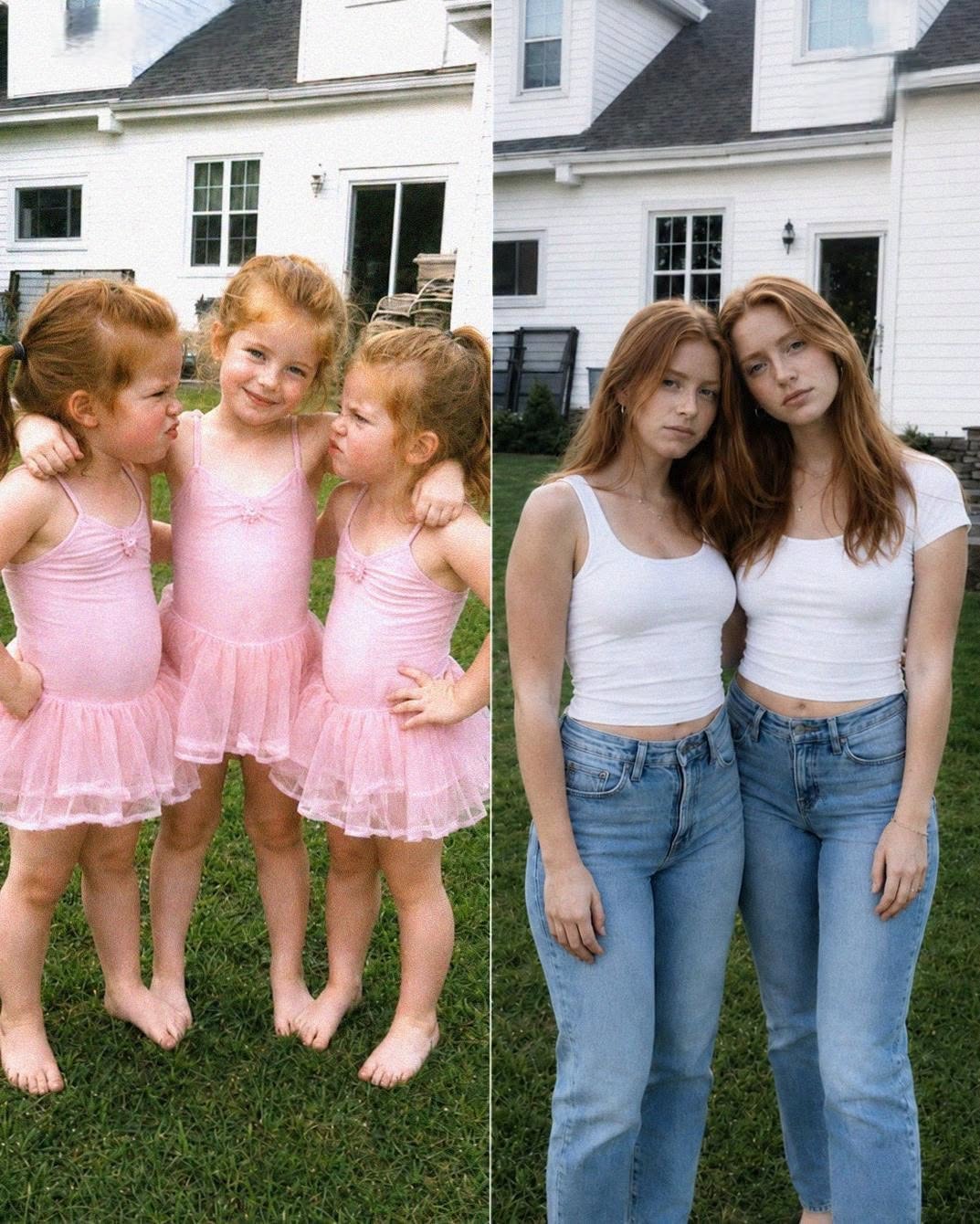
For the first time in ten years, Leila reached for my hand before I reached for hers.
It was such a small thing.
A simple movement.
Yet it felt larger than every birthday, every holiday, every strained conversation we had stumbled through since Nora died.
Our fingers locked together as Nora’s voice faded into static.
Nobody spoke.
Not Mom.
Not Dad.
Not Leila.
Not me.
The room sat suspended between past and present, grief and relief, silence and understanding.
Then our mother broke.
A sob escaped her chest so suddenly it seemed to surprise even her.
She covered her face with both hands.
“I’m sorry,” she whispered.
The words hung in the air.
“I’m so sorry.”
Leila looked at her first.
“For what?”
Mom lowered her hands slowly.
“For letting all of us disappear.”
Tears streamed down her face.
“After Nora died, I thought surviving was enough. I thought if we just kept moving, eventually the pain would get smaller.”
She shook her head.
“But it didn’t.”
No one argued.
Because we all knew she was right.
We had become experts at surviving.
Terrible at living.
Dad stared at the cassette player.
His eyes never left it.
“I couldn’t listen to her voice,” he admitted quietly.
The confession startled me.
Dad rarely admitted anything.
Not fear.
Not sadness.
Not weakness.
“I found that tape years ago,” he continued. “Your mother wanted to save it for your twenty-first birthday, but I couldn’t even touch it. Every time I tried, it felt like losing her all over again.”
His voice cracked.
The sound made him seem suddenly older.
Not just older in years.
Older in sorrow.
Leila squeezed my hand harder.
Then she stood.
Without saying a word, she walked to the empty chair.
Nora’s chair.
The chair we had spent years pretending wasn’t important.
The chair no one ever used.
The chair nobody dared move.
Leila placed the paper crown carefully on the seat.
Then she stepped back.
The room watched.
For a moment, it looked ridiculous.
A faded paper crown resting on an empty chair.
Then it didn’t.
It looked exactly right.
A place reserved not for absence.
But for belonging.
“She would have loved this,” Leila said softly.
I laughed through my tears.
“She would have hated how much we’re crying.”
That earned a real laugh.
The first real laugh I could remember hearing inside that house in years.
Mom smiled.
Dad smiled.
Even Leila smiled.
And somehow, the room felt lighter.
Not healed.
Not fixed.
But lighter.
Later that evening, after the cake was gone and the sun had begun to disappear behind the trees, Leila and I sat on the back porch together.
The old friendship bracelet Nora had left me rested around my wrist.
Leila turned her letter over and over in her hands.
“You know,” she said finally, “I always thought you stopped talking because you were stronger than me.”
I looked at her.
“What?”
“You never cried.”
I stared out at the yard.
“Yes, I did.”
“Not where anyone could see.”
The truth of it landed quietly.
For years, we had misunderstood each other.
I thought Leila was angry.
She thought I was strong.
Neither of us had been right.
We had both just been hurting.
“I missed you,” she said.
Three words.
Ten years late.
Exactly when they needed to arrive.
I swallowed hard.
“I missed you too.”
The porch light flickered on above us.
Somewhere inside the house, Mom was washing dishes.
Dad was humming softly to himself.
Ordinary sounds.
Beautiful sounds.
Living sounds.
Leila leaned her head against my shoulder.
And for the first time since Nora left us, the future did not feel like something to endure.
It felt like something we might actually share.
The empty chair would always remain.
There would always be birthdays with one person missing.
Photographs with a gap no one could fill.
Questions that would never be answered.
But Nora’s final gift had changed something important.
She had shown us that love does not end when a life does.
It simply changes shape.
And sometimes, years later, it finds its way back home.
That night, before I went to sleep, I looked at the friendship bracelet wrapped around my wrist.
Then I whispered into the darkness:
“Happy birthday, Nora.”
For the first time in a decade, the silence that followed did not feel empty.
It felt like an answer.