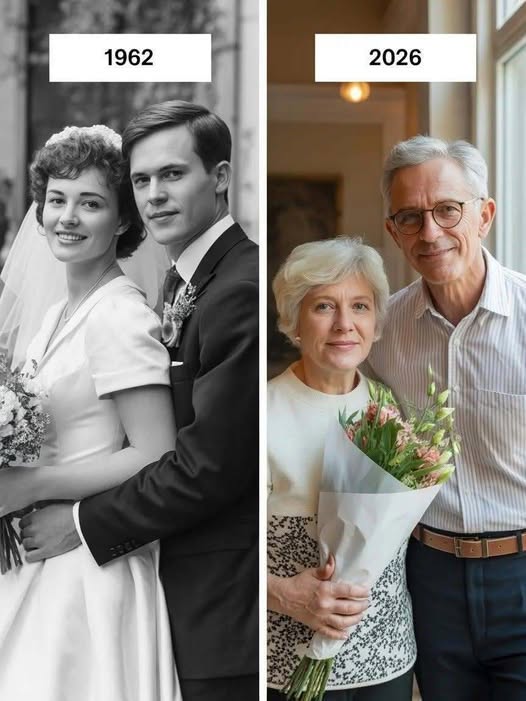
Love didn’t die when his heart stopped—it simply transformed into something I never expected. For sixty-three consecutive Valentine’s Days, Robert had never forgotten me. Through busy years, difficult years, joyful years, and heartbreaking ones, he always found a way to remind me that I was loved. So when February arrived for the first time without him, I believed the silence would finally win. I expected loneliness. I expected grief. I expected a day spent staring at old photographs and wondering how to survive another year without the man who had been beside me for most of my life.
Instead, early that morning, a stranger appeared at my door carrying a dozen red roses.
My hands trembled as I accepted them. Attached was a small envelope containing a brass key and an address written in Robert’s unmistakable handwriting. No explanation. No instructions. Just a simple note:
“Trust me one last time.”
The words sent a chill through me.
For hours, I sat at the kitchen table staring at the key. My imagination became my enemy. Had Robert hidden something from me all these years? Was there another woman? Another family? A secret life I knew nothing about? Grief has a cruel way of turning love into suspicion. The longer I looked at that address, the more terrifying the possibilities became.
By afternoon, curiosity finally defeated fear.
I called a cab.
The entire ride felt unbearable. Twice I nearly asked the driver to turn around. Every block brought me closer to answers I wasn’t sure I wanted. My heart pounded against my ribs as we crossed unfamiliar streets and entered an older part of the city I barely recognized.
When the cab stopped in front of a narrow brick building, I almost stayed inside.
Instead, I stepped out.
The address led to the third floor. My fingers shook as I inserted the key into a weathered wooden door. For a moment I simply stood there, unable to breathe. Then I turned the lock and pushed the door open.
The room beyond was silent.
Sunlight spilled through tall windows, illuminating rows of sheet music, shelves filled with journals, and a beautiful grand piano sitting at the center of the room.
I froze.
Nothing about it made sense.
Robert had never mentioned this place.
Not once.
Slowly, I walked forward. Dust floated through the beams of light. Everything had been carefully maintained, as though someone had been preparing for my arrival.
Then I noticed a journal resting on the piano bench.
I opened it.
The first page was dated thirty-eight years earlier.
The handwriting was Robert’s.
As I turned the pages, tears blurred my vision. Entry after entry described secret visits to the room. He wrote about learning music theory late at night. He described taking piano lessons from retired teachers. He documented every mistake, every breakthrough, every song he practiced.
But what stunned me most wasn’t the music.
It was who the music was for.
Every page was about me.
He wrote about the young woman he had fallen in love with decades ago—the ambitious girl who dreamed of becoming a concert pianist before life intervened. The girl who gave up scholarships, performances, and opportunities because family responsibilities demanded something different.
The girl I had forgotten.
Robert never forgot her.
In his journals, he described watching me close the piano lid one final time after our second child was born. He wrote about seeing the sadness I tried to hide whenever classical music played on the radio. He remembered conversations I barely recalled having.
“I miss hearing her play,” one entry read.
Another said:
“She thinks the dream is gone. I wish she could see what I still see.”
By the time I reached the final notebook, I was openly crying.
For years, while I believed he was simply working late or running errands, he had been coming here. Not to escape me.
To preserve something for me.
The final journal contained a handwritten composition.
His composition.
A piece he had spent years writing.
The notes weren’t perfect. Some passages were crossed out repeatedly. Entire sections had been rewritten dozens of times. Yet every page radiated devotion.
It wasn’t the work of a professional composer.
It was the work of a husband hopelessly in love.
Tucked beside the manuscript was another letter.
My hands trembled as I unfolded it.
“My darling,” it began.
“If you’re reading this, then I’m gone. There are so many things I wish I could still say to you. But most of all, I need you to remember something you’ve forgotten. Before you were my wife, before you were a mother, before you carried everyone else’s dreams on your shoulders, you were a musician.”
I had to stop reading for a moment.
The tears wouldn’t let me continue.
Eventually, I wiped my eyes and finished.
“This room was never my secret. It was always yours. I borrowed it so I could protect a dream you abandoned too soon. If I leave before you do, promise me one thing: sit at that piano and play again. Not for me. For yourself.”
The room felt impossibly still.
I sat down at the piano bench.
The keys were cool beneath my fingertips.
For several minutes, I couldn’t move.
Then, slowly, I played a single note.
Its sound echoed through the room like a voice returning from the past.
Another note followed.
Then another.
Before I realized it, melodies I hadn’t touched in decades began finding their way back to me. The music felt unfamiliar and familiar at the same time, like meeting an old friend after many years apart.
For the first time since Robert’s death, I wasn’t consumed by loss.
I felt alive.
Weeks later, I returned to the room and began working through the composition he had left behind. It wasn’t easy. Some sections were incomplete. Others needed interpretation. But little by little, I finished what he had started.
The day I played the final note, I looked around the room and finally understood.
This place wasn’t a monument to secrets.
It wasn’t evidence of betrayal.
It wasn’t proof of another life.
It was proof of extraordinary love.
Robert hadn’t spent decades hiding from me.
He had spent decades believing in me when I had stopped believing in myself.
The room became a bridge connecting every version of who I had been—the hopeful young pianist, the exhausted mother, the devoted wife, and the grieving widow learning how to live again.
People often ask me what Robert’s final Valentine’s gift was.
They assume it was the roses.
Or the key.
Or the song.
They’re wrong.
His greatest gift was something far more precious.
He gave me permission to reclaim the part of myself I thought was lost forever.
He reminded me that dreams do not always die when we abandon them.
Sometimes they wait patiently in quiet rooms, hidden behind locked doors, until someone who loves us enough helps us find our way back.
And every time I sit at that piano now, I realize that Robert was right.
Love didn’t end when his heart stopped.
It simply changed shape—and became the music that still fills the room long after he’s gone.