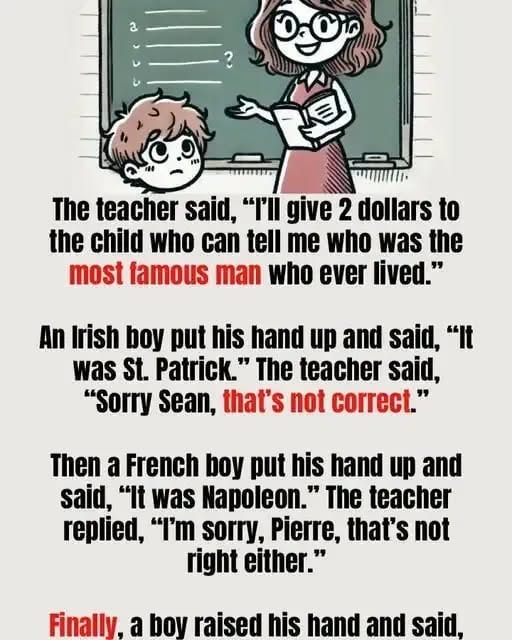
Humor often reveals truths that people would rather ignore. What appears to be a simple joke about a young boy choosing a two-dollar bill over a religious symbol actually touches on a much larger reality about human behavior. When faced with a choice between an immediate reward and a distant principle, many people instinctively reach for what they can hold in their hands.
This idea extends far beyond childhood stories. Throughout life, people regularly find themselves balancing values against opportunities. The decision may not always involve money directly, but it often comes down to personal gain versus personal conviction. The joke resonates because it reflects a tendency most of us recognize in ourselves.
Consider the story of a man who dreams of marrying a wealthy heiress. When she rejects him, his disappointment centers less on the loss of love and more on the fortune he imagined becoming his. In that moment, emotions become secondary to financial ambition. The relationship is no longer viewed through the lens of affection, but through the lens of missed opportunity.
Another example can be found in the tale of a man offered a supposedly magical desk capable of bringing success. Rather than questioning whether the magic is real, he focuses on whether the price is justified. His reaction illustrates a mindset that has become increasingly common: even wonder and possibility are evaluated according to their practical return.
These stories remain memorable because they expose a truth about modern life. Many people pursue careers for status rather than fulfillment. Others maintain relationships that no longer bring happiness because the social or financial cost of leaving feels too high. Over time, these small compromises accumulate, shaping lives in ways that often go unnoticed.
Yet the purpose of these stories is not to condemn human nature. Instead, they encourage reflection. They invite us to consider what truly matters and whether there are principles we refuse to exchange for comfort, money, or approval. In a world where nearly everything seems to have a price, integrity may be one of the few things that retains its value only when it remains untouched.
Ultimately, the question is not how much something is worth, but what we are willing to give up to obtain it. When the rewards fade and the excitement disappears, we are left with our choices. Those choices, more than any possession or achievement, become the measure of who we are.