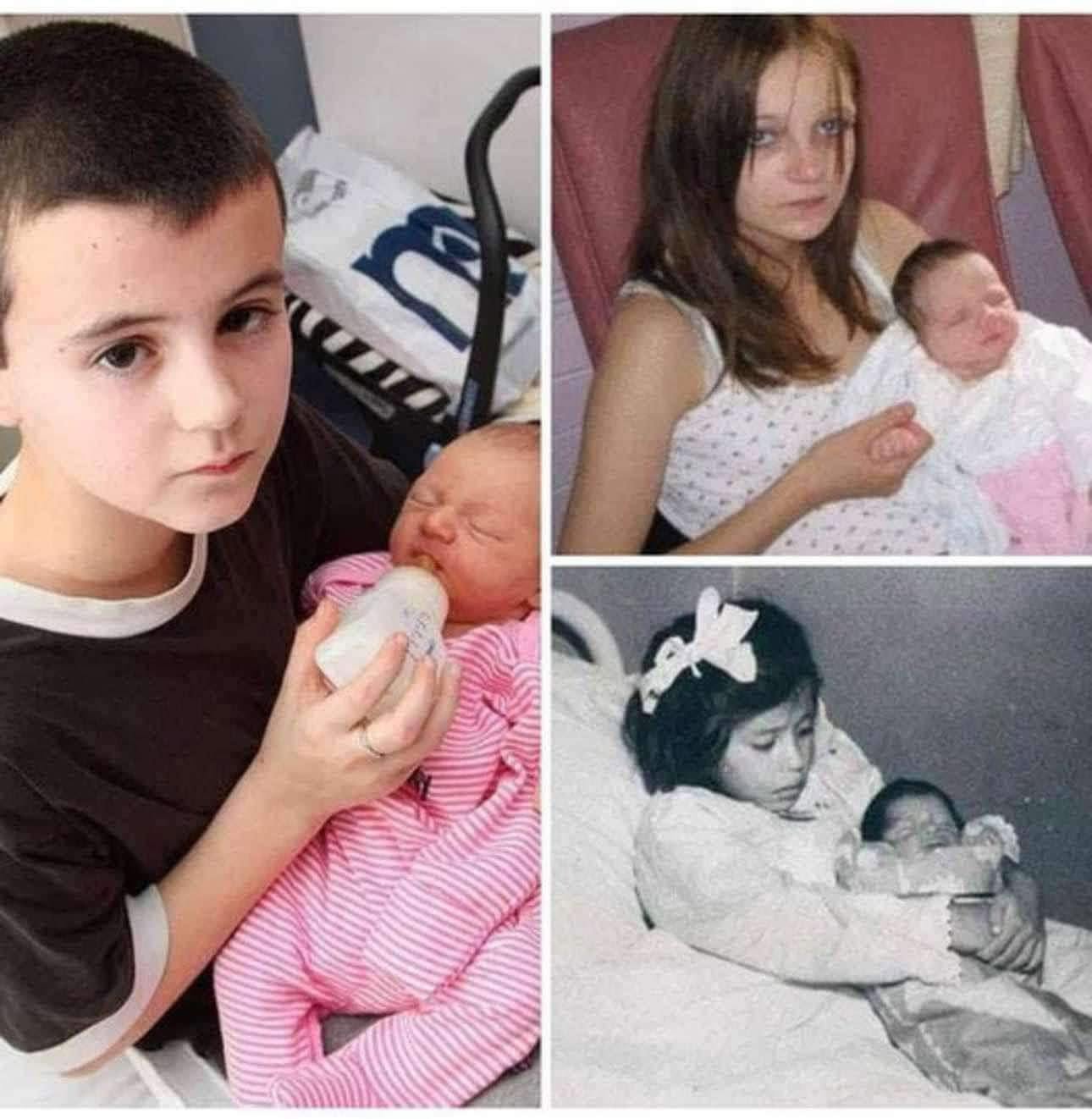
But perhaps the most remarkable transformation belongs not to April, but to Jamie himself.
The tiny baby who spent his first days fighting for survival in a hospital intensive care unit is no longer the fragile infant whose condition once dominated national headlines.
Jamie is now a teenager.
Tall.
Confident.
And, according to those closest to him, surprisingly grounded considering the extraordinary circumstances of his birth.
For most of his childhood, Jamie knew his story was different.
It was impossible not to.
Every few years, an old newspaper article would resurface online.
Classmates would discover videos.
Strangers would recognize his mother’s name.
Questions inevitably followed.
“Is it true your parents were thirteen and fourteen?”
“Are you really the baby from the news?”
At first, Jamie hated it.
He hated being treated like a curiosity.
He hated feeling as though people were more interested in the circumstances of his birth than the person he was becoming.
One afternoon, when he was about twelve, he finally asked his mother a question she had been dreading for years.
“Do you regret having me?”
April later admitted that the question broke her heart.
She sat quietly for several seconds before answering.
“Never.”
Not once.
Not for a single day.
“I regret how difficult things were.”
“I regret how scared we all were.”
“I regret mistakes I made.”
“But I have never regretted you.”
Jamie stared at her for a long time.
Then nodded.
The subject never came up again.
Because he already knew the answer.
Despite the hardships, April had spent her entire adult life proving it.
As the years passed, she worked tirelessly to build stability.
She completed her education.
Found steady work.
Created a home filled with structure, warmth, and love.
Her younger children grew up in a completely different environment than the one she experienced as a frightened teenager.
And yet she never hid her past from them.
The story remained part of the family history.
Not as a source of shame.
But as a reminder.
A reminder of how quickly life can change.
A reminder that mistakes do not have to define a person’s future.
Meanwhile, Nathan’s path unfolded differently.
After years of little contact, he slowly re-established a relationship with Jamie as the boy grew older.
It wasn’t easy.
Lost time never returns.
Missed birthdays remain missed birthdays.
Missed years remain missed years.
But both father and son eventually chose something more difficult than resentment.
They chose effort.
The relationship developed slowly.
Awkward phone calls became conversations.
Conversations became visits.
Visits became memories.
No fairy-tale reunion.
No dramatic reconciliation.
Just two people trying to build something from what remained.
And sometimes that is enough.
Today, when people revisit the story of Britain’s youngest parents, they often focus on the sensational headlines.
The ages.
The controversy.
The media attention.
The criticism.
But those who lived through it understand something the headlines never captured.
The real story was never about being the youngest.
It was about surviving what came afterward.
It was about a thirteen-year-old girl becoming a mother while the entire country watched.
It was about a fourteen-year-old boy trying to understand responsibility before he was old enough to understand himself.
It was about families who stepped in when two children needed help raising another child.
And ultimately, it was about proving that one difficult beginning does not determine an entire life.
Looking at photographs today, it is hard to reconcile them with the frightened faces that once appeared on front pages.
April Lianna smiles beside her partner and children.
Jamie stands taller than his mother.
The chaos that once defined their lives has been replaced by something far quieter.
Something far less newsworthy.
And far more meaningful.
Normal life.
The very thing that seemed impossible back in 2010.
The very thing everyone doubted they would ever achieve.
And perhaps that is the final lesson hidden inside their extraordinary story.
The world may remember the headline.
But the people who lived it remember the years that came after.
The ordinary mornings.
The school runs.
The family dinners.
The second chances.
Because in the end, the most remarkable part of their story was not how it began.
It was that they kept going.