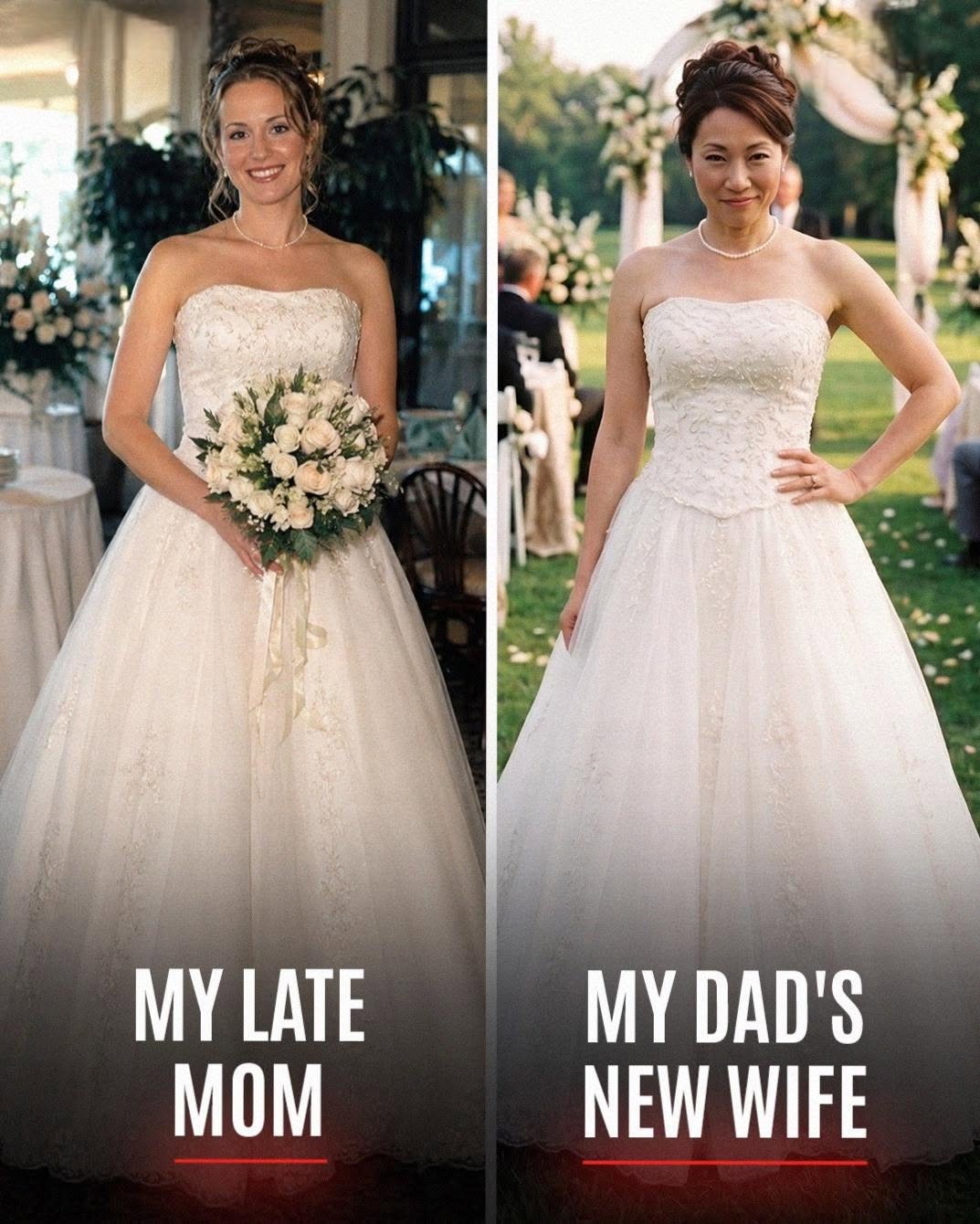
For ten long years, my mother’s wedding dress had been more than a piece of fabric to me. It was the last physical reminder of the woman who raised me, loved me, and left behind a legacy I refused to let fade away. Every stitch carried memories, every fold held a piece of her story. That dress was meant to remain untouched until the day I chose to wear it myself. But everything changed when my father’s fiancée decided she was entitled to it. What she viewed as a beautiful vintage gown, I saw as something sacred. The moment she put it on and mocked my feelings, she started a chain of events she never saw coming.
When I arrived at my father’s house for the rehearsal dinner, I immediately felt uncomfortable. The home no longer felt familiar. Over the previous months, Susan had slowly removed nearly every trace of my mother from the place where our family history had been built. The curtains my mother chose were gone. The dishes she loved had disappeared. Even small decorative items she had treasured had been replaced with expensive modern alternatives. Susan insisted she was “updating” the house, but it felt more like she was erasing someone. For my father’s sake, I had remained quiet. I convinced myself it wasn’t worth the fight. Looking back, that silence only encouraged her.
The real shock came later that evening.
As guests gathered around the dining room, Susan entered with a smile that seemed almost triumphant. The room fell silent for a moment, and I instantly understood why. She was wearing my mother’s wedding dress.
My mother’s dress.
The very gown I had carefully preserved in a protective box for years.
For a second, I couldn’t breathe.
The delicate lace, the ivory silk, the design I had memorized since childhood—it was all there. Yet now it was draped over a woman who had spent months trying to erase my mother’s memory.
My father stood beside her smiling proudly, completely unaware of the damage being done.
When I finally found my voice and demanded an explanation, Susan didn’t apologize. She didn’t even pretend to understand why I was upset.
Instead, she laughed.
With a smug expression, she told me the dress looked far better on her than it ever had on my mother. Then she casually dismissed my mother as someone from the past who no longer mattered.
The cruelty of her words stunned everyone nearby.
My father tried to calm the situation, accusing me of overreacting and making unnecessary drama before the wedding.
That was the moment something inside me changed.
I stopped arguing.
I stopped defending myself.
I simply left.
The cool evening air felt sharper than usual as I walked to my car. By the time I reached the driver’s seat, I had already made a decision.
I called Lena.
Lena had been my mother’s closest friend for decades. She was intelligent, resourceful, and fiercely loyal. If anyone understood what that dress meant, it was her.
After listening to everything, she remained silent for several seconds.
Then she said four words:
“Let’s fix this properly.”
Over the next three days, we developed a plan.
Not a tantrum.
Not revenge fueled by emotion.
A carefully organized response.
While Susan enjoyed a luxury bridal spa weekend, completely unaware of what was happening behind the scenes, I quietly entered the house.
Lena had spent nearly forty-eight hours creating a remarkable replica of the dress. To most people, the copy was indistinguishable from the original. Every detail had been reproduced with astonishing accuracy.
Before making the swap, I carefully removed several unique lace sections from the authentic gown—details only I would recognize.
Then I exchanged the dresses.
Susan never noticed.
She believed she still possessed the original.
That was exactly what we wanted.
But replacing the gown was only part of the plan.
While organizing family belongings in the basement months earlier, I had discovered an old hard drive containing videos, letters, and recordings from my mother’s final years. She had left messages intended for me, reflections on life, love, and family.
For hours, I reviewed every file.
Some made me laugh.
Some made me cry.
Eventually, I created a presentation that would be impossible to ignore.
It wasn’t designed to embarrass Susan.
It was designed to remind everyone who my mother truly was.
The wedding day arrived wrapped in perfection.
The flowers were flawless.
The decorations looked expensive.
Guests filled the venue dressed in their finest clothes.
Susan floated through the room believing she had won.
Then I entered.
The reaction was immediate.
Conversations stopped.
People stared.
Gasps echoed through the ballroom.
I was wearing the real wedding dress.
The authentic gown.
The dress my mother had worn.
The dress Susan thought belonged to her.
The look on Susan’s face was unforgettable.
Shock.
Confusion.
Then panic.
She looked from her dress to mine and immediately realized something was wrong.
Before she could recover, I walked calmly toward the DJ station.
My hands were steady.
My heart was racing.
I pressed play.
The giant screen illuminated the room.
A video appeared.
And then my mother’s face filled the screen.
Young.
Beautiful.
Alive.
The room became silent.
Her voice echoed throughout the ballroom.
“If my daughter ever wants this dress,” she said softly, smiling into the camera, “I want her to have it. It belongs to her. It always will.”
Several guests began crying immediately.
Others stared at the screen in disbelief.
My father looked completely frozen.
More videos followed.
Family memories.
Holiday gatherings.
Messages she had recorded for the future.
Words filled with kindness, warmth, and love.
The contrast between my mother’s grace and Susan’s behavior became impossible to ignore.
Susan tried to interrupt.
She accused me of ruining the wedding.
She claimed I was jealous.
She called me unstable.
But nobody was listening anymore.
The room’s attention remained fixed on the screen.
For the first time, my father wasn’t looking at Susan.
He was looking at my mother.
He was remembering the woman who had built a life with him, the woman whose memory had slowly disappeared beneath years of convenience and avoidance.
The realization hit him hard.
You could see it in his face.
Not anger.
Not embarrassment.
Regret.
Deep, overwhelming regret.
In that moment, the wedding stopped being about Susan.
It became about truth.
And the truth was something no replica, no performance, and no replacement could ever erase.