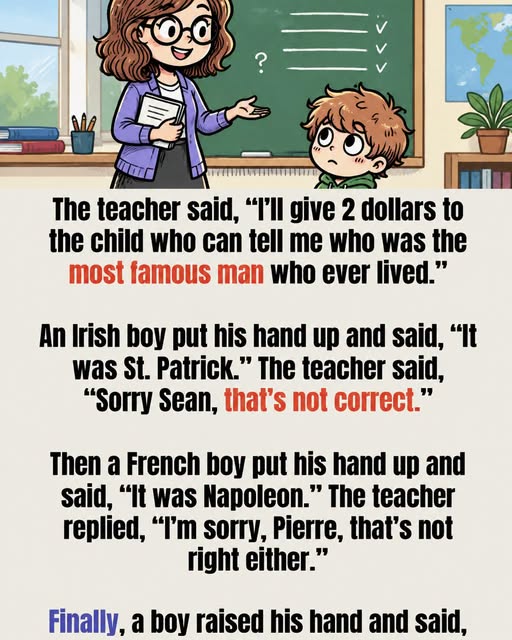
A boy chose two dollars over a sacred symbol, and suddenly the joke stopped feeling harmless.
At first, it sounds like nothing more than a silly little decision. A child sees something he wants, someone offers him a choice, and he chooses the immediate reward.
Two dollars.
A small amount.
Almost nothing compared with the symbolic object placed in front of him.
But then you stop laughing for a second.
Because beneath that tiny decision is a question most adults would rather avoid:
How much would it take to make our deepest convictions negotiable?
We like to imagine that certain things in our lives are beyond price.
Faith.
Love.
Loyalty.
Dignity.
Principles.
Family.
But what happens when someone places something tangible in front of us and asks us to choose?
The three stories in these parables approach that question through humor, but the laughter gradually becomes uncomfortable.
The first story centers on a child.
He is offered a choice between something connected to religious symbolism and two dollars.
The amount is small enough to make the decision seem almost ridiculous.
Yet that is exactly what makes it interesting.
The child does not appear to be thinking about sacred meaning, tradition, or long-term consequences.
He sees something immediate.
Something he can have right now.
And he chooses it.
For an adult watching, the decision can feel funny because children often reveal priorities without the layers of explanation adults use to justify their choices.
But perhaps the child is also showing us something adults recognize in themselves.
We often say one thing matters most to us.
Then circumstances change.
An opportunity appears.
A financial incentive arrives.
A convenient shortcut becomes available.
Suddenly, the thing we claimed was non-negotiable becomes negotiable.
The second story moves from childhood innocence to adult disappointment.
An impoverished suitor is rejected by an heiress, and at first the situation appears to be about love.
A romantic rejection should hurt because a relationship has been lost.
But the punchline reveals something more complicated.
The man is grieving not only the woman he imagined himself marrying.
He is grieving the fortune he imagined coming with her.
That changes the entire meaning of his sadness.
Was he heartbroken because he lost the person?
Or because he lost the life he thought her money would provide?
The distinction is uncomfortable because financial security can influence relationships in ways people do not always admit.
People may tell themselves that love is the only consideration, while quietly calculating what a relationship will mean for their future.
Money can affect attraction.
Status can affect decisions.
Security can influence whom people choose to stay with—or leave.
Again, the joke works because it exposes something we would rather keep hidden.
Then comes Stanley and the five-thousand-dollar “magic desk.”
The premise sounds absurd.
A desk supposedly has extraordinary qualities, and Stanley has to decide whether its promised benefits are worth the price.
The humor comes from the idea of treating something fantastical as though it were a normal purchase.
But underneath the absurdity is another familiar calculation.
What is something worth?
What are we willing to pay for convenience?
What are we willing to sacrifice for an advantage?
And how easily can we convince ourselves that a questionable bargain is actually a good deal?
The three stories are different, but they keep circling the same uncomfortable idea.
Money can become a measuring stick for things we claim cannot be measured.
The child chooses money over symbolism.
The suitor mourns lost wealth alongside lost romance.
Stanley weighs an extraordinary promise against an extraordinary price.
Each story asks us to look at the gap between what people say they value and what they actually choose when something concrete is placed in front of them.
That gap can be revealing.
It does not automatically mean someone is immoral.
Practical decisions are part of life.
Money matters.
Financial security matters.
A better salary can change a family’s future.
A useful connection can open a door that would otherwise remain closed.
A cheaper option can sometimes be the sensible option.
There is nothing inherently wrong with considering material consequences.
The problem begins when we stop asking what those choices are costing us.
A higher salary may look wonderful on paper.
But what if the job destroys your health, relationships, or sense of identity?
A powerful connection may create an opportunity.
But what if maintaining that relationship requires you to constantly compromise your values?
A comfortable lifestyle may seem worth pursuing.
But what if the price is becoming someone you no longer recognize?
These are not questions about whether money is good or bad.
They are questions about boundaries.
Everyone has a point at which a practical compromise becomes something more.
The difficult part is knowing where that point is before you cross it.
Most compromises do not begin dramatically.
They begin with something small.
Just this once.
Just until things improve.
Just because the opportunity is too good to refuse.
Just because everyone else is doing it.
And then another compromise becomes easier.
Then another.
Eventually, something that once seemed impossible becomes ordinary.
That is why these jokes are more interesting than they first appear.
They turn ordinary bargains into exaggerated little morality plays.
The child receives a tiny reward.
The suitor imagines a fortune.
Stanley considers an absurd purchase.
The situations are funny because they are extreme.
But the emotional mechanism underneath them is familiar.
We all make calculations.
We all decide what something is worth.
Sometimes we calculate with money.
Sometimes with time.
Sometimes with comfort.
Sometimes with attention.
And sometimes, without realizing it, we calculate with parts of ourselves.
The deeper question is not whether we should ever compromise.
We have to.
Life requires flexibility.
People change.
Circumstances change.
Priorities change.
The question is which things should remain protected even when the offer is tempting.
What would you refuse, regardless of the price?
What would you never trade for convenience?
What part of your identity should not become another item on a negotiation table?
Those questions become especially important because the rewards of compromise are usually immediate, while the costs may arrive much later.
The money appears now.
The promotion arrives now.
The relationship provides security now.
The opportunity looks exciting now.
But the consequences may take years to become visible.
A person can wake up much later and realize that the bargain they accepted was far more expensive than they understood.
That is the quiet warning hidden inside these jokes.
Not every profitable decision is a good decision.
Not every sacrifice is noble.
Not every opportunity deserves to be taken.
And not everything that can be purchased should be treated as something for sale.
The child choosing two dollars is funny because the stakes appear so small.
But perhaps that’s what makes the story useful.
If we cannot recognize the pattern in a tiny joke, we may miss it when the stakes become much larger.
A few dollars can become a career.
A career can become a lifestyle.
A lifestyle can become an identity.
And an identity can become difficult to recover once it has been traded away piece by piece.
The same thing can happen in relationships.
A person may overlook one troubling behavior because the relationship offers security.
Then another.
Then another.
Eventually, the benefits that once seemed worth the compromises may disappear, while the damage remains.
That is why repeated compromises deserve attention.
Not because every compromise is wrong, but because repetition can slowly redefine what we are willing to accept.
And perhaps that is the real punchline.
The stories make us laugh at people who put a price on things that should be priceless.
Then, if we are honest, they make us wonder whether we do the same thing.
Maybe not with a sacred symbol.
Maybe not with an heiress.
Maybe not with a magical desk.
But perhaps with our time.
Our peace.
Our relationships.
Our principles.
Our dignity.
The challenge is recognizing the bargain before we agree to it.
Because some opportunities disappear when you say no.
Some money is never earned.
Some doors remain closed.
But there are also things that, once traded away, are much harder to get back.
So the next time something looks like an irresistible deal, perhaps the most important question isn’t simply, “What do I get?”
It is:
“What am I giving up?”
Because some things are valuable precisely because they should never have a price.