The fear hits before the facts do.
The word alone can make your stomach drop, your mind race, and your instincts immediately say, “Not me.”
For many people, the thought of a colonoscopy brings images of embarrassment, discomfort, awkward conversations, and worst-case scenarios. Some imagine the procedure itself being unbearable. Others simply do not want to think about what the doctor might find.
So they postpone it.
They tell themselves they will do it next year.
Then next year becomes another year.
But what if the test you are avoiding is actually one of the things standing between you and a silent, growing danger that you cannot feel, cannot see, and may not notice until it has become much harder to treat?
That is the part many people forget.
Colon cancer and precancerous polyps do not always announce themselves with obvious warning signs. A person can feel perfectly normal while changes are developing inside the body.
There may be no dramatic pain.
No obvious alarm.
No moment when the body tells you, “Something is wrong.”
That is why screening exists.
We often imagine a colonoscopy as a punishment, when in reality, its purpose is protection. While you are worrying about embarrassment or discomfort, your medical team is thinking about something much more important: finding potential problems before they become serious.
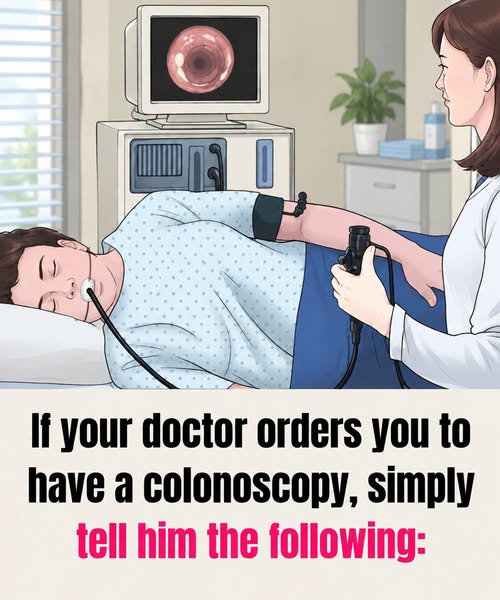
A colonoscopy allows doctors to examine the inside of the colon and look for abnormalities such as polyps or signs of cancer.
And there is something especially powerful about this test.
It may not only find a problem.
It can sometimes help prevent one from becoming a future cancer.
When certain polyps are discovered during the examination, they can often be removed during the same procedure. That means a potential future problem can sometimes be dealt with before it has the opportunity to develop further.
Instead of discovering cancer later, doctors may be able to remove a precancerous growth earlier.
That changes the entire meaning of the procedure.
It is no longer simply a test where you wait to hear bad news.
It can be an opportunity to stop a problem before it becomes one.
For many people, the preparation is actually the part they dislike most. The examination itself is often performed with sedation, and many patients sleep through much of the procedure.
They arrive nervous.
They imagine the worst.
And then, before they know it, they are awake again.
The procedure is over.
What seemed terrifying beforehand can turn out to be far less dramatic than the mind had predicted.
Of course, preparation is not always pleasant. It can require following specific instructions and clearing the colon so doctors can properly see what is happening inside.
That part can feel inconvenient.
But inconvenience and danger are not the same thing.
A difficult day of preparation is temporary.
The potential consequences of ignoring a serious health problem can last much longer.
Fear, however, has a way of making temporary discomfort feel bigger than it really is.
People imagine the embarrassment.
They imagine the worst possible result.
They imagine losing control of the situation.
And sometimes, those thoughts become powerful enough that they avoid making the appointment at all.
But avoiding the test does not make the risk disappear.
If a hidden polyp is present, it continues to exist whether you know about it or not.
And if something concerning is developing, waiting does not necessarily make the situation safer.
That is why understanding the purpose of screening can change the way you think about it.
You are not doing it because you enjoy medical procedures.
You are doing it because your future health matters.
You are giving doctors a chance to find something before it becomes more dangerous.
You are giving yourself information.
And information can give you choices.
Instead of discovering a serious problem only after symptoms appear, screening can sometimes identify changes while they are still manageable.
That is an enormous difference.
The exact timing of screening is not identical for everyone. Age, personal history, family history, previous test results, and other risk factors can influence when and how often someone should be screened.
That is why it is important to discuss your individual situation with a healthcare professional rather than assuming that one schedule applies to everyone.
Ask questions.
What does the preparation involve?
What will happen during the procedure?
What kind of sedation is used?
Why is the test recommended for you?
What happens if a polyp is found?
Knowing the answers can make the experience feel much less mysterious.
And when something feels less mysterious, it often feels less frightening.
The hardest part may not be the procedure at all.
It may be making the decision to stop avoiding it.
It may be picking up the phone.
It may be admitting that fear has been controlling the decision.
But courage does not mean having no fear.
Sometimes courage means being afraid and making the appointment anyway.
It means choosing a few uncomfortable hours over years of uncertainty.
It means recognizing that your health deserves more attention than your embarrassment.
Think about all the things people willingly tolerate to protect their future.
They exercise when they do not feel like exercising.
They change their diets.
They take medications.
They go to dental appointments.
They wear seat belts.
They lock their doors.
They do these things because prevention is usually easier than dealing with the consequences later.
Screening works on the same principle.
You cannot always prevent every disease.
But you can sometimes give yourself a better chance by finding problems early.
That is why the way we talk about colonoscopy matters.
Calling it a punishment makes people want to avoid it.
Seeing it as protection changes the emotional equation.
It becomes an act of self-care.
A temporary inconvenience with a potentially enormous long-term benefit.
So if fear has been keeping you from asking about screening, start with a conversation.
You do not have to know everything.
You do not have to pretend you are comfortable.
Tell your doctor what scares you.
Ask what you can expect.
Understand why the test is being recommended.
And make the decision based on facts rather than the frightening picture your imagination has created.
Because the truth is simple.
The procedure may be uncomfortable.
The preparation may be inconvenient.
The conversation may feel awkward.
But a hidden health problem can be far more serious.
In the end, a colonoscopy is not really about one uncomfortable day.
It is about protecting the years that come after it.
It is about giving yourself the chance to find trouble early, remove certain risks when possible, and walk away knowing you did something important for your future.
Fear tells you to avoid the test.
Prevention tells you to understand it.
And sometimes, the most uncomfortable appointment you make today can help protect decades of the life you still want to live.