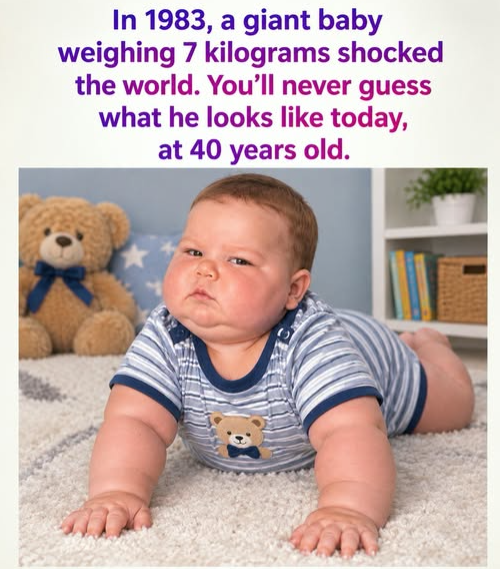
He was born into a spotlight he never asked for. At seven kilograms, Kevin became a spectacle before he could speak, while his parents struggled to protect the child behind the headlines. Before he could understand what made him different, strangers had already decided that his size was the most interesting thing about him. His birth became a story people wanted to tell, a number people wanted to repeat, and a curiosity that seemed larger than the tiny person at the center of it all. But behind the attention was simply a baby who needed to be held, comforted, protected, and loved.
Kevin’s unusual birth weight made him a curiosity, but his parents understood what the attention overlooked: their son deserved more than a lifetime measured against a headline. They knew that the world might remember a number, but numbers could never describe a person. As he grew older, they tried to give him something far more important than protection from every stare—they gave him the confidence to understand that his worth had never been determined by his appearance.
Growing up meant navigating intrusive questions, whispered observations, and the inevitable moments when people stared a little too long. Sometimes curiosity was innocent, but that did not always make it comfortable. Kevin learned early that entering a room could make people notice him before they knew anything about him. His height and size often became the first thing people saw, and sometimes the first thing they wanted to talk about.
For a child, that kind of attention can be difficult to understand. Being different can make ordinary moments feel strangely public. A trip somewhere, a conversation with a stranger, or simply walking through a crowded place could bring another round of looks and questions. Kevin had to learn how to live with attention that he had never asked for and could not simply switch off.
Yet over time, he found ways to meet that discomfort without allowing it to dictate his character. Humor became one of his tools. Instead of allowing every awkward moment to become painful, he could sometimes make a joke, smile, or laugh and move the conversation forward. It was not about pretending the attention never bothered him. It was about refusing to let other people’s curiosity control how he experienced his own life.
Kindness became just as important. Kevin discovered that once people moved beyond the first impression, there was an opportunity for something much more meaningful. A person who initially saw only his height could eventually see his personality, his sense of humor, his patience, and the way he treated others. The more people got to know him, the less important the physical difference became.
That gradual shift—from being observed to being known—became one of the most meaningful parts of his life. There is a profound difference between someone looking at you and someone actually seeing you. Kevin spent years experiencing the first, but the life he built increasingly became about the second.
Now 40 and standing over two meters tall, Kevin has built a life whose importance lies in its everyday details. His story is no longer defined by the extraordinary circumstances surrounding his birth. It is defined by the ordinary things that make a life meaningful: relationships, laughter, companionship, responsibilities, routines, and the people who know him for who he is rather than what he looks like.
He is a partner. He is a friend. He is a dog owner. He has people in his life who know his personality rather than simply knowing his measurements. His world is filled with the kinds of ordinary moments that rarely become headlines but often matter far more than anything that does.
There is something especially powerful about that contrast. The world once wanted to make Kevin extraordinary because of the size of the baby he had been. But as an adult, what matters most to him is not being extraordinary. It is being ordinary in the best possible way. It is having the freedom to wake up, spend time with the people he loves, care for his dog, laugh with friends, and live without feeling that every room has to become a stage.
His beginnings remain part of his history, and he cannot erase the fact that his birth attracted extraordinary attention. But history is not destiny. The headline that once introduced him to the world does not have to remain the headline that defines him.
Perhaps that is the most important lesson in Kevin’s story. People are often reduced to the most unusual thing about them. A number becomes an identity. A physical characteristic becomes a personality. A remarkable moment becomes an entire biography. But no person can be fully understood that way.
Kevin’s life demonstrates what happens when someone refuses to remain trapped inside the first impression other people created for him. His size may always be noticeable, but it does not have to be the center of his existence. His relationships, experiences, choices, humor, kindness, and memories carry far more meaning than a measurement ever could.
The baby who once attracted attention simply because of how much he weighed eventually grew into a man who learned that the most valuable kind of recognition is not being noticed by strangers. It is being understood by the people who truly know you.
And today, the life Kevin values is not another spectacle. It is something quieter and much more meaningful. It is the freedom to be known without explanation, loved without conditions, and remembered for the person he became—not simply for the extraordinary size of the baby he once was.