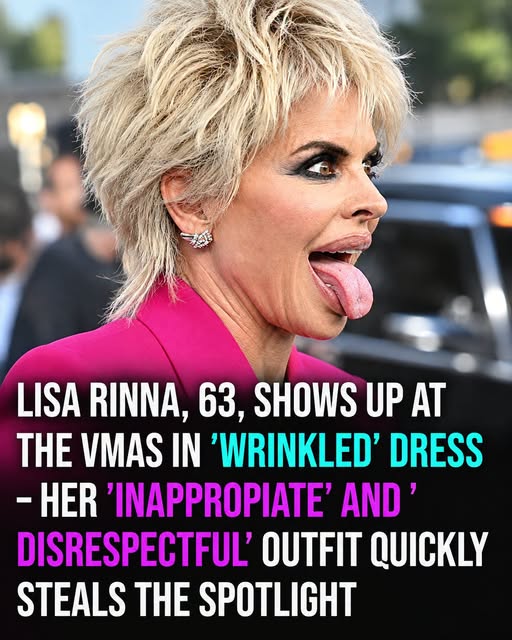
Lisa Rinna stepped onto the VMAs carpet and straight into a firestorm. At 63, with spiky platinum hair and a sculpted white gown featuring faux nipples, she became a lightning rod for admiration, outrage, and accusations of disrespect. What might have been a straightforward fashion appearance quickly turned into a much larger conversation about celebrity culture, personal expression, and the expectations placed on women as they grow older. Social media amplified every reaction, turning a single red-carpet look into a debate that reached far beyond the outfit itself.
The attention was immediate. Rinna’s sharply styled platinum hair gave the appearance a deliberately rebellious edge, while the sculpted white gown ensured that cameras had plenty to focus on. The faux-nipple detailing was clearly designed to provoke a reaction, and it succeeded. Some viewers saw the look as fearless and playful, while others considered it unnecessarily provocative. Within minutes, the conversation moved from fashion into questions about taste, intention, and whether there are still boundaries surrounding what celebrities should wear at major public events.
Rinna’s appearance turned a fashion moment into an argument about visibility. Her sharply styled hair and deliberately provocative dress drew sharply divided responses: supporters celebrated the confidence, individuality, and willingness to ignore conventional expectations, while detractors found the presentation inappropriate or distracting. The disagreement was not simply about whether the dress looked good. It became a discussion about who gets to command attention and whether a celebrity has a responsibility to consider how their appearance affects the larger event.
Claims that she had diverted attention from Madonna added another layer to the backlash. Some observers interpreted Rinna’s highly noticeable appearance as an attempt to compete for attention during an event where another major figure was already expected to be the center of interest. Others argued that red-carpet appearances are inherently about visibility and that celebrities cannot realistically control every reaction to what they wear. Yet that accusation was an interpretation, not proof of intent. A conspicuous outfit alone cannot establish that its wearer meant to diminish somebody else’s moment.
That distinction matters because celebrity appearances are often judged not only by what is visible but by what audiences imagine the person intended. A dramatic outfit can be described as attention-seeking, empowering, disrespectful, playful, or simply fashionable depending on the person interpreting it. The same image can produce completely opposite reactions from different viewers. Without direct evidence of what Rinna intended, conclusions about motive remain assumptions rather than established facts.
The deeper tension was about expectations. When an older woman chooses spectacle over subtlety, criticism of her clothes can quickly become a judgment about how she should behave. Society has long imposed different expectations on women as they age, often encouraging them to become less visible, less provocative, and less experimental. When someone refuses that script, the reaction can reveal as much about the audience as it does about the celebrity standing on the carpet.
That does not make every objection ageist, nor does confidence place fashion beyond criticism. People are allowed to dislike an outfit. They can find it excessive, distracting, strange, or simply unattractive. Fashion is subjective, and celebrities who choose deliberately provocative looks should expect strong reactions. But the distinction matters. Criticizing the design itself is different from suggesting that a woman is somehow too old to dress boldly or command attention.
Rinna’s look was divisive, and there is no requirement that everyone agree about it. Some people saw confidence where others saw excess. Some saw humor and theatricality, while others saw unnecessary provocation. Those competing interpretations are part of what makes celebrity fashion such a powerful cultural conversation. Clothes on a red carpet are rarely just clothes; they can become statements about identity, confidence, age, sexuality, and the right to be seen.
The controversy also highlights how quickly social media can transform a fleeting moment into a lasting debate. A celebrity can spend only a few minutes walking a carpet, but photographs of that appearance can circulate for days. Every angle becomes a post. Every expression becomes a reaction. Supporters and critics can turn a fashion choice into evidence for much larger arguments about culture and personal values.
At the center of all of this is a relatively simple question: who gets to decide when a woman should become less visible? Rinna’s appearance challenged the expectation that growing older should automatically mean becoming more restrained. Whether someone likes her dress or dislikes it is ultimately a matter of personal taste. But the larger discussion becomes more complicated when criticism shifts from the clothing to assumptions about what a woman of a certain age should or should not be allowed to wear.
In the end, the VMAs carpet did exactly what a major celebrity event often does: it created an image that people could not stop discussing. Rinna’s appearance became a spectacle, a controversy, and a cultural argument all at once. Her look may not have been universally admired, but it certainly succeeded in generating attention and conversation.
And perhaps that is why the reaction became bigger than the dress itself. Beneath the debate over whether she stole Madonna’s spotlight was a sharper question about women, aging, confidence, and visibility. Rinna’s look was divisive, but the conversation surrounding it revealed how easily personal taste can become a demand that women retreat from view once they reach a certain age. The disagreement may continue, but the underlying question remains: should getting older mean becoming quieter, or should women remain free to decide for themselves how boldly they want to be seen?