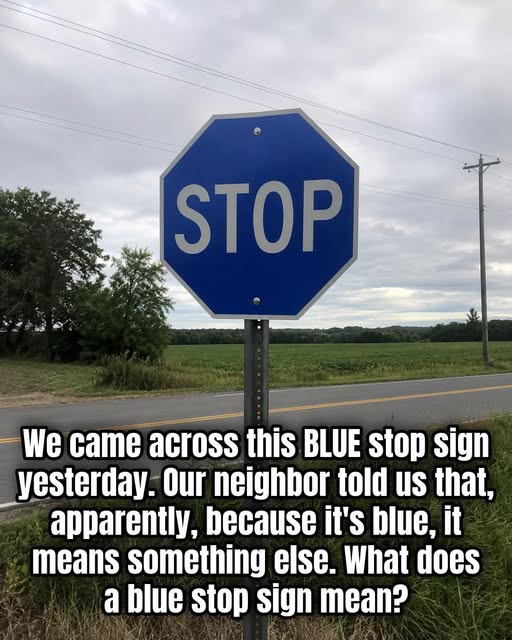
A blue stop sign can feel like a glitch in reality. Your brain immediately screams “wrong,” yet your eyes insist that the unusual sign is actually there, standing beside the road and commanding you to hit the brakes. The familiar red octagon has been part of driving for so long that most people recognize it almost automatically. So when that same unmistakable shape suddenly appears in blue, it can create a strange moment of uncertainty. Is it legal? Is it a prank? Is it a private sign? Or is there some unusual reason for the color? The truth behind these signs is more complicated than the image first suggests.
That jolt of confusion is exactly what makes a blue stop sign so fascinating. Drivers are trained from childhood to associate the red octagon and white lettering with the command to stop. The shape and color work together to create an immediate visual message, often before the driver has consciously read the word itself. Federal MUTCD standards in the United States specify red as the color associated with STOP and prohibition, and the standard STOP sign is a red octagon with white lettering.
A blue version therefore stands out immediately because it does not match the familiar federal standard. That does not necessarily mean that the sign was placed randomly or that there is no reason for it to exist. Unusual signs can appear in places where private property owners, communities, campuses, parking facilities, or other controlled environments use their own signage. The exact legal significance can depend on the location and the rules governing that property, so a blue sign should not automatically be assumed to have the same legal status as a standard public-road STOP sign.
The important point is that drivers should not treat the unusual color as permission to ignore the instruction. If you encounter a blue octagonal sign at a location where vehicles are expected to stop, the safest response is to slow down and determine what the sign is controlling. Look carefully for traffic, pedestrians, cyclists, gates, or other vehicles before proceeding. Even if the sign is not a standard MUTCD STOP sign, the intersection or crossing point may still present a genuine safety risk.
There is also a reason these unusual signs can create such strong reactions online. A photograph of a blue stop sign can look almost impossible at first glance because people immediately recognize the shape while simultaneously noticing that the color is wrong. That contradiction makes the image feel like an optical trick. Some viewers assume the photograph must have been edited, while others begin searching for an unusual traffic rule that explains it. In reality, the explanation may simply involve where the sign was installed and who controls the roadway or property.
It is also important not to confuse the color of a sign with its authority in every situation. Traffic-control rules can depend on jurisdiction, road ownership, and whether a roadway is public or private. The MUTCD establishes national standards for traffic control devices used in the United States, but the precise legal consequences of a nonstandard sign can involve state and local law as well as the circumstances of the roadway.
So if a blue stop sign ever catches you by surprise, don’t let the unusual appearance distract you from the road itself. Treat the situation cautiously, slow down, check the intersection carefully, and look for any additional signs or markings that explain the instruction. The safest habit is to respond to the potential conflict point rather than assuming that an unfamiliar color makes the situation irrelevant.
What makes the blue stop sign so memorable is the clash between familiarity and something that feels completely wrong. The red octagon is so deeply embedded in our driving habits that changing its color can make a perfectly ordinary roadway look suddenly unfamiliar. But the mystery becomes easier to understand once you remember that standard traffic-control signs follow specific design conventions, while unusual signs can appear in different private or specialized settings.
In the end, the safest lesson is simple: when something on the road looks unusual, don’t let curiosity override caution. A blue stop sign may not match the standard federal design, but the safest reaction is still to slow down, assess the situation, and make sure you understand what is happening before continuing. Sometimes the strangest-looking sign on the road is also the one that reminds you to pay the closest attention.