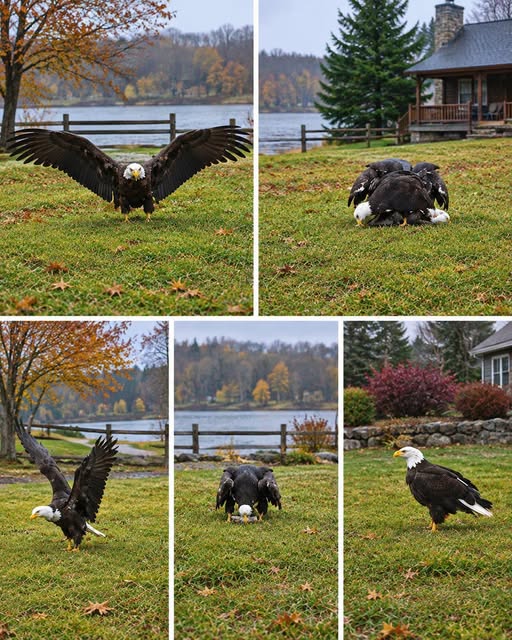
Your quiet backyard can become unrecognizable in a heartbeat. An eagle standing on the lawn, with its powerful talons, broad wings, and towering silhouette, can turn an ordinary morning into a moment of disbelief. For someone who has never seen one this close, the bird may appear almost too large to be real, especially when it stands beside familiar objects such as fences, patio furniture, or garden decorations. But before you rush outside to get a closer look—or let the family dog investigate—there is something important to understand about this unexpected visitor. One decision in those first few moments can determine whether the encounter remains peaceful or becomes dangerous for both the bird and your pets.
A bald eagle on suburban grass can look almost unreal, particularly when the surrounding environment makes its size easier to appreciate. The bird’s presence may immediately lead people to wonder why it has appeared in a residential yard. In many cases, however, the explanation can be much simpler than the rumors that sometimes spread when wildlife appears unexpectedly. Nearby rivers, lakes, ponds, open fields, or other hunting areas can bring eagles close to neighborhoods. An eagle may also be attracted by an available food source, including a meal it has found rather than actively hunted.
Female bald eagles are generally larger than males, and the bird’s appearance can become even more impressive when its feathers are fluffed out while it is resting. From a distance, a large eagle standing completely still can seem almost intimidating, but its presence does not necessarily mean that it is targeting the people or pets nearby. As eagle populations have recovered in many areas, sightings in places close to human development have become less surprising. Residential communities can exist surprisingly close to waterways, forests, fields, and other habitats that provide wildlife with food and shelter.
That overlap between human neighborhoods and natural habitat is often the reason unusual encounters occur. A backyard that feels completely ordinary to a homeowner may sit only a short distance from an eagle’s normal hunting or resting territory. The bird may simply be taking advantage of a temporary opportunity before continuing on its way. Seeing one on the ground does not automatically mean that something is wrong. In many cases, the best thing people can do is resist the temptation to interfere and allow the animal to decide when it is ready to leave.
The safest response is quiet restraint. Bring cats and small dogs indoors immediately, especially if the eagle is still nearby. Larger dogs should also be kept under control rather than being allowed to run toward the bird. Even when an eagle appears calm, approaching it can cause unnecessary stress and may provoke defensive behavior. The safest viewing position is from inside the home or from a considerable distance. Binoculars can provide an excellent view without forcing the bird to retreat or making it feel surrounded.
People should also avoid trying to feed the eagle. Offering food may encourage wildlife to associate residential areas with an easy food source and can create problems during future visits. It is also important not to attempt to touch, capture, chase, or relocate the bird simply because its presence seems unusual. Wild animals can react unpredictably when they feel threatened, and an attempt to help can sometimes create more danger than leaving the animal alone.
There is one important exception: if the eagle appears genuinely injured, unusually weak, trapped, or unable to fly, it may need professional assistance. Signs such as an obvious injury, prolonged inability to stand or fly, or behavior that suggests serious distress can justify contacting a licensed wildlife rehabilitator or the appropriate local wildlife agency. People should avoid attempting a rescue themselves, because handling a large wild raptor requires experience and appropriate equipment.
Otherwise, the best approach is remarkably simple: give the eagle space and let it leave naturally. Keep pets indoors, observe quietly, and resist the urge to turn a peaceful wildlife encounter into a confrontation. What may initially seem like a shocking invasion of a suburban backyard can actually be a brief reminder that wild animals continue to share the landscape with us. When given enough room and respect, the encounter can remain exactly what it should be—a rare, extraordinary moment that ends as quietly as it began.