It started with a phone call from my son’s school — the kind of call that should have meant something small and forgettable.
Maybe a fever.
A scraped knee.
A forgotten lunch sitting on the kitchen counter.
Nothing serious.
Nothing life-changing.
Certainly nothing capable of tearing an ordinary afternoon apart so completely that afterward, nothing about my family would ever feel the same again.
But by the time I reached the school parking lot, I already knew something was wrong.
There was a police car parked outside the entrance.
An ambulance sat nearby with its lights flashing silently, not rushing anywhere, which somehow made it feel even worse. Teachers stood near the front office speaking in low voices while parents walking past slowed down instinctively, sensing tension they didn’t fully understand.
And inside that tension, one name kept surfacing:
My mother-in-law’s.
Diane.
Hearing adults say her name in careful, nervous tones immediately made my stomach tighten.
That was the first moment I felt it — the realization that something terrible had already happened, and I had arrived too late to stop it.
I remember walking through the hallway feeling strangely disconnected from my own body, like the air itself had become heavier around me. Children’s artwork still covered the walls. Tiny backpacks still hung from hooks. Somewhere far away, I could hear kids laughing in another classroom.
But near the principal’s office, everything felt wrong.
The principal stepped out to meet me before I even reached the door.
Her expression wasn’t simply concerned.
It was shaken.
“Your son is safe,” she said immediately, almost urgently, like she needed to give me that fact before anything else.
My heart dropped anyway.
“What happened?”
She hesitated.
That hesitation terrified me more than any answer possibly could.
“There was something found in his lunchbox,” she said carefully. “And we contacted the police.”
My mind stopped processing normally after that.
Lunchbox.
Police.
My son.
Those words did not belong together.
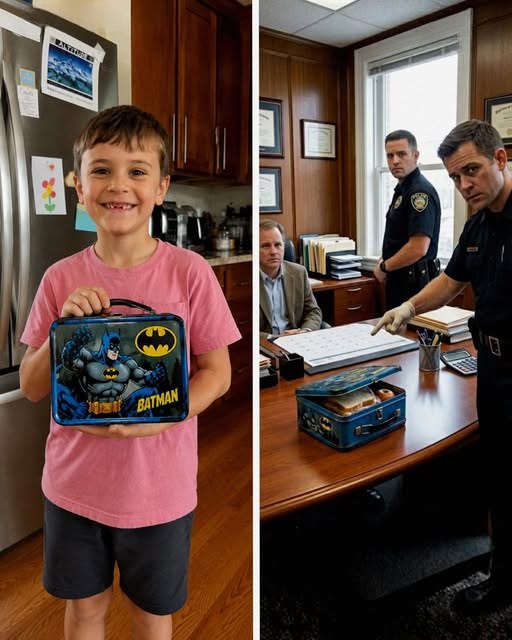
I barely remember entering the office, but suddenly I was standing inside staring at Elijah’s old Batman lunchbox sitting open on the principal’s desk.
Half unpacked.
That detail disturbed me more than I can explain.
Half unpacked meant interruption.
Something ordinary suddenly becoming dangerous.
Inside the lunchbox were all the normal things first.
A sandwich wrapped neatly in plastic.
Apple slices.
A juice box.
The familiar little routines of motherhood laid out under fluorescent office lights.
Then I saw the envelope.
Plain white.
Slightly wrinkled.
Placed carefully beside a thick stack of cash.
Too much cash.
Far too much.
My knees weakened instantly.
The police officer standing beside the desk looked at me gently.
“Do you recognize the handwriting?”
I didn’t want to look.
But I already knew before I even answered.
“My mother-in-law,” I whispered. “Diane.”
The officer unfolded the letter slowly.
Then he began reading aloud.
At first, the words didn’t fully register because my brain refused to believe they belonged to my life.
Please don’t call me. He monitors everything. He has my keys. He tracks my phone. I placed this so it would fall out when your son opened the lunchbox. The teacher would notice. I had no other way. This is everything I have left. Please help me get away.
For a few seconds, the room became distant and unreal.
Like I was hearing someone else’s nightmare instead of my own.
Then the officer quietly said:
“This was inside your son’s lunchbox when he opened it this morning.”
And suddenly the situation became horrifyingly real.
“She packed his lunch,” I whispered.
“Yes.”
The principal nodded carefully.
“She brought him to school herself today.”
That was when the memories from the previous night suddenly rearranged themselves inside my head.
Diane had come over unexpectedly.
She stayed longer than usual.
Talked less than usual.
Kept glancing toward the windows.
And when I accidentally reached past her for a dish towel, she flinched so violently that I actually stopped moving.
At the time, I convinced myself it meant nothing.
Now I realized it meant everything.
The officer asked quietly, “Do you know where she might be now?”
Someone answered before I could.
“She was found near County General Hospital. Severe panic response. She specifically requested you.”
Twenty minutes later, I was walking into a hospital room that felt painfully bright.
And there she was.
Diane.
But not the Diane I knew.
Not the sharp-tongued, intimidating woman who usually controlled every room she entered.
This version of her looked smaller somehow.
Exposed.
There were bruises along her wrist.
A faint mark near her jaw.
Her hands kept shaking nervously in her lap.
The second she saw me, her face collapsed emotionally.
“I didn’t know who else to trust,” she whispered.
I couldn’t even sit down yet.
“What is happening?”
Then she said his name.
“Ray.”
At first, the story sounded ordinary enough.
Loneliness.
Late-life companionship.
A man who seemed kind in the beginning.
But slowly the truth underneath began surfacing piece by piece.
“He started small,” she explained quietly. “Asking where I went. Watching what I spent. Telling me I forgot conversations that I knew happened differently.”
Then her voice tightened.
“He’d move things around the house. Hide them. Then accuse me of losing them.”
A cold feeling spread through my chest.
“Then he took my keys,” she whispered. “So I couldn’t leave when I was upset.”
Her eyes filled with tears.
“My phone after that. My bank cards. Passwords. Everything.”
I stared at her in disbelief.
“And I let him,” she admitted quickly. “Because fighting him became harder than surrendering.”
That sentence changed something inside me.
For years, I saw Diane as difficult.
Critical.
Sharp.
But suddenly I saw something else entirely.
A woman who had been slowly disappearing inside fear.
Then she said the sentence that still haunts me:
“The first time he hit me, he cried afterward. And I believed him.”
The room went silent.
Finally I asked the question that had been building inside me since the beginning.
“Why didn’t you tell us?”
She laughed softly, bitterly.
“Because Ben would’ve gone after him immediately,” she said. “Ray would’ve denied everything. And then things would’ve gotten worse. I was trying to survive quietly.”
Then she looked directly at me.
“You think differently when you’re afraid every day.”
That sentence stayed with me longer than almost anything else.
Because fear had been living inside her for months, maybe years, and none of us recognized it clearly enough to stop it.
Then came the part that broke me emotionally.
“I didn’t want Elijah involved,” she whispered. “I swear I didn’t. I just needed someone to notice quickly.”
My anger and sympathy collided so hard inside me I couldn’t separate them.
“You used my son.”
“I know.”
And for the first time since I’d known Diane, she didn’t defend herself.
Didn’t argue.
Didn’t justify.
She simply admitted it.
A police officer entered shortly afterward explaining that they were issuing an emergency protective order. Ray’s access to her would be restricted immediately.
Then he asked the obvious question.
“Where will she stay after discharge?”
Neither of us answered right away.
Finally I heard myself speak.
“She comes home with me.”
Diane looked stunned.
“But this stops here,” I added firmly. “My son is never part of this again.”
She nodded immediately.
When I called my husband Ben, his voice changed the second I mentioned his mother and the hospital.
“I’m coming now.”
“You are not going after Ray,” I warned him immediately.
A long silence followed.
Then quietly:
“Okay.”
That night, after bringing Diane home, I locked every door in the house.
Not casually.
Carefully.
Like safety had become something physical instead of emotional.
When Elijah came home later, he ran directly into Diane’s arms without hesitation.
Children don’t analyze situations the way adults do.
He didn’t see scandal or danger.
He saw his grandmother.
And when he hugged her tightly, Diane completely broke down crying.
Later that night, while we sat alone in the kitchen, she finally admitted something unexpected.
“I think I was jealous of you.”
I stared at her in confusion.
“What?”
“Of how naturally he loves you,” she whispered. “Of how easily you belong in this family.”
Then came another truth.
“I spent years criticizing you because if you were doing motherhood wrong… maybe I still mattered.”
For the first time, I understood that much of her cruelty had never truly been about me.
It came from fear.
Loneliness.
Irrelevance.
Then suddenly the front door slammed violently.
A hard knock followed.
Then another.
Every instinct in my body went cold instantly.
I already knew who it was before I looked.
Ray.
Standing outside.
Shouting Diane’s name.
Switching between rage and desperate pleading so quickly it made my skin crawl.
Diane froze completely.
I grabbed my phone and called 911 while stepping instinctively between her and the hallway.
“He found us,” she whispered.
But something inside me sharpened instead of collapsing.
“No,” I said quietly. “He followed what he thought you’d do.”
Outside, his voice grew louder.
Inside, I looked directly at Diane.
“You are not going back.”
Something shifted in her face then.
Not healing.
Decision.
As police sirens approached outside, Diane suddenly stepped toward the door and shouted through tears:
“Stay away from my family!”
That was the moment everything changed.
The police arrived quickly.
The arrest happened quickly.
But emotionally, it felt like years collapsing at once.
Ben arrived shortly afterward.
The second he saw his mother sitting there bruised and shaking, all his anger disappeared.
He dropped to his knees in front of her.
“Mom,” he whispered.
That single word carried everything else none of us knew how to say yet.
The months afterward weren’t easy.
There were court hearings.
Therapy sessions.
Protective orders.
Long conversations that felt emotionally exhausting.
Diane stayed with us much longer than expected.
Not fully healed.
Not magically transformed.
Just learning slowly how to exist without fear controlling every movement.
And gradually, awkwardly, something between us changed too.
Not instantly.
Not perfectly.
But honestly.
One evening I walked into the kitchen and found Diane helping Elijah pack his lunch for school.
He grinned proudly and announced:
“Grandma promised no more secret money in my lunchbox.”
Diane froze in horror.
“Please never repeat that outside this house.”
Elijah burst out laughing.
Then I laughed too.
And finally, after everything, Diane laughed with us.
Not nervously.
Not like survival.
Like peace had finally entered the room quietly after chaos left.
We were still damaged.
Still rebuilding.
Still carrying scars.
But for the first time in a very long time…
We actually felt like a family again.