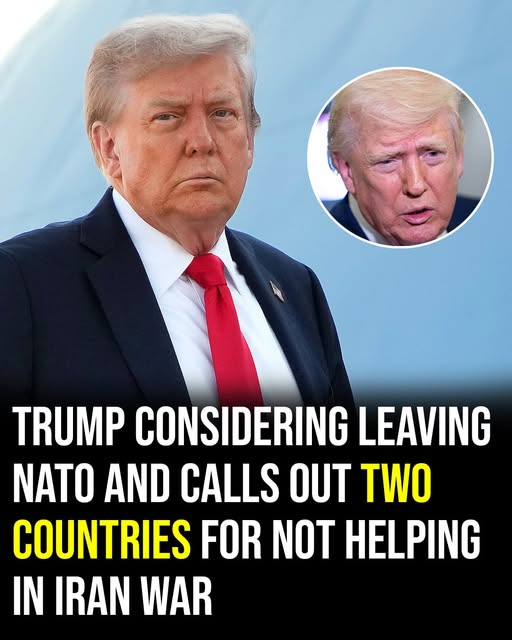
Donald Trump has once again thrown the Western security architecture into uncertainty. In a fierce and unusually public critique, he has labeled NATO a “paper tiger,” questioned the U.S.’s long-term commitment to the alliance, and openly chastised two of America’s closest European partners—Britain and France—by name. This comes at a moment when tensions are already running high: the conflict with Iran is escalating, global security concerns are intensifying, and the world is watching Washington’s every move. By suggesting that the United States may no longer be willing to shoulder the burden of defending its allies, Trump has injected a new level of unpredictability into an institution that has long been considered the bedrock of transatlantic stability. Diplomats and security experts are now left scrambling to interpret whether this is rhetoric aimed at toughening allies, an ideological challenge to multilateralism, or a genuine signal that the U.S. might walk away. Either way, the implications are profound.
Trump’s critique of NATO strikes at the heart of the post-World War II international order. For decades, the alliance has been built on the assumption that the United States would act as the guarantor of European security, even in moments of friction or disagreement. This assumption underpins not only military coordination but also economic and diplomatic stability across the North Atlantic. By publicly calling NATO a “paper tiger” and accusing Britain and France of shirking their responsibilities or showing cowardice, Trump challenges a foundational expectation: that the U.S. will remain a reliable anchor, come what may. Allies who once operated on the certainty of American support are now left to question whether they can count on Washington in a crisis, forcing them to reconsider defense planning, spending commitments, and strategic partnerships.
The timing of Trump’s attacks amplifies their impact. Europe and the Middle East are already facing heightened volatility due to the intensifying war with Iran, regional power shifts, and ongoing threats from both state and non-state actors. Normally, NATO unity would be emphasized in such circumstances; public displays of solidarity would reassure allies and deter adversaries alike. Instead, Trump has chosen to humiliate key members, mocking the British navy’s readiness and criticizing France for allegedly obstructing critical support to Israel. These comments are more than rhetorical flourishes—they are symbolic gestures that reverberate through diplomatic channels, shaking trust and raising questions about whether traditional norms of alliance behavior still hold.
Analysts warn that the consequences could extend far beyond NATO itself. When the leader of the world’s most powerful military questions the value of longstanding partnerships, adversaries take note. Russia, China, and Iran are likely to interpret the public disagreements as signs of cracks in the Western coalition, potentially encouraging more aggressive posturing or opportunistic actions. Within Europe, governments may accelerate efforts to increase defense spending, pursue independent security arrangements, or seek alternative partnerships to hedge against the possibility of diminished American engagement. Even if NATO as an institution survives, it will inevitably emerge altered: its cohesion tested, its credibility questioned, and its decision-making burden increasingly complex.
The rhetoric also carries domestic implications for the United States. Critics argue that Trump’s comments undermine decades of bipartisan foreign policy consensus, erode international trust in U.S. commitments, and risk destabilizing alliances that have kept Europe and the broader Western world relatively secure for generations. Supporters, meanwhile, may see his statements as a reaffirmation of a “America First” posture, insisting that European nations take more responsibility for their own defense rather than relying on U.S. resources and manpower. The tension between these two interpretations underscores the broader debate about America’s role in global affairs and the limits of military and diplomatic engagement abroad.
In the end, whether Trump’s remarks are intended as negotiating leverage, a political statement, or a genuine reevaluation of NATO’s relevance, the immediate effect is clear: the alliance’s traditional sense of stability has been shaken. Partners are being forced to confront the possibility that the assumptions underpinning decades of collective security may no longer be guaranteed. NATO may survive this latest crisis, but its future will be shaped in part by how it responds to a United States willing to publicly question the very foundation of the alliance. Trust, once eroded in the public eye, is difficult to restore, and the world is watching closely to see whether the West can maintain cohesion in the face of both external threats and internal discord.