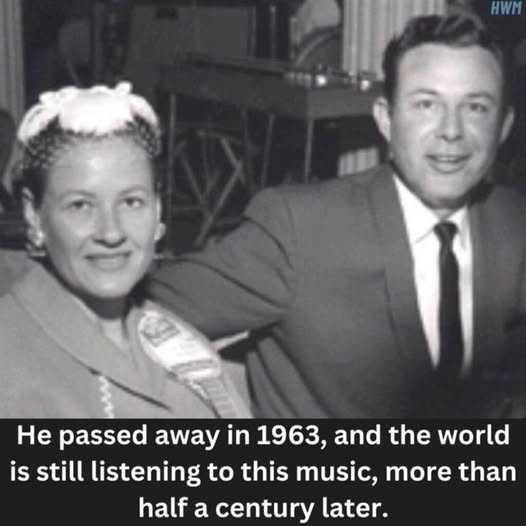
A really famous song’s impact frequently comes from its ability to whisper straight into the listener’s soul rather than from its loudness. The music business was used to the raw grit and twang of classic honky tonk when Jim Reeves recorded He’ll Have to Go in 1960. However, this song entered the public consciousness like a private chat overheard on a wet midnight, rather than arriving with a crash or a planned spectacle. Reeves turned a frantic late-night phone call into a personal and timeless masterpiece with a velvety voice and a performance that revolutionized the genre’s emotional depth. It is still regarded as one of the best songs ever recorded, proving that even the most subdued feelings may have the greatest impact on a person’s life.
In the country music industry, Jim Reeves has always stood out. Reeves maintained a polished and composed demeanor that won him the enduring moniker Gentleman Jim, while his peers leaned into the rawness of pain. He worked in radio for years before the world of professional music completely engulfed him. His understanding of music as a guide to be followed rather than a force to be controlled or a tool to dominate was deeply ingrained in his artistic DNA. He exploited his understanding of the strong bond between a human voice and a microphone to draw listeners in as though they were the only people in the room. Reeves was already well-known by the time this famous song was recorded, but this particular performance marked the turning point in his career from celebrity to legend.
The song’s origins are rooted in the kind of ordinary realism that only the greatest songwriters are able to convey. It began when Joe Allison heard a man at a bar talking into a phone in an attempt to keep a shaky connection with someone on the other end. There was a startling amount of vulnerability in that one poignant statement, “Put your sweet lips a little closer to the phone.” It was human in the most direct and agonizing sense, encapsulating the gap that technology attempts, but frequently falls short of, bridging. Reeves didn’t attempt to exaggerate the lyrics’ suffering when he entered the studio. The arrangement remained simple and delicate under the meticulous and sophisticated production of the renowned Chet Atkins. The deep resonance of Reeves’ voice led the way while the instruments were instructed to retreat into the shadows.
The song’s reaction was a cultural phenomenon that upended the music industry’s preexisting boundaries. It swiftly rose to the top of the country charts before doing something incredibly uncommon for the time: it entered the pop sphere and peaked at number two on the mainstream charts. This triumph demonstrated that country music could enter the global mainstream without losing its essential essence, something that many executives had been dubious about. He’ll Have to Go turned into a key component of the Nashville Sound. High production values and intricate arrangements were given priority in this more polished and seamless fusion of pop and country music. It created opportunities for upcoming generations of artists who refused to compromise between a broader commercial appeal and their emotional roots.
Over the years, Reeves and this particular recording continue to have an impact. The original remained an untouchable standard despite other artists, such as Elvis Presley and Ry Cooder, trying to capture the charm with their own renditions. This was because to the silence that Reeves created in between the notes, not merely the tune or the lyrics. He recognized the importance of the space where feeling resides and the force of the pause. Shania Twain, Taylor Swift, and Keith Urban are just a few of the musicians who have followed in Reeves’ footsteps, demonstrating that country music can be both intensely personal and universally appealing.
However, a significant tragedy that took place at the pinnacle of Gentleman Jim’s popularity casts a shade over the story. Reeves was died in a private plane crash in 1964 when he was just forty years old. The industry was rocked by the unexpected loss, and there was a persistent feeling that something was unfinished. He was a man who was constantly developing as an artist and discovering fresh approaches to unite innovation and heritage. Even though he was no longer physically present, the spirit of his work persisted. Songs like “He’ll Have to Go” linger in the air, waiting to be discovered by future generations, rather than fading into the archives of history. Instead of hearing the song as a holdover from a bygone age, modern listeners perceive it as oddly contemporary and emotionally relevant to today’s challenges.
The song’s simplicity hasn’t diminished in the modern era of large volume production and digital streaming. If anything, in a setting where loudness is sometimes mistaken for profundity, it feels even more uncommon and valuable. The yearning in Reeves’ voice hasn’t changed, and any aspiring artist may still learn from the self-control he displayed in the studio. Jim Reeves’ understanding of a basic human truth—that you don’t have to raise your voice to be heard by the heart—made him remarkable. All he had to do was be truthful, and the room’s silence would take care of the rest.
Gentleman Jim’s influence may be heard in every calm moment of a contemporary country ballad and in every performer who puts the audience connection ahead of stage extravaganza. He’ll Have to Go is a model for poignant narrative, not merely a popular song. It crosses genre boundaries and the passage of decades by capturing a moment in time—a man with a phone and a fading love—and transforming it into a universal experience. We come to the conclusion that the best songs are those that make us feel noticed in our most intimate moments as the song’s last chords fade into the background. The world continues to hear the echo of Jim Reeves’ velvet voice over the telephone line of time because he was the master of that link.