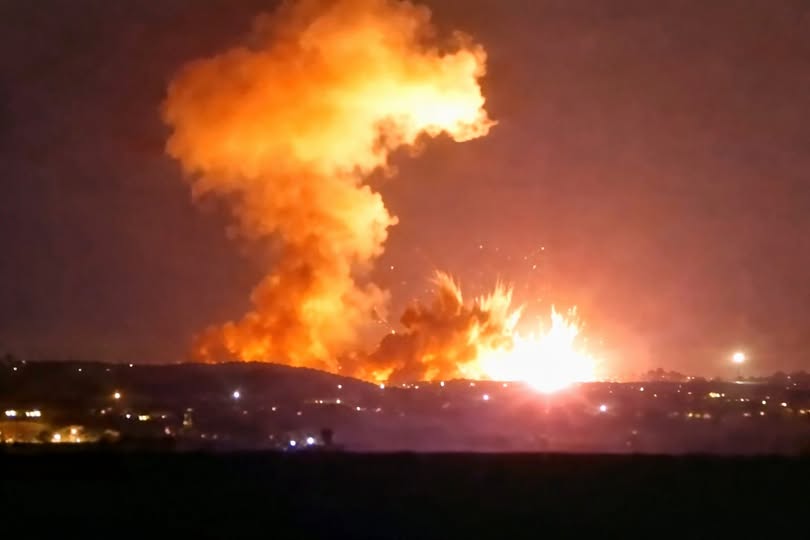
A colossal fireball erupted over Iran, a shockwave of light and heat that lit up the night sky like something out of a blockbuster film. Yet this was no cinematic spectacle—it was a real, lethal strike, and what made it even more surreal was the way a former U.S. president shared it, almost as if promoting a movie trailer. As Donald Trump blasted footage of Isfahan erupting on social media, the world watched in stunned silence, torn between disbelief and dread. Questions spiraled immediately: How much uranium was affected? Were bunker busters deployed? What is the true scope of the destruction? How close is a city sitting atop the volatile edge of a nuclear arsenal to complete disaster? While the Pentagon maintained a cautious and near-total silence, global observers held their breath, watching a conflict unfold in real time, filtered through tweets, clips, and fragments of official statements.
The explosion over Isfahan was far more than a spectacular display of fire and smoke—it was a blunt, unmistakable message delivered in concrete and flame. Beneath the surface of that ancient city lie Iran’s most sensitive sites: 60% enriched uranium stockpiles, sprawling missile factories, and fortified bunkers that constitute the hardened heart of a regime that has spent decades meticulously burying its ambitions under layers of rock and reinforced concrete. When Trump posted the strike video, he did more than share a clip; he amplified a signal of escalation, broadcasting to the world a moment that the Pentagon itself still refused to contextualize or explain in real time. The imagery sent a double message: to Tehran, a warning of reach and capability; to global audiences, a display of power and unpredictability.
Operation Epic Fury, which followed last year’s Midnight Hammer raid, is part of a clear, escalating pattern: the United States and Israel hunting Iran’s most sensitive weapons where they are physically stored, in vast underground “missile cities” constructed with technical assistance from North Korea and China. Each operation may successfully trap more of Tehran’s arsenal in shattered tunnels, but it also drives the conflict deeper, both literally underground and metaphorically into dangerous political territory. Every explosion, every breach of reinforced vaults, every satellite flash captured above these cities stretches the boundary between strategic deterrence and catastrophic disaster. The raids are surgical in intent but terrifying in their potential consequences, leaving analysts, diplomats, and civilians alike questioning where the line is—and whether it has already been crossed.
Somewhere between Truth Social posts, satellite imagery, and the silence of military briefings, the world sees the thin line of control blur. Deterrence is meant to prevent escalation, yet the optics and messaging of these strikes risk provoking precisely what they aim to prevent. Each blast, each mushroom cloud, carries a weight far beyond the physical destruction: it shifts calculations in Tehran, accelerates clandestine mobilization, and heightens global anxiety over a war that no one voted for but everyone feels the effects of. In sharing the footage, Trump transformed what is typically a hidden military operation into a public spectacle, making the invisible machinery of war visible and intensifying the psychological dimension of conflict. Analysts now study not just the targets, but the signals: the timing, the messaging, and the human and geopolitical reactions that ripple outward from every strike.
In the end, what unfolded over Isfahan is more than a military maneuver; it is a moment that encapsulates the dangers of modern conflict, where real explosions intersect with social media, where nuclear stockpiles lie just beneath city streets, and where the line between warning and catastrophe becomes increasingly indistinct. Operation Epic Fury illustrates that modern warfare is no longer contained in classified briefings—it plays out in real time, on screens across the globe, with consequences that could reshape the political and military landscape in ways that are unpredictable, irreversible, and frighteningly immediate.