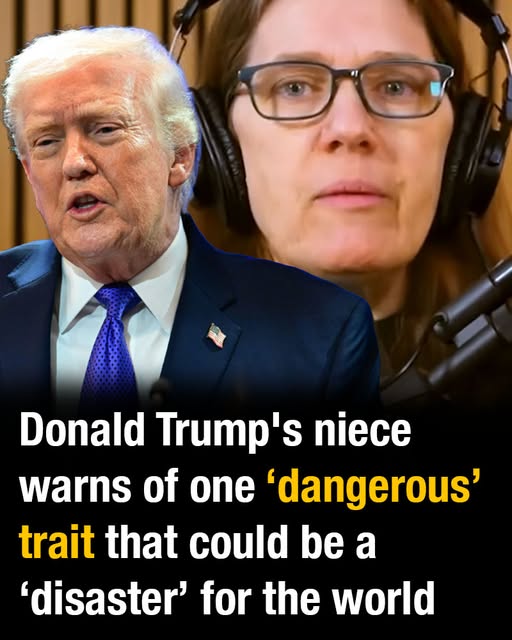
Mary Trump isn’t holding back anymore. Her warnings about Donald Trump’s most dangerous traits have grown colder, sharper, and far more urgent than anything she has ever said before. As a trained psychologist, a niece who has watched him for decades, and a lifelong observer of his behavior both in public and private, she sees patterns that others miss—and the connections she draws are deeply troubling. She paints a picture of a man who never backs down, no matter the cost, who escalates every confrontation until there is nothing left to lose. This isn’t merely a matter of political misjudgment; she fears the consequences could ripple outward in ways that are global, economic, and potentially irreversibly destructive. According to her analysis, Donald Trump is not simply a combative figure prone to outbursts—he is someone whose instincts and compulsions are intertwined with power, ego, and the relentless drive to dominate any situation, regardless of the collateral damage.
Mary Trump portrays a man whose actions are guided less by coherent strategy and more by wounded pride and reflexive defiance. In her view, Donald Trump’s tendency to “double down” whenever challenged is not mere stubbornness; it is a compulsion that feeds on conflict, public humiliation, and the perception of weakness. Each time an opponent retreats, concedes, or hesitates, he internalizes a lesson that fuels the next escalation: confrontation works, aggression produces results, and consequences—no matter how severe—can be survived or ignored. She argues that this cycle has repeated itself countless times, creating a self-reinforcing feedback loop that few can interrupt. It is not simply an annoyance or a political inconvenience; it is a behavioral pattern with real-world implications, capable of destabilizing relationships, institutions, and even nations.
What terrifies her now is the sheer scale of his influence. This is no longer a family feud, no longer a boardroom spat, or even a high-stakes political battle limited to the United States. This is a man with the power to manipulate markets, fracture alliances, and test the limits of global diplomacy—all while interpreting pushback as a personal affront that demands a louder, more forceful response. Yet Mary also senses a subtle shift in the landscape. Institutions, prosecutors, even former allies are beginning to push back, saying “no” and meaning it, challenging the idea that he can act without consequences. But the question that hangs over everything is urgent and frightening: has this resistance arrived in time to prevent irreversible damage, or has his long-established pattern of pushing every boundary until something breaks already gone too far? The stakes, she insists, are higher than ever, and the world is now witnessing a version of Trump that is unrestrained, unchecked, and increasingly unpredictable.
In Mary Trump’s analysis, the danger is amplified by the combination of scale, history, and the psychological forces at work. Each escalation carries not just political fallout, but economic shockwaves, strained international relations, and the potential for conflicts that could spiral beyond anyone’s control. Her warnings are not abstract—they are drawn from decades of close observation, psychological insight, and an understanding of the mechanisms that drive his decisions. The portrait she paints is stark: a man who thrives on confrontation, who interprets caution as weakness, and who has learned that boldness—however reckless—is rewarded. The only remaining question is whether the institutions, legal systems, and social checks that have begun to resist him will be enough to prevent the next crisis, or whether the world will be forced to witness the devastating consequences of a pattern that has been decades in the making.