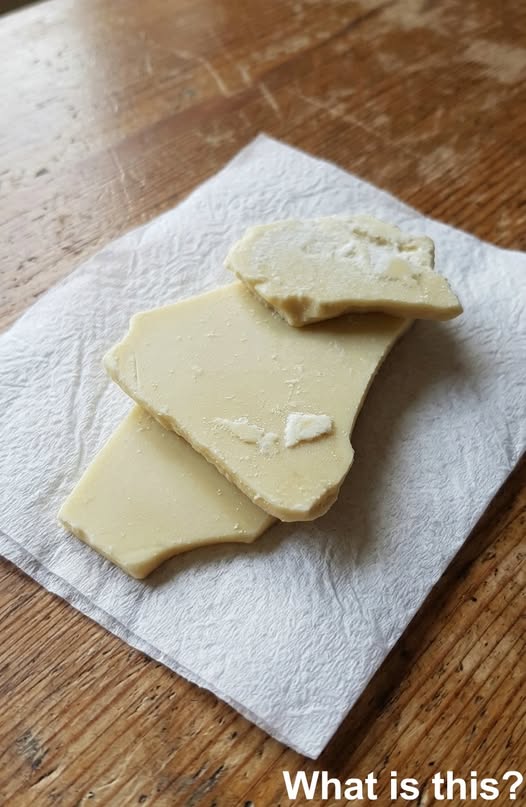
I knelt on the ground and carefully turned the odd pieces over in my fingers, examining them from every perspective as though a closer look might reveal something. They didn’t feel comfortable. Instead of being crumbly or squishy like anything new, the texture felt dry and slightly chalky. Their pale, almost ghostly hue further heightened the discomfort. They were even more strange because of the thin, powdery layer that clung to the surface; they seemed to have changed over time in a way that I couldn’t comprehend.
I didn’t stop to think about straightforward explanations. It rushed ahead, using fear rather than facts to fill in the blanks. I considered the things that parents secretly worry about but seldom discuss aloud—dangers that don’t make themselves obvious, substances that don’t belong, and hidden habits. The kind of discoveries that raise questions you’re not yet prepared to ask, rather than simply explaining themselves.
I sat there for a few long moments, certain that I had discovered something important—something that didn’t belong in my house and that I ought to have realized sooner. Suddenly, the silence around me seemed heavier and different, as though the room itself had changed. Every little detail felt more acute. I flipped the pieces over once again, applying a little pressure and even shattering one to see if the interior could provide a hint. It didn’t. If anything, it made the mystery more enigmatic.
The peculiar thing about dread is that it doesn’t require much to develop. It develops swiftly and self-assuredly, creating a narrative from fragments and ambiguity. I wasn’t just staring at a few strange objects on the floor at the time. I was seeing discussions, repercussions, and the chance that something had been going on without my knowledge.
Then something sliced through all of it, softly, almost lovingly.
A hint of sweetness.
It was so faint at first that I nearly ignored it. However, it grounded me as soon as it registered. I stopped, moved one of the pieces closer, and let my senses to catch up with my thoughts. And everything changed in an instant.
Now it was impossible to miss the smell. After the intensity of the previous few moments, it felt almost reassuring—soft, syrupy, and familiar.
chocolate.
Specifically, white chocolate—dried out, aged, and covered in that innocuous bloom that develops when it is left out for too long. That suspicious-looking powdered coating turned out to be just separated cocoa butter. It had appeared odd, but it was only work time.
It wasn’t a gradual realization. It struck all at once.
And it brought with it an instantaneous sense of relief that nearly made me laugh aloud. Something lighter, even ridiculous in contrast, replaced the tension that had developed so swiftly. I shook my head at myself as I sat there for a while, partly amused and half ashamed of how far my imagination had gone.
At that moment, I yelled out to my son in that familiar tone parents use when a problem turns out to be much less serious than anticipated, without being harsh or angry. A polite reminder to keep food in the kitchen. A minor, everyday modification that was appropriate for a typical day.
But something about it stuck with me even after the moment was over.
I was stunned not just by the misidentification of a few lost chocolate bits, but also by the speed at which love had turned doubt into terror. How instinct had taken precedence over logic, filling in the voids with worst-case possibilities before truth had a chance to speak.
I became aware of how protective instincts function as a result. They don’t hold out for clarification. They don’t request verification. They respond instantly, creating a story to get you ready for danger—even when there isn’t any. Even if that instinct has a purpose, in situations like this, it may make something seemingly insignificant seem overwhelming.
Ultimately, it was little more than a few bits of outdated white chocolate that had been forgotten.
But it had been something quite else during those little moments.
And perhaps that’s the subtle reality concealed in situations like this: sometimes our contributions to a circumstance are more important than the situation itself.