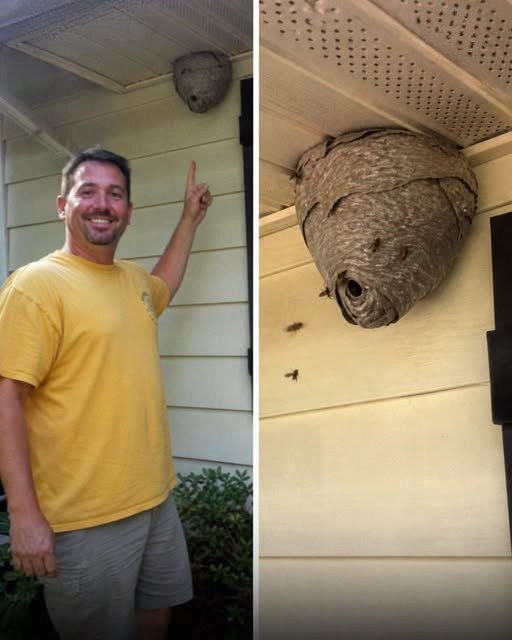
Silently, the wasps appeared.
It started out as a quiet hum close to the back door. When you’re carrying shopping, responding to emails, and instructing your five-year-old to put on her shoes for the third time, you hardly notice the sound.
However, the nest expanded.
The tension increased as well.
One afternoon, Evie stood far away from the door as if it might bite her and whimpered, “Mommy, they’re watching me.”
I made an effort to laugh it off. “Sweetheart, they’re just bugs.”
However, they were no longer merely insects. They posed an issue.
Like many issues in my marriage, I brought it up, and Daniel dismissed it.
He said, “I’ll take care of it,” without taking his eyes from his phone.
That’s what he always said.
The internet was the source of the plan.
It did, of course.
Daniel informed me on Sunday morning, halfway dressed like a man ready to prove something, “I saw a life hack.” At daybreak, you shower the nest. They move slowly. Simple.
I gazed at him. “You have an allergy.”
He dismissed it as if I had brought up the weather. “Everything will be alright.”
I should have said no at that point.
I gave him the spray instead.
Because marriage teaches you to trust someone’s confidence more than your own intuition, which can be harmful.
Everything broke quickly.
Too quickly.
There was a piercing hiss as the spray struck the nest, and then the air burst.
Not excited.
blew up.
Like something living, furious, and well-coordinated, a swarm erupted. The ladder moved, Daniel jerked back, and then—
That sound.
the sound his body made as it struck the floor.
I doubt I will ever forget that.
The wasps were already on him when he attempted to stand. His respiration became irregular, his hands flailed, and his face—
His face, God.
It was bulging already.
I grabbed the hose and screamed at him to move, at Evie to stay inside, and at 911 as if they could arrive sooner if I sounded more desperate.
He was hardly aware when the paramedics came.
There was no sense of relief in the hospital.
It was suspension-like.
Daniel experienced the fall, the allergic reaction, and the injuries. tubes, sensors, and drugs that reduced him to a nearly nonexistent replica of himself.
And me?
I started working in logistics.
Get up. Work. Insurance calls. drop-offs at schools. meals. updates. Do it again.
Crying isn’t always a sign of grief.
It appears to be operating too well at times.
Then she appeared.
Marjorie.
My mother-in-law didn’t start a fight or storm in. She brought sandwiches, coffee, and a tone I had never heard from her before.
Kind.
She put a cup in front of me and said, “You can’t do everything.”
Our relationship had been… polite friction for ten years. The kind that conceals criticism within praise.
It seemed as though something had changed when she offered to assist by picking up Evie and sitting with Daniel.
Perhaps she had become softer after nearly losing him.
As if we were at last growing into a true family.
Yes, I replied.
That was my second error.
The assistance was flawless.
Too ideal.
She provided updates. stayed with Daniel. relieved stress in ways I wasn’t even aware I needed.
However, her communications included something.
a tone.
“I told him you were busy when he asked for you.”
I thought about it for longer than I should have.
However, fatigue has great power. It causes you to disregard impulses that you would otherwise believe.
I disregarded it as a result.
Until Evie said something.
Everything changed once again while we were in the car.
“Want to go see Daddy?” I inquired.
“No,” she replied.
I looked at her in the mirror. “Why not?”
She paused. examined her footwear.
Then she uttered it.
“Because while you’re at work, another mommy kisses Daddy.”
Youngsters are unable to comprehend the consequences of their remarks.
They simply speak the truth.
Easy. Clean and devastating.
“They told me not to tell you,” she whispered. “However, she claimed that she is more capable of caring for him than you.”
It wasn’t like something broke inside of me.
It became chilly.
That day, there was something odd about the drive to the hospital.
Not in a panic.
concentrated.
I didn’t make a prior call. I didn’t get ready.
I simply entered and unlocked the door.
And there it was.
Next to my husband’s bed was a woman.
She put her hand around his.
Her mouth touched his cheek.
cozy.
Well-known.
As if she had a place there.
And standing at the window, observing everything as it should have?
Marjorie.
“Stop kissing my husband.”
The room broke.
The blonde, calm woman turned, and I recognized her.
Not from actual life.
from pictures.
from tales I was never meant to believe.
Vanessa.
The former.
Marjorie’s favorite all along.
It wasn’t subtle what came next.
It wasn’t concealed.
It was intentional.
Marjorie remarked, “You’re hardly ever here,” as if she had been waiting years to say it aloud.
As if maintaining a life, working, and raising a child were all considered absences.
As if I were replaceable due of weariness.
It clicked at that point.
This wasn’t an issue.
This did not assist.
This was a tactic.
She had held out.
I held off on saying yes until I was sufficiently stretched.
Until I took a small step back so she could intervene.
She then filled the void I had left with someone else rather than support.
However, she made a mistake in one calculation.
Daniel.
He was initially confused when he woke up and saw Vanessa.
Next, clarity.
Then rage.
“Claire is my wife,” he stated in a feeble but confident voice. “Back then, I choose her. I’ve now decided on her.
The illusion vanished in an instant.
Not in a calm manner.
Absolutely.
Vanessa departed.
Marjorie trailed behind.
Not vanquished.
but revealed.
After they left, the place had a different vibe.
Not more light.
but more lucid.
Daniel grasped my hand as if he were trying to bring himself back to the present.
“I was unaware,” he remarked.
And I took him at his word.
Because the source of betrayal isn’t usually what you anticipate.
It occasionally enters with coffee.
Later, Evie scaled the bed.
tiny. Watchful and cautious.
“Is there a new mother?” she inquired.
closer spite of the discomfort, Daniel drew her closer.
“No,” he replied. “There’s just one mother. She also kept me alive.
Then she gave me a glance.
looked really good.
and gave a nod.
The wasps weren’t the true threat in the end.
They were only the start.
Someone who smiled and offered assistance caused the true pain. and bided my time until I was too exhausted to ask her.
And a sting like that?
Your skin doesn’t swell as a result.
It alters your sense of trust.
Indefinitely.