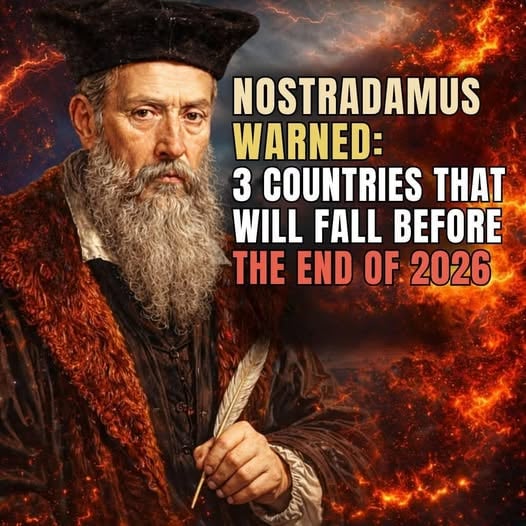
The human mind has an innate, almost desperate need for order amidst the chaos of history. When the world feels as though it is tilting on its axis—when old empires falter, global tensions peak, and familiar institutions groan under the weight of change—we instinctively look backward for guidance to navigate forward. In 2026, as the geopolitical landscape undergoes profound and often violent shifts, the enigmatic verses of Michel de Nostredame, the sixteenth-century French astrologer better known as Nostradamus, have resurfaced at the center of cultural discussion. His warnings, wrapped in layers of metaphor and shadow, feel less like historical curiosities and more like sirens in the dark, signaling a transformation that many struggle to comprehend.
Nostradamus’ enduring fascination lies not in clarity, but in deliberate ambiguity. He was a master of suggestion, a poet of apocalypse who never fully explained his visions, instead inviting each generation to project its own fears onto his blurred symbols. Today, three of his most haunting images—the wounded eagle, the trapped bear, and the aging lion—have become the primary lenses through which people interpret contemporary global crises. On the surface, the mappings seem straightforward: the eagle representing a struggling American hegemony; the bear, a Russia increasingly isolated; and the lion, a European or British influence trying to retain relevance in a multipolar world. Yet the ease with which we assign these sixteenth-century creatures to twenty-first-century powers says more about our collective anxiety than it does about an astrologer who wrote by candlelight.
Humans crave patterns in chaos. We seek narrative threads to make the terrifying uncertainty of the present feel less random—and, perhaps, less our responsibility. A “prophesied” future implies inevitability, a script we merely follow. Yet the deeper truth in our obsession with Nostradamus is uncomfortable: history is not scripted; it is patterned. Nations have always overreached, retreated, fractured, and occasionally reinvented themselves. Prophecy, at its most powerful, serves as a warning, a psychological mirror reflecting the consequences of our trajectory—but it cannot act on our behalf.
The wounded eagle resonates most today. In a United States defined by internal division and a reevaluation of its global role, the image of a majestic bird struggling to stay aloft feels uncomfortably accurate. But a wound is not a death sentence; it can prompt reflection and healing. The trapped bear symbolizes the peril of power without an exit strategy—a situation demanding not only strength from adversaries but also a nuanced understanding of desperation. The aging lion represents the challenges of established institutions striving to remain relevant in a world that no longer automatically defers to traditional authority.
The turning point for civilization is not hidden in a cryptic 1555 verse. It lies in how leaders and citizens respond when institutions falter and myths of greatness crumble. Today, the twentieth century’s sustaining myths—of infinite growth, absolute security, and a single dominant way of life—are being challenged. Nostradamus’ work echoes this moment: the sound of a system reaching its limits. Between the paralysis of fear and the labor of renewal, the future tilts toward the choices we make now, not the verses inherited from the past.
Nostradamus’ strange visions feel familiar because human nature remains constant. The pride that toppled empires in the sixteenth century persists in modern boardrooms. The fear that drove people to astrologers during the plague now drives us to refresh news feeds, seeking a stabilizing sign. Our fascination is a form of collective storytelling, a way to make sense of a world where even “experts” seem bewildered.
Yet leaning too heavily on prophecy risks fatalism. If the lion must age and the eagle must fall, one might think striving is futile. The true lesson of these ancient warnings is recognizing the recurring pitfalls of human behavior. When Nostradamus writes of “the great brothers” or “the city of gold,” he addresses timeless themes of rivalry and greed. By identifying these patterns, we gain the chance to break them. The future is not a destination we passively approach; it is a structure we build with every policy, diplomatic gesture, and act of communal resilience.
As 2026 unfolds, we must remember: the “lion,” the “bear,” and the “eagle” symbolize millions of lives, complex economies, and shared global heritage. The uncertainty of the future is not a flaw in history, but a feature of human freedom. Institutions are shaking, myths are faltering—but this is not an ending; it is the beginning of a new chapter yet to be written.
The future belongs to those who look past the sirens in the dark and recognize the possibilities of the dawn. It belongs to choices prioritizing the common good over ego, long-term planetary health over short-term gain. Whether guided by Nostradamus or modern science, the mandate remains: we are the architects of the patterns the next generation will decipher. Fascination with Nostradamus may endure as long as humans dream of the future, but the power to shape that future rests firmly in our hands.