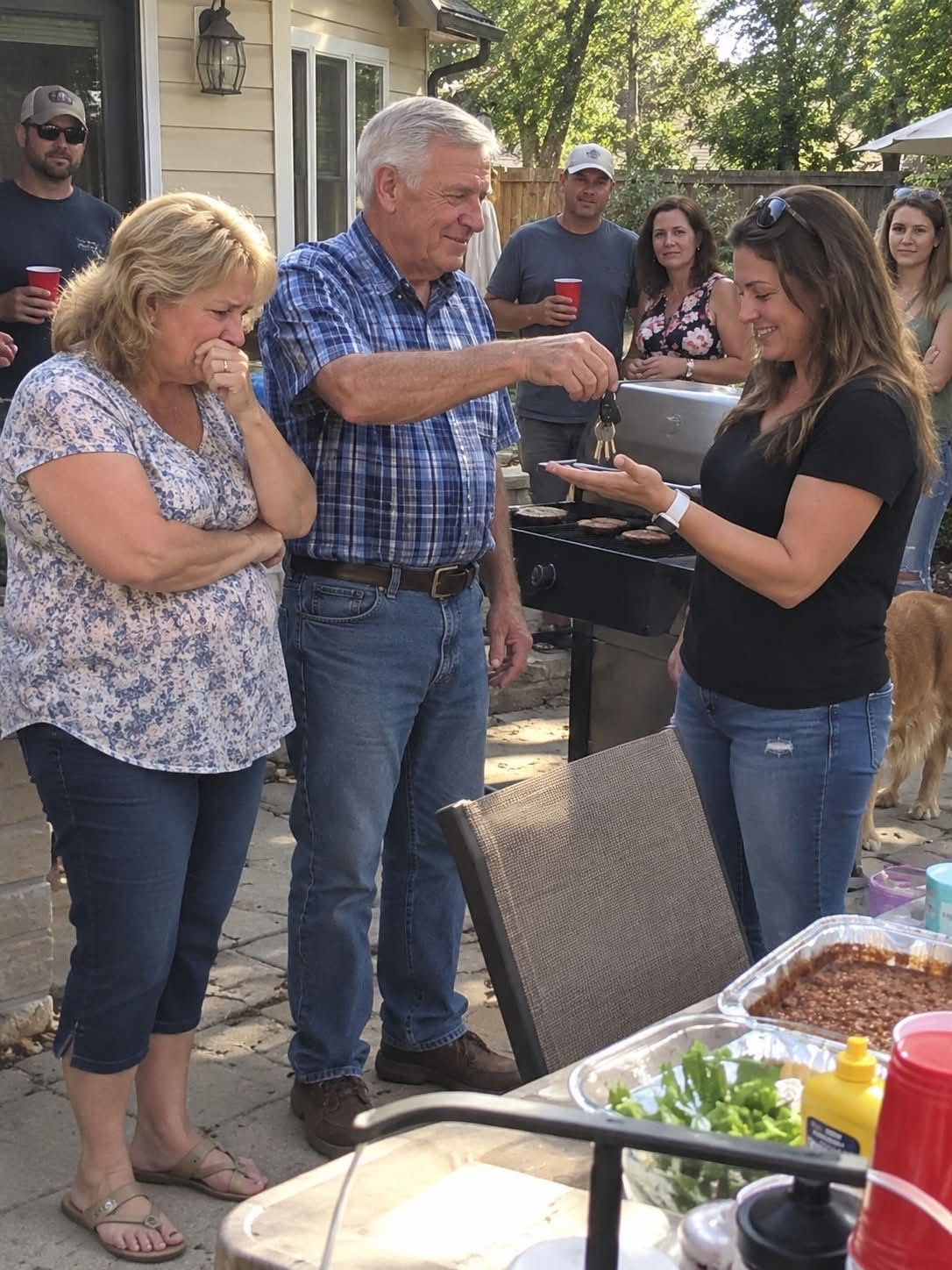
The keys were brand new. That’s what I noticed first. Not the words. Not the clapping. The keys.
They were bright brass, cut that week at the hardware store on Glenstone Avenue. I knew because I’d seen the little paper envelope from the store in Gary’s truck on Thursday, on the passenger seat, under a receipt for charcoal. I’d thought he was finally replacing the spare for the back door that went missing last spring.
He wasn’t.
He was standing on our deck in front of twenty-three relatives, holding those keys up in the afternoon sun so they caught the light, and putting them in his daughter’s hand.
“It’s time you had your own,” he said.
And everybody clapped.
I was standing at the patio door with a glass bowl of potato salad in my arms. I’d made it that morning at six. My mother’s recipe. Red potatoes, celery, a little mustard, a lot of paprika. I’d made it for every one of Gary’s family barbecues for twenty-three years.
I stood there holding it while my husband gave away our home.
My name is Linda Haskell. I’m sixty-one years old. My husband, Gary, and I have lived in the same house outside Springfield, Missouri, since 1998.
It’s a modest three-bedroom ranch at the end of a gravel road, with white siding and green shutters and a wooden deck Gary built himself the summer of 2003. The backyard is full of trees. Two big oaks, a dogwood, a crabapple, and a pin oak we planted the year we moved in that’s taller than the house now. There’s a vegetable garden along the back fence and a birdbath my mother gave me and a tire swing nobody has used in fifteen years that neither of us has the heart to take down.
Nothing fancy.
But everything we own has been earned.
I worked thirty-one years as a receptionist at Dr. Ferris’s dental office on Battlefield Road. I answered phones and made appointments and calmed down crying children and talked grown men out of canceling their root canals. I retired last year. They gave me a cake and a plaque and a gift card to Olive Garden.
Gary drove delivery trucks for a beverage distributor for thirty-four years. Soda, mostly, and beer. He knew every gas station and grocery store and bar in five counties. He retired in 2020, the spring everything shut down. He says it was the best timing of his life.
Between us, we made every mortgage payment on that house. Every single one. Three hundred and thirty-six of them. We repaired every leaking pipe, replaced the roof twice, rebuilt the septic system, put in central air in 2007 after the summer it hit a hundred and eight. We saved for every home improvement. We never once missed a payment.
Well. Almost never. But I’ll get to that.
Gary has a daughter from his first marriage.
Her name is Brittany. She’s thirty-eight now.
I’ve known her since she was nine.
Gary and his first wife, Sheila, divorced when Brittany was six. It was ugly. Sheila moved to Joplin with Brittany and remarried a man who sold boats. Gary got every other weekend and two weeks in the summer. He was not good at it. I’ll be honest. He was young and he was hurt and he drank too much back then, and some weekends he didn’t show up to get her. Brittany would sit on Sheila’s front step in Joplin with her little backpack, waiting, and Gary would call at six o’clock and say something came up.
I met Gary when Brittany was nine. He was thirty-three, divorced, delivering Pepsi to the gas station next to Dr. Ferris’s office. He asked me out four times before I said yes. On our third date, he told me about Brittany sitting on the step with her backpack.
“I’m a lousy father,” he said. “I know it. I want to be better.”
I believed him. I married him two years later.
And for the next twenty-nine years, I helped him try.
I helped with Brittany’s homework on the weekends she stayed with us. Fractions. Book reports. A diorama of the Oregon Trail that took us an entire Saturday and a bag of cotton balls. I planned her birthday parties when they were at our house. I drove her to her friends’ sleepovers. I bought her first bra at Walmart because Gary turned red as a beet and couldn’t do it. I sat up with her when she had the flu and Gary was on a delivery route in Branson.
I never had children of my own. We tried for a few years. It didn’t happen. I made my peace with it, mostly. Brittany was the closest I ever came.
When she was seventeen, I spent three weekends helping her fill out college applications at our kitchen table. She got into Missouri State. She lived with us for her first two years, in the back bedroom, because Sheila couldn’t afford the dorms and neither could we. I packed her lunches. I did her laundry. I met her boyfriends.
At her wedding, when she was twenty-six, I sat in the second row behind Sheila and her boat salesman husband. Brittany didn’t mention me in her speech. I told myself it didn’t matter.
But over the years, Brittany developed a habit.
It started small. Around the time she got married. She’d come over for Sunday dinner with her husband, Travis, and she’d look around the living room and say something like, “Dad, you really need new furniture. This couch is older than me.” And Gary would laugh. And I’d say nothing. I’d picked out that couch.
Then it got bigger. When Travis started his landscaping business, Brittany suggested we sell my car, since I “didn’t really drive anywhere.” When Gary had his knee replaced in 2019, she sat by his hospital bed and told him he should “get his affairs in order.” When he turned sixty-five, she bought him a book about estate planning and wrote inside the cover, You’re not getting any younger, Dad!
She’d walk through our house like she was measuring it. She’d open closets. She’d say things like, “When this is mine, I’m knocking out this wall,” and laugh, like it was a joke.
Gary would laugh too.
I never laughed.
Last spring, Gary had a heart scare.
He was mowing the lawn in May and sat down suddenly on the riding mower in the middle of the yard and didn’t get up. I saw him from the kitchen window. I ran out. He was pale and sweating and holding his left arm.
It turned out to be angina, not a heart attack. They put in a stent at Cox South and sent him home three days later with a bag of pills and a pamphlet about low-sodium diets.
But something changed in him after that. He got quiet. He started sitting on the deck in the evenings, looking at the trees, not saying much. He started talking about “when I’m gone.” He started calling Brittany more. Every few days. Long calls, out on the deck, with the sliding door closed.
I didn’t ask what they talked about. Maybe I should have.
Every August, Gary hosts a family barbecue.
It’s a big deal in his family. The Haskells are a big, loud, Missouri family. Gary’s two sisters. His brother. Their kids and grandkids. Cousins I’ve only met at these barbecues and funerals. They come from Springfield and Joplin and Rolla and Branson, and they bring coolers and lawn chairs and casseroles, and they stay from noon until the fireflies come out.
Last Saturday was the twenty-third one we’ve hosted.
By two o’clock, the backyard was crowded. Gary was at the grill in his KISS THE COOK apron, flipping hamburgers. His brother Ron was manning the cooler. The kids were running through the sprinkler in their swimsuits, screaming. Gary’s sister Darlene was sitting in the shade under the big oak with her feet up, complaining about her hip. Somebody had brought a speaker and was playing Garth Brooks.
Brittany had come with Travis and their daughter, Kaylee, who was sixteen. Kaylee sat on the edge of the deck with her phone, looking bored the way sixteen-year-olds look bored. I’d paid for her braces two years earlier. Brittany hadn’t asked. She’d just mentioned that they couldn’t afford them, and Kaylee had been crying about her teeth, and I’d called Dr. Ferris and set it up. Kaylee had sent me a thank-you card. Brittany hadn’t.
I was in the kitchen most of the afternoon. Refilling the iced tea. Getting more napkins. Cutting watermelon. Bringing out the baked beans. That’s how it always was at these barbecues. Gary at the grill being the host. Me in the kitchen being the help.
Around two thirty, I picked up the glass bowl of potato salad from the refrigerator and carried it toward the patio door.
That’s when Gary tapped his beer bottle with a spoon.
“Everybody,” he called. “Everybody, listen up. I’ve got an announcement.”
The backyard got quiet. Somebody turned down Garth Brooks. The kids in the sprinkler kept screaming until their mothers shushed them.
I stopped near the patio door. I stood there holding the potato salad.
Gary was standing on the deck by the grill. He looked happy. Nervous, but happy. He smiled across the deck at Brittany.
“Most of you know I had a little scare this spring,” he said. “With the old ticker.”
People murmured. Darlene said, “Thank the Lord you’re alright, Gary.”
“Well, it got me thinking,” Gary said. “About what happens when I’m gone. About what I’m leaving behind.” He cleared his throat. “And I’ve decided something.”
He looked at Brittany. She was already smiling. Like she knew what was coming.
“I’ve decided that when I’m gone,” Gary said, “this house will belong to my daughter.”
People started clapping.
Not everybody. But a lot of them. Gary’s brother Ron whistled. Brittany’s cousins cheered. Somebody said, “That’s real nice, Gary.” Travis grinned and put his arm around his wife.
I stood at the patio door with the potato salad and didn’t move.
Then Gary added something I hadn’t expected.
“And we’re going to start transferring things over now,” he said. “No sense waiting. Brittany and I have talked to somebody about getting the paperwork started. So she won’t have to deal with all that probate business later.”
Brittany jumped up from her lawn chair and ran across the deck and hugged him. She actually squealed.
Gary reached into the pocket of his apron and pulled out a set of keys.
Bright brass. Brand new. On a little silver ring with a tag from the hardware store still on it.
He handed them to her.
“It’s time you had your own,” he said.
More clapping. Somebody took a picture with their phone.
I stared at those keys.
Nobody had discussed this with me.
Not once. Not in twenty-eight years of marriage. Not in the three months since his heart scare. Not over coffee in the morning or dinner at night or in bed in the dark. He’d never once said, Linda, what do you think should happen to the house?
He’d called his daughter on the deck with the sliding door closed instead.
Brittany stepped back from her father. She held up the keys and jingled them, grinning. Then she turned and looked directly at me, standing in the patio doorway with my bowl.
“Don’t worry, Linda,” she said. Loud enough that everybody could hear. Sweetly. “You’ll always be welcome to visit.”
Visit.
The word hung in the air over that backyard like smoke from the grill.
Visit.
I’d lived in that house for twenty-eight years. I’d planted the pin oak. I’d painted every room. I’d scrubbed every floor. I’d sat up in the living room at three in the morning with her when she had the flu. I’d cried in the bathroom the month my mother died. I’d watched my husband come home from the hospital in May with a bag of pills and helped him up those three back steps one at a time.
And his daughter was standing on my deck telling me I’d be welcome to visit.
And my own husband had just let her.
Nobody said anything. The backyard had gotten very quiet. A few people looked at me. A few people looked away. Darlene, under the oak tree, had put her hand over her mouth.
Kaylee, sitting on the edge of the deck, had looked up from her phone. She was staring at her mother with a strange expression. Like she was embarrassed.
Gary noticed my face.
His smile flickered. Just for a second. Then he looked at me hard, the way he used to look at me in the early years when he’d had too much to drink and I said something he didn’t like in front of his friends.
“Linda,” he said. Low. Warning. “Don’t make this uncomfortable.”
I looked at him for a long moment.
Then I walked across the deck and set the potato salad on the picnic table, next to the baked beans.
“Of course not,” I said.
And I turned around and went inside.
Nobody followed me. I heard the music come back on behind me. Garth Brooks, “Friends in Low Places.” I heard somebody laugh, a little too loudly. I heard the barbecue start up again, the way a stream starts flowing again after somebody drops a rock in it.
I walked down the hallway to our bedroom.
I didn’t cry. I want you to know that. I’ve cried plenty in my life. But not that day.
I opened the closet. On the top shelf, behind my winter sweaters, there’s a gray metal filing cabinet. Two drawers. It’s where we keep the important papers. Birth certificates. Passports we’ve never used. Gary’s Army discharge. The title to the truck. Our wills.
And the house.
I opened the top drawer and pulled out a green folder. It was labeled, in my handwriting, PROPERTY. 2410 Ridgeline Road.
I sat down on the edge of the bed with it in my lap.
There was something in that folder Gary had apparently forgotten.
Something we’d signed together eleven years earlier.
I’ll be honest. I’d half forgotten it too. I’d put it in this folder in the summer of 2015 and closed the drawer and told myself I’d never need to look at it again. I’d told myself it was over. That we’d gotten through it. That it was behind us.
But I’d kept it. Because my mother taught me to keep everything.
I opened the folder. On top was the original deed from 1998, with both our names on it. Under that, the refinancing papers from 2009.
And under that, a document on heavy cream-colored paper with a raised county seal.
Quitclaim Deed. Greene County, Missouri. Recorded June 22, 2015.
Grantor: Gary Wayne Haskell.
Grantee: Linda Marie Haskell.
I read it twice, even though I knew exactly what it said.
Under it, there was a second document. Six pages, stapled. A postnuptial agreement. Signed by both of us. Notarized. Witnessed.
And clipped to the front of it, a business card. Yellowed now. A little bent.
Harlan Beck, Attorney at Law. Family and Estate. And a phone number.
I took out my cell phone. I dialed it.
I didn’t know if it would still work. Harlan was seventy-four now. He’d retired three years ago. I’d heard he’d closed his office on Walnut Street and moved out to a farm near Fair Grove to raise Angus cattle and fish.
He answered on the second ring.
“Harlan Beck.”
“Harlan,” I said. “It’s Linda Haskell. I don’t know if you remember…”
“Linda?” His voice warmed right up. “Of course I remember. How are you, honey? Everything alright?”
I looked out the bedroom window. I could see the backyard from there. Twenty-three relatives eating hamburgers. My husband at the grill. Brittany sitting in a lawn chair on the deck, still holding up those new brass keys, showing them to her cousin.
“No, Harlan,” I said. “I don’t think it is. I think you need to come over.”
He was quiet for a second.
“Is this about the house?”
“It’s about the house.”
“Is Gary there?”
“He’s at the grill. With twenty-three of his relatives. He just gave his daughter a set of keys and told everybody the house is hers.”
There was a longer silence on the line.
“I’m in Fair Grove,” Harlan said. “I’ll be there in twenty minutes. Don’t let anybody sign anything.”
I went back out to the kitchen. I didn’t go outside. I stood at the kitchen sink and washed the dishes that had piled up. The baked bean pot. The serving spoons. The bowls from the coleslaw. I washed them slowly and carefully and set them in the drying rack, and I looked out the window over the sink at the front of the house, at the long gravel driveway curving up from Ridgeline Road through the trees.
Gary’s sister Darlene came in at one point, limping, with her empty plate.
She set the plate on the counter. She stood next to me for a moment without saying anything.
“Linda,” she said quietly. “Did you know?”
“No.”
Darlene shook her head slowly. She’s seventy, two years older than Gary. A retired schoolteacher. She’s always been kind to me.
“Our daddy did the same thing to our mama,” she said. “Did you know that? Left the farm to Ron without asking her. Mama found out at the reading of the will. Lived the last six years of her life in Ron’s back bedroom like a boarder.” She picked up a dish towel and started drying the bean pot. “I always swore I’d never let it happen to anybody I loved.”
I didn’t say anything. I couldn’t.
“Whatever you’re going to do,” Darlene said, “I’m on your side.”
At two fifty-eight, a white pickup truck came up the gravel driveway.
It was an old Ford F-150, the kind with the rounded hood. Dusty. A little rust on the wheel wells. There was a dog in the passenger seat, a black-and-white border collie, with its head out the window.
The truck stopped in the driveway behind Ron’s minivan. The driver’s door opened.
An older man climbed out. Tall, a little stooped, with a white crew cut and a sunburned neck. He wore jeans and a plaid shirt with snaps instead of buttons and cowboy boots that had seen a lot of mud. He told the dog to stay. Then he reached back into the cab and took out a worn brown leather folder.
He walked around the side of the house, toward the backyard.
I dried my hands and followed him out the patio door.
Gary was standing beside the grill when he saw him.
He had a beer in one hand and a spatula in the other. He was laughing at something Ron had said.
Then he looked up and saw Harlan Beck walking across the lawn.
His smile vanished.
All at once. Like somebody had wiped it off with a cloth. The color went out of his face. The spatula dropped out of his hand onto the deck with a clatter.
And then the beer bottle slipped out of his other hand and hit the deck and broke, and foam spread across the boards toward his shoes.
He didn’t even look down.
“What is he doing here?” Gary said. His voice was strange. Hoarse.
People turned to look. Conversations stopped. Somebody turned down Garth Brooks again.
Harlan walked straight toward our patio. Slowly. Not in a hurry. The way a man walks when he’s walked into a lot of courtrooms and knows exactly what’s going to happen next.
Brittany stood up from her lawn chair. She frowned at Harlan. Then at her father.
“Dad,” she said. “Who is that?”
Gary didn’t answer. He was staring at Harlan like he’d seen a ghost.
Harlan came up the three wooden steps onto the deck. He nodded politely at the relatives. He nodded at Darlene. He nodded at me, standing by the patio door. A small nod. I’ll be alright, the nod said. You’ll be alright.
Then he opened his leather folder. He looked at the shiny brass keys in Brittany’s hand.
Then he turned toward my husband.
“Gary,” he said. His voice was calm. Courteous. “Before you give that young lady another key, perhaps you’d better explain what happened at the county recorder’s office in 2015.”
For the first time all afternoon, nobody said a word.
The kids in the sprinkler had stopped running. Somebody’s baby started fussing and was quickly bounced quiet. Garth Brooks was off. The only sound was the hiss of the burgers burning on the grill, because nobody was watching them anymore.
Gary looked at Harlan. He looked at me. He looked at Brittany. He opened his mouth.
Nothing came out.
“What’s he talking about, Dad?” Brittany said. She was still holding the keys. “What happened in 2015?”
Gary didn’t answer.
So I did.
I walked across the deck. I stood next to Harlan. I didn’t look at the relatives. I looked at my husband.
“Gary,” I said quietly. “Do you want to tell them? Or should I?”
He looked at me. And for a second, just a second, I saw the man I’d married. Thirty-three years old in a Pepsi uniform, telling me about his daughter waiting on a step with her backpack. I’m a lousy father. I want to be better.
Then he looked down at the broken beer bottle at his feet.
“Linda,” he said hoarsely. “Not here. Please. Not in front of everybody.”
“You did it in front of everybody, Gary,” I said. “You stood up on this deck and gave away my house in front of everybody. You let your daughter tell me I could visit in front of everybody.” I took a breath. “I’m not going to hide this anymore. Not for you. Not after this.”
He closed his eyes.
“Tell them,” he whispered.
So Harlan did.
He spoke calmly and plainly. The way he must have explained things to a thousand nervous people in his office on Walnut Street.
“In the spring of 2015,” Harlan said, “Gary came to see me. He was in some trouble.”
Brittany’s face went white. “What kind of trouble?”
Harlan glanced at me. I nodded.
“Gambling,” Harlan said. “The riverboat casinos in Kansas City and over in Caruthersville. Blackjack, mostly. Some slot machines. It had been going on for about three years. Gary had taken out a second mortgage on this house without telling his wife. Sixty-two thousand dollars. He’d lost all of it. He was four months behind on both mortgages. The bank had sent a notice of default. They were going to start foreclosure proceedings in thirty days.”
Somebody gasped. I think it was Gary’s brother Ron.
I didn’t look at any of them. I kept looking at Gary. He’d put his face in his hands.
I remembered that spring like it was yesterday. Finding the letter from the bank. In the mailbox, at the end of the gravel driveway, on a Tuesday afternoon in March. I’d opened it standing right there in the road. I’d read it four times. Notice of Default. Second Mortgage. I hadn’t known there was a second mortgage. I’d sat down in the gravel. Right there in the middle of Ridgeline Road. I’d sat there until a neighbor drove by and stopped to ask if I was okay.
That night, I’d waited up for Gary. He’d come home at two in the morning from a “delivery route” that I later found out had been the casino in Caruthersville. I’d been sitting at the kitchen table with the letter in front of me. He’d taken one look at it and sat down across from me and cried for an hour.
“Linda’s mother had passed that winter,” Harlan went on. “She left Linda an inheritance. About eighty-four thousand dollars. It was everything her mother had. Her savings. Her little house in Nixa. Linda had been planning to use it for her own retirement.”
I closed my eyes.
My mother’s house in Nixa. The house where I grew up. Where she taught me to make potato salad. Where she’d lived alone for twenty years after my father died, scraping by on Social Security and a little pension from the shoe factory. She’d saved every penny she could. She’d told me once, near the end, “That’s for you, Linda. That’s so you’ll never have to depend on anybody. So you’ll always have a place of your own.”
“Linda used her inheritance to pay off both mortgages on this house,” Harlan said. “All of it. The original mortgage and the second one Gary had taken out. She saved this house from foreclosure. With her mother’s money.”
The backyard was absolutely silent.
“She came to me,” Harlan said. “She wanted to make sure it couldn’t happen again. She wanted protection. For herself. So she’d never sit in the road with a foreclosure letter again.” He opened his folder and took out a cream-colored document with a raised seal. The same one I had in my bedroom. “On June twenty-second, 2015, Gary and Linda came to my office. Then they went down to the Greene County recorder’s office together. And Gary signed this quitclaim deed. Transferring his entire interest in this property to his wife.”
He held it up.
“This house hasn’t belonged to Gary Haskell for eleven years,” Harlan said quietly. “It belongs to Linda. Solely. Free and clear. It’s in her name. It’s been in her name since 2015.”
Nobody moved.
“And the postnuptial agreement,” Harlan went on, holding up the second document, “which they also signed, states that in exchange for Linda paying off his debts, Gary agreed that the property would remain Linda’s separate property. That he’d retain the right to live in it with her for the rest of his life. And that he would never again take on debt secured by this house, or attempt to transfer it, without her written consent.”
He closed the folder.
“Gary can’t give this house to anybody,” Harlan said. “Not now. Not when he’s gone. He doesn’t own it.” He looked at the keys in Brittany’s hand. “Those keys open the door of a house that belongs to Linda Haskell. Not to your father.”
Brittany stared at the keys in her hand like they’d turned into a snake.
Then she turned to her father.
“Is this true?” she said. Her voice was shaking. “Dad. Is this true?”
Gary lifted his face out of his hands. His eyes were red.
“Yes,” he said.
“You told me.” Brittany’s voice rose. “You told me the house was yours. You told me you’d talked to a lawyer. You said we could start the transfer this month. Travis already talked to the bank about a home equity loan for the business. We were going to…”
She stopped.
The backyard got even quieter, if that was possible.
“A home equity loan,” I said slowly. “On my house.”
Brittany’s face went from white to red.
“That’s not, I didn’t mean…”
“You were going to borrow against it,” I said. “Weren’t you? Travis’s landscaping business. It’s in trouble.”
Travis, standing behind his wife, looked down at his boots.
“We were going to pay it back,” Brittany said. “Dad said it was fine. Dad said you wouldn’t mind. Dad said you’d never even have to know.”
I turned and looked at my husband.
He couldn’t meet my eyes.
“Gary,” I said. “Did you tell her that?”
He didn’t answer for a long time.
“I thought,” he said finally, very quietly. “I thought, after the heart thing. I thought, I don’t have much time. And I’ve never given her anything. Not when she was little. Not ever. I missed half her weekends. I missed her birthdays. I was drunk at her high school graduation.” His voice cracked. “And I thought, I can give her this. I can give her the house. Before I go. It’ll make up for it.”
“With my house,” I said. “With my mother’s money. Without asking me.”
“I thought you’d understand,” Gary whispered. “I thought you’d say yes. You always say yes. You’ve always been so good to her.”
“I have always been good to her,” I said. “For twenty-nine years. I was good to her when you weren’t. I sat with her when you didn’t show up. I bought her first bra because you were too embarrassed. I spent three weekends on her college applications while you were at the casino.” I took a breath. “And you didn’t even ask me, Gary. You didn’t even ask.”
Gary put his face back in his hands.
Brittany was crying now. Not loud. Just tears running down her face. She was still holding the keys.
“I didn’t know,” she said. “About the gambling. About Grandma’s money. Linda. I swear to God. I didn’t know any of it.”
I looked at her.
“I know you didn’t,” I said. “Because your father never told you. Because I never told you. Because I wanted to protect him.” I looked at Gary. “I’ve been protecting him for eleven years. I never told a soul. Not Darlene. Not my sister. Not anybody at work. I let everybody think we were a normal couple with a normal house. I let him go on being the big man at the grill every August while I stood in the kitchen.” I turned back to Brittany. “And you let him tell you I’d never even have to know.”
Brittany flinched.
“You’ll always be welcome to visit,” I said quietly. “That’s what you said to me. On my own deck.”
She looked at the keys in her hand.
Then she held them out to me.
“I’m sorry,” she whispered. “Linda. I’m so sorry.”
I didn’t take them right away.
I looked past her at Kaylee. My sixteen-year-old step-granddaughter, sitting on the edge of the deck with her phone forgotten in her lap. She was staring at her mother with her mouth open. She was crying too. Silently. The way kids cry when they’re old enough to understand something terrible about their parents for the first time.
I took the keys.
“Thank you, Brittany,” I said.
Then I turned to Harlan.
“Thank you for coming, Harlan. I’m sorry to drag you away from your cattle.”
“Linda,” Harlan said, with a small smile. “Those cows have been waiting eleven years for me to say I told you so to somebody. Today was worth it.” He snapped his leather folder shut. “You know where to find me if you need anything else.”
He nodded politely to the relatives. He tipped an imaginary hat at Darlene. Then he walked down the deck steps and across the lawn to his white pickup, where his border collie was waiting with her head out the window.
He drove away. The gravel crunched under his tires. And then he was gone.
The barbecue ended fast after that.
Nobody wanted to be there anymore. Ron packed up his cooler without a word. Gary’s other sister, Paula, gathered up her grandchildren from the sprinkler. The cousins from Rolla left their casserole dish behind. People said goodbye quietly. Most of them didn’t look at Gary. A lot of them hugged me.
Darlene hugged me longest. She held on in the kitchen for almost a minute.
“Eleven years,” she said in my ear. “You carried that for eleven years. By yourself.”
“I didn’t know what else to do.”
“You call me,” she said. “Any time. Day or night. You hear me?”
Brittany left without saying anything else. Travis took her arm and walked her to their truck. She was still crying. She didn’t look back.
Kaylee stopped in the kitchen doorway before she left.
She stood there with her phone in her hand, looking at me. She had Brittany’s dark hair and Gary’s blue eyes and the straight white teeth I’d paid for.
“Grandma Linda,” she said. Her voice was very small. “Did you really pay off the whole house? With your mom’s money?”
“Yes, honey.”
“And you never told anybody?”
“No.”
Kaylee was quiet for a long moment.
“That’s the nicest thing I’ve ever heard of anybody doing,” she said. “And the saddest.”
Then she turned around and ran out to her parents’ truck.
By five o’clock, the backyard was empty. Paper plates and plastic cups everywhere. The sprinkler still running. The grill still smoking, with six burned hamburger patties on it like little black hockey pucks.
Gary was sitting on the deck in his lawn chair. He hadn’t moved. He was staring at the trees.
I went out and turned off the sprinkler. I turned off the grill. I picked up the broken beer bottle, piece by piece, and put it in a paper bag. I started picking up the plates.
Gary didn’t help. He just sat there.
After about twenty minutes, he said, “Linda.”
I didn’t stop picking up plates.
“Linda. Please. Sit down.”
I put the stack of plates on the picnic table. I didn’t sit down.
“What, Gary?”
He looked up at me. His face was gray. He looked older than I’d ever seen him. Older than in the hospital in May.
“I forgot,” he said.
“You forgot what?”
“About the deed.” He shook his head slowly. “I swear to God, Linda. I forgot. Not forgot. I put it out of my mind. I made myself forget. That whole year. The casino. The bank. You sitting in the road.” He swallowed. “I’ve been going to Gamblers Anonymous every Tuesday for eleven years. I’ve got my eleven-year chip in my wallet. I made myself think it was over. Behind us. Like it never happened.”
“It did happen.”
“I know.” He wiped his eyes with the back of his hand. “And after the heart thing, I got so scared. I kept thinking about Brittany sitting on that step in Joplin. With her backpack. Waiting for me. And I never came.” He looked at me. “I thought if I gave her the house, it would make up for it. I thought she’d finally forgive me.”
“And me?” I said. “What about me, Gary?”
He didn’t answer.
“Where was I going to go?” I said. “When you were gone? When Brittany took out a loan on the house for Travis’s business, and the business failed, which it’s going to, because Travis can’t run a lawnmower straight? Where was I going to live? In her back bedroom? Visiting?”
“I wasn’t thinking,” Gary whispered.
“No,” I said. “You never think about me. That’s the problem. You haven’t thought about me in a long time.”
He flinched like I’d slapped him.
“That’s not true.”
“Isn’t it?” I sat down finally, on the edge of the picnic table, across from him. “When did you last ask me what I wanted, Gary? About anything? Not about dinner. About anything that mattered.”
He opened his mouth. Then he closed it.
“You had a heart scare,” I said. “And the first person you called was Brittany. Not me. I was standing in the hospital room. You called her. You talked to her about the house. Out on the deck, with the door closed. For three months. And you never said one word to me.” My voice was shaking now. “Twenty-eight years, Gary. I saved this house for you. I gave up my mother’s money for you. I kept your secret for you. And you stood up in front of your whole family and gave it away like I wasn’t even standing there.”
Gary put his head down on his knees.
“I’m sorry,” he said. “Linda. I’m so sorry.”
“I know you are.”
“What do I do?” He lifted his head. “Tell me what to do. I’ll do anything.”
I looked at him for a long time. At the man I married. At the man who came home from the casino at two in the morning and cried at the kitchen table. At the man with the eleven-year chip in his wallet.
“I don’t know yet, Gary,” I said honestly. “I need to think.”
I got up. I picked up my stack of plates. I went inside.
He sat on the deck until it got dark. I watched him from the kitchen window. The fireflies came out over the backyard, the way they do every August, and he just sat there in the middle of them.
I slept in the back bedroom that night. Brittany’s old room. Where she lived her first two years of college. Where I’d packed her lunches and done her laundry.
I lay there in the dark and thought about everything.
The next week was quiet. Too quiet.
Gary and I were polite to each other. He made coffee in the mornings. I made dinner at night. We watched the news. We said goodnight. I kept sleeping in the back bedroom. He didn’t ask me to come back.
On Wednesday, he went to his Gamblers Anonymous meeting a day early. He’d never done that before. When he came home, his eyes were red.
On Thursday, he called Brittany. Out on the deck. But this time he left the sliding door open. I could hear every word.
“Britt,” he said. “I need to tell you something. All of it. The whole story. From the beginning.” He took a breath. “I need to tell you about the step in Joplin. Why I didn’t come. And I need to tell you about the casino.” Another pause. “And I need to tell you about Linda. About what she’s done for me. For us. For you. For twenty-nine years.”
He talked for two hours. I didn’t listen to all of it. I couldn’t. But I heard enough. I heard him tell her about the drinking, back when she was little. The weekends he’d been too hungover to drive to Joplin. I heard him tell her about the casino. The second mortgage. The letter from the bank. I heard him tell her about me sitting in the gravel in the middle of Ridgeline Road.
I heard him cry. A lot.
And at the very end, I heard him say, “She’s the best person I’ve ever known, Britt. And I treated her like furniture. Like she came with the house. I don’t know how to fix it.”
I went into the bathroom and closed the door and sat on the edge of the tub for a long time.
On Saturday morning, a week after the barbecue, there was a knock on the front door.
I opened it. It was Kaylee. By herself. She’d driven over in Travis’s old pickup. She’d just gotten her license that summer.
“Hi, Grandma Linda,” she said. “Can I come in?”
We sat at the kitchen table. I made her hot chocolate, even though it was August and eighty-five degrees outside. She’d always loved my hot chocolate. Since she was little.
“Mom’s been crying all week,” Kaylee said. “Ever since Grandpa called her. She won’t come out of her room.”
“I’m sorry, honey.”
“Don’t be sorry. She deserves it.” Kaylee wrapped both hands around her mug. “I heard her and Dad fighting. Before the barbecue. About the house. Dad said they needed the loan or they were going to lose the business. Mom said Grandpa had promised. Dad asked what about you. Mom said…” She stopped.
“What did she say?”
Kaylee looked down at her mug.
“She said, ‘Linda’s not really family. She’ll be fine. She always lands on her feet.’”
I didn’t say anything. I sat there and looked at my hands on the table.
Not really family.
“I told her she was wrong,” Kaylee said fiercely. “Right then. I said you were more family than anybody. I said you paid for my braces when she couldn’t. I said you came to every single one of my band concerts, even the bad ones, and she only came to two.” Her eyes filled up. “She told me to mind my own business.”
“Kaylee,” I said. “You didn’t have to do that.”
“Yes, I did.” She wiped her eyes. “Grandma Linda, I’ve been thinking about it all week. What you did. With your mom’s money. And never telling anybody. Letting everybody think Grandpa was the big hero. Letting Mom treat you like a guest.” She shook her head. “Why did you do that? Why didn’t you just tell everybody?”
I thought about it for a long time.
“Because I loved him,” I said finally. “And because I was ashamed. Not of me. Of us. Of what happened. I thought if nobody knew, it was like it never happened.” I looked at her. “And because I didn’t think anybody would care. I didn’t think anybody would take my side.”
Kaylee reached across the table and took my hand.
“I’d have taken your side,” she said.
“I know you would have, sweetheart.”
She held my hand for a while. Then she said, “Grandma Linda. What are you going to do? With the house?”
I looked out the kitchen window. At the pin oak. At the deck Gary built. At the tire swing nobody had used in fifteen years.
“I don’t know yet,” I said.
But I did know. Sitting there holding my step-granddaughter’s hand, I realized I’d known since the barbecue.
I just hadn’t been ready to say it out loud.
Brittany came the next Saturday.
She came alone. No Travis. No Kaylee. She stood on the front porch holding a pie. Apple. Store-bought. With the price sticker still on the plastic lid.
“Hi, Linda,” she said. She didn’t look at me. She looked at the pie. “Can we talk?”
We sat on the deck. Gary was at his meeting. He’d started going twice a week.
Brittany didn’t say anything for a long time. She just sat in the lawn chair with her hands in her lap, looking at the backyard. At the oak trees. At the garden. At the tire swing.
“I used to swing on that,” she said finally. “When I was ten. When I stayed here on weekends. You pushed me.”
“You’d make me push you for an hour,” I said. “My arms would fall off.”
“You never said no.” She looked at me for the first time. “You never said no to me. Not once. Did you know that? My whole life. Mom said no. Dad didn’t show up. But you never said no.”
I didn’t say anything.
“Dad told me everything,” Brittany said. “On the phone. Last week. For two hours. About the drinking. About the casino. About Grandma Haskell’s money.” She swallowed. “About you sitting in the road.”
“I know. I heard.”
“I didn’t know any of it, Linda. I swear to God. I thought…” She stopped. “I thought you were just Dad’s wife. The lady he married. I thought the house was his and you just lived in it. I thought when he was gone, it would be fair if it came to me. Because I’m his blood.” She laughed, a horrible broken laugh. “I said you weren’t really family. Kaylee told you that, didn’t she?”
“She told me.”
“She hasn’t spoken to me in a week.” Brittany’s face crumpled. “My own daughter. She says she’s ashamed of me. She says she’s going to live with you when she turns eighteen.”
Despite everything, I almost laughed.
“She’s sixteen, Brittany. She’ll come around.”
“Will she?” Brittany wiped her eyes. “I don’t know. I don’t think I would. If I were her.” She was quiet for a while. “Travis’s business is going under. Did Dad tell you that too?”
“He mentioned it.”
“We owe a hundred and forty thousand dollars. On equipment loans. On the truck. On the credit cards.” She stared at the tire swing. “That’s why I pushed Dad so hard. After his heart scare. That’s why I kept calling. I thought if I could get the house, we could borrow against it and save the business. I thought…” She stopped. “I thought I was just being practical. Planning ahead.”
“You were planning to put my house up as collateral for a failing landscaping business,” I said quietly. “Without telling me.”
“Yes.”
“And if it failed, I’d have lost my home.”
“Yes.”
Brittany put her face in her hands.
“I’m sorry,” she said. “Linda. I’m so sorry. I’m the worst person in the world.”
I looked at her. This woman sitting in my lawn chair. Thirty-eight years old. Crying into her hands. And I saw a nine-year-old girl at my kitchen table, stuck on a fraction problem, crying because she was sure she was stupid. I’d sat with her for an hour that day. I’d drawn pizzas on a napkin until she got it. And then she’d thrown her arms around my neck and said, “You’re the best, Linda.”
“You’re not the worst person in the world, Brittany,” I said. “You’re just your father’s daughter. You both have the same problem.”
She looked up. “What problem?”
“You think love is something you can make up for with things,” I said. “With a house. With a set of keys. You think if you give somebody something big enough, it’ll cover up all the times you weren’t there.” I shook my head. “It doesn’t work like that. It never did.”
Brittany stared at me.
“How does it work, then?” she whispered.
“You show up,” I said. “Every time. When it’s boring. When it’s hard. When nobody’s clapping.” I looked out at the backyard. “You push the swing for an hour, even when your arms fall off.”
She cried for a long time after that. I let her. I didn’t hug her. I wasn’t ready for that yet. But I sat next to her on the deck until she was done.
When she finally stood up to leave, she stopped at the top of the steps.
“Linda,” she said. “What are you going to do? About the house? About Dad? About us?”
“I’ve been thinking about it,” I said.
“And?”
“And I’ll tell you,” I said. “All of you. At the same time. Next Saturday. Here.”
I called Harlan Beck on Monday.
On Saturday, Harlan’s white pickup came up the gravel driveway again. Same dusty Ford. Same border collie in the passenger seat.
Gary was there. Brittany was there. Travis was there, shuffling his boots. Kaylee was there, sitting next to me. Darlene had driven over from Republic, because I’d asked her to. She sat in the shade under the big oak, the same spot as the barbecue, with her feet up.
We sat around the picnic table on the deck.
I’d made potato salad. My mother’s recipe. Nobody touched it.
Harlan opened his leather folder. He took out three documents. He set them on the table in front of me.
“Linda asked me to draw these up,” he said. “I’ll let her explain.”
I took a breath.
“I want to start by saying that I’m not angry anymore,” I said. “Not like I was. I’ve had two weeks to think. I’ve thought about a lot of things.” I looked at Gary. “I’ve thought about what you did. And why. And I’ve thought about what I did. And why. And I’ve realized we both did the same thing. We both tried to buy something with this house. You tried to buy forgiveness from your daughter. And I tried to buy…” I stopped.
“What?” Gary said quietly.
“Safety,” I said. “When I paid off the mortgages in 2015. I didn’t just want to save the house. I wanted to make sure nobody could ever take it from me. Not you. Not the bank. Not anybody.” I looked at my hands. “I put the house in my name because I didn’t trust you anymore, Gary. I haven’t really trusted you for eleven years. I just pretended I did.”
Gary closed his eyes.
“And I let you go on being the big man at the grill,” I said, “because that was easier than telling your family the truth. And I let Brittany think the house was yours because it kept the peace. And I stood in the kitchen every August making potato salad because I didn’t think I deserved to be on the deck.” I looked at Brittany. “I let you treat me like a guest, honey. For years. Because I didn’t think I had the right to be anything else.”
Brittany was crying again.
“So,” I said. I put my hand on the first document. “Here’s what I’ve decided.”
“This first one,” I said, “is my new will. Harlan drew it up. I signed it on Thursday.” I took a breath. “When I’m gone, this house goes into a trust. For Kaylee.”
Kaylee made a sound beside me. A gasp.
Brittany stared at me.
“Not to Brittany,” I said. “Not to Gary. To Kaylee. She’ll get it when she’s thirty. Not before. Harlan’s going to be trustee until then. And after him, his daughter, who’s also a lawyer.” I looked at Kaylee. “And if she wants to sell it, she can sell it. Or live in it. Or rent it out and use the money for whatever she wants. But it’s hers. Free and clear. Nobody can borrow against it. Nobody can take it from her.” I paused. “My mother wanted me to always have a place of my own. So I’m passing that on.”
Kaylee threw her arms around my neck and sobbed into my shoulder.
“Grandma Linda,” she kept saying. “Grandma Linda.”
I held her. Over her head, I looked at Brittany.
Brittany wasn’t angry. I’d been afraid she would be. But she wasn’t. She was looking at her daughter crying in my arms, and her face was just. Broken. In a quiet way.
“That’s right,” Brittany whispered. “That’s right. That’s exactly right.”
“The second document,” I said, once Kaylee had let go of me, “is a modification to our postnuptial agreement, Gary. Harlan’s going to explain it.”
Harlan put on his reading glasses.
“Gary keeps his life estate,” he said. “He can live in this house for the rest of his life. With Linda. But the provisions about not borrowing against the property or attempting to transfer it stay in place. Permanently. And there’s one new provision.” He looked at Gary over his glasses. “You’ll keep going to Gamblers Anonymous. Every week. For the rest of your life. And if you miss more than three meetings in a year without a medical excuse, Linda can ask you to leave. No questions asked.”
Gary didn’t hesitate.
“I’ll sign it,” he said. “Right now. Give me a pen.”
“Gary,” I said. “Read it first.”
“I don’t need to read it.”
“Read it, Gary,” I said quietly. “That’s the whole point. You never read anything. You never ask. You never listen. Read it.”
He looked at me for a long moment. Then he picked up the document. He put on his own reading glasses. And he read it. All six pages. Every word. It took him twenty minutes. Nobody said anything the whole time.
When he was done, he put it down.
“I’ll sign it,” he said. “And Linda. I’m not signing it because you’re making me. I’m signing it because you’re right.”
He signed it.
“And the third one,” I said.
I put my hand on the last document. I didn’t open it.
“This one’s for Brittany,” I said.
Brittany looked up.
“It’s not a house,” I said. “It’s not money. Not exactly.” I slid it across the picnic table to her. “It’s a loan agreement. From me to you and Travis. Fifty thousand dollars. To restructure the business debt. At two percent interest. Over ten years. With Harlan’s office handling the payments.”
Brittany stared at the document. Then at me.
“Why?” she said. “After everything. Why would you do that?”
“Because Kaylee needs a house to live in,” I said. “Until she gets this one. And because I’m not your mother, Brittany. But I raised you more than she did. And I’m not going to watch you lose everything.” I paused. “But it’s a loan. Not a gift. You’ll sign it. You’ll make every payment. On time. And Travis is going to take a small business course at Ozarks Tech this fall, because Harlan says the business plan he showed the bank is the worst one he’s ever seen.”
Travis turned red. “That’s fair,” he mumbled.
Brittany picked up the document. Her hands were shaking.
“And there’s one more condition,” I said.
“What?”
“Next August,” I said. “At the family barbecue. You’re going to make the potato salad.”
Brittany stared at me. Then she started to laugh. Through her tears. A real laugh.
“I don’t know how to make potato salad.”
“I’ll teach you,” I said. “It’s my mother’s recipe. Red potatoes, celery, a little mustard, a lot of paprika.” I looked at her. “And you’re going to stand in that kitchen for six hours on a Saturday morning making it. And then you’re going to carry it out onto the deck. And you’re going to see what it’s like.”
Brittany looked at me for a long time.
“Okay,” she said. “Okay, Linda. I’ll make the potato salad.”
Before Harlan left, he pulled me aside by his truck. His border collie licked my hand through the window.
“You did good, Linda,” he said. “Better than good. In fifty years of practice, I’ve watched a hundred families tear each other apart over a house. You’re the first one I’ve seen use it to put one back together.”
“Is it back together, Harlan?”
He looked at the deck. Gary was standing at the grill, which wasn’t even lit, just standing there with his hands in his pockets, looking at the trees. Brittany was sitting at the picnic table reading the loan agreement very carefully, line by line, with a pen in her hand, making notes. Kaylee was sitting on the tire swing. The old one. The one nobody had used in fifteen years. She was swinging very slowly back and forth, her feet dragging in the dirt.
“Not yet,” Harlan said. “But it’s got a good foundation.” He got into his truck. “That’s all any house needs, really.”
He drove away down the gravel.
It’s been a year now.
Gary goes to his meetings every Tuesday and Thursday. He’s got his twelve-year chip now. He keeps it in his wallet next to the eleven. He hasn’t missed a single meeting.
He moved back into our bedroom in November. He didn’t ask. He just knocked on the door of the back bedroom one night and stood there in his pajamas and said, “Linda. I miss you. Can I come home?”
And I said yes. Because he asked.
He asks now. About everything. What I want for dinner. Where I want to go on vacation. Whether we should paint the living room. Whether we should finally take down the tire swing. He asks, and then he waits for the answer, and he listens to it. It’s strange, after twenty-eight years. It’s the best thing he’s ever given me.
We didn’t take down the tire swing, by the way. Kaylee asked us not to.
Brittany has made every loan payment on time. Every single one. Travis finished his business course at Ozarks Tech with a B plus. He’s down to two trucks instead of five and three employees instead of eight. He says it’s the first time in years the business has made a profit. He sent me a thank-you card. In his own handwriting. With a picture of a lawnmower on the front.
Brittany comes over every other Sunday now. Sometimes with Kaylee, sometimes without. We cook dinner together. She’s learning. She burned the first pot roast. And the second. The third one was alright.
She calls me Linda. Not Mom. I never asked her to call me anything else. But in March, on my birthday, she gave me a card. Inside, she’d written: To the woman who pushed my swing. I’m sorry I forgot. Love, Britt.
I keep it on the refrigerator.
Kaylee turned seventeen in the spring. She’s applying to colleges in the fall. Missouri State, like her mother. And the University of Missouri. And a little nursing school in Kansas City. She comes over on Wednesday afternoons after school and does her homework at my kitchen table. The same table where her mother did fractions twenty-nine years ago.
Last month she asked me to help with her college essays. We spent three Saturdays on them. One of the prompts asked her to write about a person who’d influenced her.
She didn’t let me read it until it was finished.
It was about me.
The title was The Woman in the Kitchen.
Last Saturday was the family barbecue. The twenty-fourth one.
By two o’clock, the backyard was crowded. Twenty-six relatives this year. Gary at the grill in his KISS THE COOK apron. Ron at the cooler. Darlene under the big oak with her feet up. The kids in the sprinkler, screaming. Garth Brooks on somebody’s speaker.
I wasn’t in the kitchen.
I was sitting on the deck in a lawn chair. With a glass of iced tea. With my feet up on the railing.
Brittany was in the kitchen.
She’d been there since six that morning. I’d stood next to her the whole time and taught her. Red potatoes, boiled until a fork slides in. Celery, chopped fine. A little yellow mustard. Mayonnaise. Salt and pepper. Hard-boiled eggs. And paprika. A lot of paprika. More than you think. My mother always said you could tell a good potato salad by how red the top was.
Brittany had cried twice. Once because she cut her finger on the celery. Once because she realized I’d been doing this every August for twenty-three years without anybody ever saying thank you.
Around two thirty, she came out the patio door carrying the glass bowl.
The same bowl. My mother’s bowl. The one I’d been holding the year before when Gary tapped his beer with a spoon.
She carried it across the deck to the picnic table. She set it down carefully next to the baked beans. The top was bright red with paprika.
Nobody clapped. Nobody even noticed, really. Ron grabbed a spoonful. One of the cousins from Rolla grabbed a plate. The kids ran past in their swimsuits, dripping.
Brittany stood there next to the picnic table, looking at the bowl.
Then she looked at me across the deck.
I lifted my iced tea to her. Just a little.
She smiled. Then she sat down in the lawn chair next to mine and put her feet up on the railing too.
“Six hours,” she said. “For a bowl of potato salad. And nobody even said anything.”
“I know,” I said.
“Twenty-three years?”
“Twenty-three years.”
She shook her head slowly. She was quiet for a long time.
“I’ll make it next year too,” she said.
“You don’t have to.”
“I know,” Brittany said. “That’s why I’m going to.”
Around four o’clock, Gary tapped his beer bottle with a spoon.
The backyard got quiet. Somebody turned down the music. I saw a few people glance at me. I saw Darlene, under the oak, sit up straight in her chair.
Gary stood on the deck by the grill. He didn’t look nervous this time. He looked at me.
“Everybody,” he said. “I’ve got an announcement.”
Nobody clapped. Everybody waited.
“Last year,” Gary said, “I stood up here and made a fool of myself. You all remember. I’m not going to go over it again.” He paused. “But I want to say something this year. To my wife.”
He turned and looked at me.
“Linda,” he said. “This is your house. It’s always been your house. You saved it. You built it. You kept it. Every room. Every tree. Every nail.” His voice cracked a little. “I’m just lucky you let me live in it.”
The backyard was very quiet.
“And I want everybody here to know,” Gary said, “that the best thing I ever did in my life was marry Linda Haskell. And the worst thing I ever did was forget it.”
He raised his beer.
“To Linda,” he said.
Nobody said anything for a moment.
Then Darlene, under the big oak, raised her iced tea.
“To Linda,” she said.
And then everybody said it. All twenty-six relatives. Ron and Paula and the cousins from Rolla and the kids in the sprinkler, dripping. Brittany, next to me, holding up her glass. Kaylee, on the tire swing.
“To Linda.”
I didn’t cry. I want you to know that. I sat in my lawn chair on my deck, in my own backyard, with my feet up on the railing, and I didn’t cry.
I just smiled.
That night, after everyone had gone home and the fireflies had come out, I walked down to the end of the gravel driveway to get the mail.
I don’t know why. It was Saturday. There wasn’t any mail. But I wanted to stand there. In the road. In the same spot where I sat down in the gravel eleven years ago, with a foreclosure letter in my hands, and couldn’t get up.
I stood there for a long time, looking back up the driveway at the house. The white siding. The green shutters. The lights on in the kitchen. The deck Gary built. The pin oak taller than the roof.
In the kitchen window, I could see Gary washing dishes. He does the dishes now. Every night. He’s terrible at it. But he does them.
I reached into the pocket of my sweater. I took out a set of keys.
Bright brass. A little scratched now. On a silver ring.
The ones Gary cut at the hardware store on Glenstone Avenue. The ones Brittany handed back to me on the deck.
I’d kept them in my sweater pocket all year. I don’t know why. Maybe to remind myself.
I looked at them in the light from the porch.
Then I put them back in my pocket, and I walked up the driveway, and I went home.
My home.