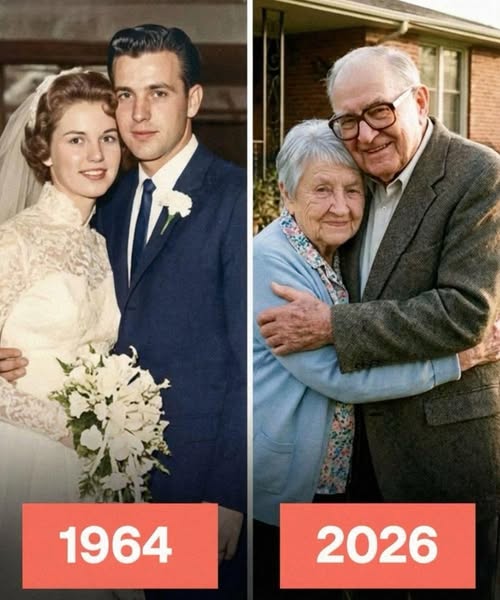
Marriage is often spoken of as a lifelong journey of transparency, a weaving together of routines, whispered dreams, and the quiet assumption that one knows every corner of a partner’s heart. For Rosa, her husband Harold was the most constant map in her life. They met at eighteen, married within a year, and together had navigated the fiery idealism of youth, the responsibilities of adulthood, and finally, the settled grace of old age. When Harold passed away in early 2026, it was as if a vital organ had been removed. At his memorial, surrounded by their grown sons, extended family, and decades of friends, Rosa believed she was saying goodbye to a life she had understood completely. She could not have imagined that Harold’s most profound chapter was only now beginning to unfold.
The first fracture in her understanding appeared after the service. Among the departing mourners, a young girl, no more than twelve or thirteen, approached Rosa with a quiet, urgent purpose. Without explanation, she handed Rosa a plain white envelope, saying only that Harold had left instructions for her to deliver it on this very day. Before Rosa could respond, the girl disappeared into the crowd. Shaken but compelled by the encounter, Rosa slipped the envelope into her purse and continued through the post-service rituals, carrying the secret in silence.
It was only later, in the heavy stillness of her home that evening, that Rosa opened the envelope at her kitchen table. Inside, she found a letter in Harold’s familiar, steady hand, accompanied by a small brass key. The letter revealed a secret Harold had kept for over sixty-five years—longer than Rosa had been his wife. It was a truth he had never spoken aloud, a burden he had carried in silence. He instructed her to go to a specific address on the outskirts of the city, to garage number 122, promising that everything she needed to understand would be there.
With a mixture of trepidation and determination, Rosa went to the row of neglected metal garages, frozen in time since the 1970s. Lifting the door of unit 122, she was met by the smell of cedar and aged paper. In the center of the dusty concrete floor rested a wooden chest, its presence almost ceremonial. Inside were artifacts of a life Rosa had never known: children’s drawings bound with faded ribbons, decades of school awards, and letters spanning generations, all signed by a woman named Virginia. At the bottom lay official documents proving that for over six decades, Harold had been quietly supporting Virginia and her daughter, providing for rent, education, and living expenses with meticulous care.
The immediate shock twisted Rosa’s mind toward the simplest, most painful interpretation: her husband had led a double life. Sitting on the cold floor, she felt the sting of perceived betrayal, questioning how the man she had loved could have maintained a hidden family. Yet the mystery deepened when the young messenger from the funeral—Gini, short for Virginia—arrived at the garage on her bicycle. Gini explained that Harold had been the most important person in their lives and that her mother, Virginia, was in the hospital awaiting life-saving heart surgery that they could not afford.
Rosa followed Gini to the hospital and met Virginia: fragile, pale, yet strikingly youthful. The situation was dire; without immediate funding, Virginia’s life was at risk. In that sterile corridor, Rosa confronted a choice. She could retreat into her grief, or she could embrace Harold’s final wish. Trusting the moral compass he had always believed she possessed, Rosa provided the funds necessary for the surgery. As Virginia began her slow recovery, the deeper truth of Harold’s secret emerged.
In a quiet moment, Virginia showed Rosa an old photograph that stopped her heart. It depicted a young Harold standing beside a teenage girl holding a baby. Rosa recognized the girl instantly: it was Iris, her sister, who had vanished from the family at fifteen. The infant in the photograph was Virginia.
Harold’s diaries confirmed what Rosa now understood: years earlier, he had found Iris struggling with a newborn and committed to supporting them both. By the time he realized the girl was his wife’s missing sister, he had already taken responsibility for their care. Revealing the truth would have reopened devastating wounds for Rosa and her parents, so he chose to shoulder the burden alone. For sixty-five years, he had protected Rosa from this pain, while ensuring that Virginia—Rosa’s niece—never went without.
Harold had not led a life of infidelity; he had lived a life of quiet, double devotion. He had bridged the chasm between two fractured families, safeguarding them both with unwavering dedication. Gini, the daughter, had been entrusted to reveal the truth only when Harold could no longer do so himself.
In the months that followed, Rosa’s grief transformed into purpose. Virginia and Gini became family, not symbols of betrayal. The void left by Harold’s death was replaced by the laughter of her niece and great-niece, lives nurtured by Harold’s unseen generosity. Rosa understood that his silence had not been a lack of trust but an act of profound protection. He had carried the weight of a hidden family so that Rosa could live unburdened by pain.
Harold’s legacy was not measured by accolades or public recognition but by the quiet, consistent work of holding lives together. He demonstrated that the greatest acts of love are sometimes not spoken aloud but lived in secret. Rosa realized that his final gift was more than support or provision—it was the reunification of a family. He had brought the lost home, ensuring that his love would continue to ripple through generations, long after he was gone.